

SERP API•
Google Custom Search API Shutdown: What to Use Instead
Google's Custom Search JSON API closes to existing customers on January 1, 2027. The official replacement is site-restricted. Here is the real migration.
Read more

Author
Ricardo is one of the founders and engineers behind its SERP and AI-search scraping infrastructure. Before cloro he scaled a financial comparison site to $7M ARR and ran the full-country operations of a unicorn to $65M ARR, then went back to building. He writes about search engine scraping, generative-engine optimization, and turning live search and AI-answer data into something teams can act on.
Google's Custom Search JSON API closes to existing customers on January 1, 2027. The official replacement is site-restricted. Here is the real migration.

Request, response and cost mappings for moving to cloro from SerpApi, DataForSEO, Serper, Bright Data, ScraperAPI or Oxylabs, with working Python.

Mention rate vs citation rate, per-engine reads, verification against real answers, and how fast AI answers actually change.

Per-tenant API keys, your own report layer, and about $62 per client per month in data costs at 200 daily prompts.
Which SERP APIs ship native n8n and Zapier integrations, and a working n8n daily rank tracker built on the cloro community node.
Async batch scraping, a webhook loader, NDJSON into a partitioned table, and what 1,000 keywords a day costs.

How many prompts and daily runs AI visibility tracking needs before a trend is real, measured with paired same-model runs minutes apart.
LLM scraping reliability in production: which providers publish SLAs, what breaks in-house, and what 1,000 ChatGPT answers actually cost.
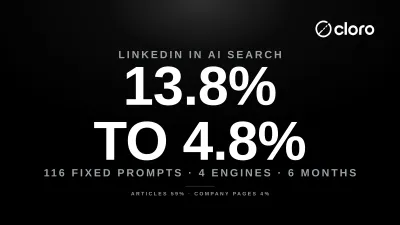
LinkedIn is widely described as the second most cited domain in AI search. On a fixed set of 116 prompts run monthly across four AI engines, its share of answers fell from 13.8% in February 2026 to 4.8% in July. Articles carry almost all of what remains, and company pages almost none of it.