
News•
Google News RSS Feed: How It Works and Its Limits
The definitive reference for Google News RSS feeds: search and topic URL anatomy, geo/language params, the documented limits, and measured reliability data.
Read more
Topic
Getting structured search results out of an API: coverage by engine, cost per call, latency, geo-targeting, and what breaks at volume.
The definitive reference for Google News RSS feeds: search and topic URL anatomy, geo/language params, the documented limits, and measured reliability data.
There is no official Google News API. Google retired it in 2011 and never replaced it. This guide maps what you can actually pull in 2026 (RSS, unofficial libraries, Custom Search, a scraping API), with an original freshness study and a Python tutorial.
There's no single 'ask Copilot' API. Here's what the official Microsoft 365 Copilot APIs actually return, who can use them, and when you have to scrape instead.
Anthropic's Claude searches the web with the Brave Search API, not Google. So how close is Brave to Google? We ran 500 identical queries through both indexes. The answer is "closer than the headline number suggests," with one real exception.
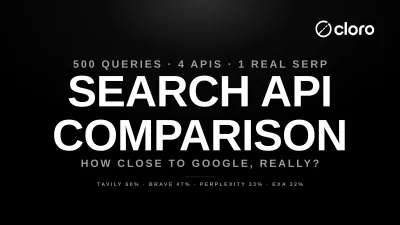
Every AI app picks a search API assuming it's basically Google. We ran the same 500 queries through Brave, Tavily, Exa, and the Perplexity Search API against cloro's live Google SERP. The result is a spectrum that runs from "Google's sources reordered" to "a different web by design", plus one thing every vendor shares.
If your LangChain or LangGraph agent searches the web, it's probably searching with Tavily, not Google. So how close is Tavily to Google? We put the same 500 queries through both. It's the closest of any search API we've measured, but it reranks Google's sources into an order of its own.
Exa searches the web by meaning, not keywords. So how different is it from Google, really? We ran 500 identical queries through Exa and cloro's live Google SERP. The overlap is the lowest of any search API we've measured, and that's exactly the point.
There are three different "Perplexity webs": the Search API, the answer users see, and Google. Most people conflate them. We ran 500 identical queries through the Perplexity Search API and cloro's live Google SERP to measure exactly how far apart they sit.
Turn one seed into thousands of keywords with a keyword research API: autocomplete, PAA and related-search fan-out, plus an AI clustering pipeline.