
Best GEO Agencies in 2026: 9 AI Search Firms Compared

On this page
Generative engine optimization (GEO) agencies exist because search stopped ending at a list of links. When a buyer asks ChatGPT, Google AI Overviews, Gemini, Claude, or Perplexity for “the best X,” the engine writes an answer and names a handful of sources. Your brand is either inside that answer or it is invisible — and the levers that put it there are not the same ten blue links you optimized for a decade.
The demand is not hypothetical. More than 800 million people now use ChatGPT every week, ChatGPT alone drives 87.4% of AI referral traffic per Conductor’s 2026 benchmarks, and those AI referrals converted 31% higher than other traffic over the 2025 holiday season per Adobe Analytics. Google AI Overviews now appear on a large share of queries — roughly 48% of tracked queries per BrightEdge, and in cloro’s own monitoring closer to 98% of commercial-intent prompts (full breakdown).
The foundational GEO research from Princeton and Georgia Tech found that three lightweight changes — adding relevant statistics, credible quotations, and citations from reliable sources — can boost a page’s visibility in generative answers by up to 40%. GEO is not mystical. It is a repeatable content-and-authority discipline, and a good agency operationalizes it across your whole site.
How we selected these GEO agencies
This is a roundup of firms you would genuinely shortlist, not a directory dump. Every agency here is real, active, and publicly positioned around AI search. We weighted five criteria — the same five you should use in a sales call:
- Technical optimization. Can they fix crawlability, rendering, structured data, and site architecture so AI crawlers can actually retrieve and parse your pages? GEO fails at the technical layer before it ever reaches content.
- Semantic content strategy. Do they build answer-first, entity-rich content with the citable statistics and quotations that engines reward — not keyword-stuffed filler?
- Authority and citation building. Can they earn the off-site mentions, digital PR, and source relationships that make an engine trust and cite you?
- Measurable lead outcomes. Does the engagement tie visibility to traffic, pipeline, and revenue — or does it stop at a vanity mention-rate chart?
- Transparency. Do they report on real surfaces (citation rate, share of voice by engine) on a fixed cadence, and will they tell you what they cannot move?
One definition to anchor the rest: a GEO agency is a marketing firm that optimizes your content, entities, and authority signals so AI engines discover, understand, cite, and recommend your brand inside their generated answers. Everything below is graded against how well each firm does that.
This roundup is published by cloro, an AI-search data provider rather than a GEO agency, so none of the nine firms below is a competitor. The citation measurements referenced throughout come from cloro’s own monitoring of ChatGPT, Perplexity, Gemini, Copilot, and Google AI Overviews, and the underlying breakdowns are published in full at the AI Overview Trigger Index.
The 9 best GEO agencies at a glance
| Agency | Best for | GEO focus | Also offers |
|---|---|---|---|
| Position Digital | B2B SaaS startups | Off-site citation building via ListBrew | SEO, technical GEO audits, digital PR |
| iPullRank | Enterprise & technical sites | Relevance engineering, retrieval-level optimization | Technical SEO, content strategy |
| Amsive | Enterprise & regulated brands | AEO/GEO with a named AI-search lead | Performance marketing, paid, SEO |
| Omniscient Digital | B2B SaaS content authority | Editorial content built to be cited | SEO, digital PR |
| Siege Media | Content-led authority | Citable content + link building | Content marketing, technical SEO |
| Single Grain | Multi-channel growth teams | GEO inside a full growth engine | Paid media, CRO, content |
| NoGood | Startups & scale-ups | GEO as part of full-funnel growth | Growth marketing, paid, creative |
| Doc Digital SEM | SMB & local, visibility-to-leads | GEO + AI SEO across all major engines | Web design, PPC |
| uSERP | B2B SaaS link building & digital PR | Placements in publications AI engines cite | Link building, digital PR, content |
The takeaway: no agency here covers all five selection criteria equally well, so the “best” one is the one whose focus column matches your actual bottleneck (technical debt, content authority, or multi-channel execution), not the one with the most name recognition. The breakdown below explains what each agency is strong at and why.
How to choose the right GEO agency for your stage
The nine firms below do not really compete with each other. They fit different stages and different gaps.
Match the agency to your bottleneck
- B2B SaaS startup that is absent from the listicles buyers ask about? Position Digital, whose citation-building work targets the third-party roundups engines quote.
- Enterprise site with technical debt or complex architecture? Start with iPullRank. Retrieval-level problems have to be fixed before content work pays off.
- Enterprise or regulated brand that needs paid and organic under senior strategy? Amsive, with a named AI-search lead and a measurement partner.
- B2B SaaS where the gap is citable content authority? Omniscient Digital or Siege Media. Pick Omniscient for operator-led SaaS strategy, Siege for content craft plus earned links.
- You want GEO connected to paid, CRO, and the whole funnel? Single Grain for multi-channel breadth, NoGood for startup-stage growth intensity.
- Smaller or local business that needs the site and ads built too, not just a strategy deck? Doc Digital SEM, which pairs GEO with web design and PPC and measures to leads.
- B2B SaaS brand that needs earned mentions in the publications engines already cite? uSERP, an editorial link building and digital PR agency.
Two rules that hold whoever you pick
First, traditional SEO earns you a ranked link; GEO earns you a sentence inside the AI answer. Make sure the agency can name the specific engines it will move and the surfaces it will report on.
Second, hold the engagement to citation rate and share of voice across engines, not to rankings alone. If you want to keep that scoreboard yourself, our AI Overview tracking tools roundup and AI search tracking playbook cover the measurement stack, and the GEO services comparison weighs hiring an agency against buying a platform or building in-house.
The best GEO agency is the one whose strengths line up with your weakest link, and whose reporting you can independently verify against what the engines are actually citing.
What a GEO agency costs
Few agencies publish prices, so the ranges come from roundups that collected them. One puts GEO retainers at $1,500 to $50,000+ per month: $1,500 to $5,000 for a one-off baseline audit, $3,000 to $10,000 a month for mid-market retainers, and $10,000+ for enterprise programs such as iPullRank’s. For full-service B2B SaaS work, Omniscient Digital’s own guide expects $10,000 to $40,000 a month, and lists its own engagements from $10,000/month. Content production and digital PR push a retainer toward the top of its range.
Red flags before you sign
Omniscient’s hiring checklist names the warning signs worth screening for on the first call:
- Guarantees. A promise of fixed placement in AI Overviews or a set number of mentions is overpromising, because citations shift answer to answer.
- No prompt library or testing plan. Without a defined prompt set and a testing cadence, the work is SEO with a new label.
- Vague deliverables. “AI-optimized content” and “improved visibility” with no artifacts or timelines give you nothing to evaluate.
- Ranking-only reports. Keyword positions and sessions with no AI surfaces or pipeline mean the agency is not doing GEO.
1. Position Digital — best for B2B SaaS startups
Position Digital is an SEO and GEO agency working with B2B and SaaS companies. It covers the usual ground (technical GEO audits, AI-friendly content optimization), but the part worth hiring it for is off-site citation building. Through its own tool, ListBrew, the agency finds and secures placements in the software listicles, product roundups, and comparison pages that LLMs already cite for a client’s target queries.
That emphasis is well aimed. When an engine answers a “best X” prompt, the sources it names are usually third-party roundups, so a placement on one of those pages moves visibility in a way on-page optimization cannot. Its GP Engine framework applies the same logic to building topical authority.
Best for: B2B SaaS startups that want AI visibility built through content and digital PR.
Notable strengths: an in-house citation-building tool, a documented framework for topical authority, and a focus on the third-party pages engines actually quote.
2. iPullRank — best for enterprise and technical sites
Mike King founded iPullRank in New York, and he frames GEO around what he calls relevance engineering: mapping user intent to content structure using embeddings, information retrieval, and query fan-out rather than surface-level keyword work.
King also wrote The AI Search Manual, an openly published, book-length treatment of how generative engines retrieve, rank, and cite content. That is much of why iPullRank counts as one of the most technically credible firms in the category.
Best for: enterprise brands and JavaScript-heavy, complex sites where GEO has to start at the retrieval and rendering layer.
Notable strengths: deep technical SEO bench, a documented retrieval-first methodology, and thought leadership that shapes how the rest of the industry talks about AI search.
3. Amsive — best for enterprise and regulated brands
Amsive has nearly two decades of performance marketing behind it, and it has formally expanded its search practice into answer engine optimization (AEO), its term for the same GEO/LLMO work. Lily Ray, VP of SEO and AI Search, leads that side of the business, and she is one of the most-cited independent voices on what AI engines actually reward versus what agencies claim they do. The firm has also partnered with the AI-visibility platform Profound to ground its work in measurement.
Best for: enterprise and regulated brands that need senior strategy, rigorous measurement, and a paid-plus-organic program under one roof.
Notable strengths: a recognized AI-search authority in-house, a mature performance-marketing foundation, and a measurement partnership rather than a black box.
4. Omniscient Digital — best for B2B SaaS content authority
The leadership at Omniscient Digital came out of in-house growth roles at companies like HubSpot and Shopify, and the firm works on B2B organic growth. It was an early mover on GEO for software brands, building editorial content designed to be cited across ChatGPT, Perplexity, and Google AI Overviews rather than only to rank.
Best for: B2B SaaS companies that want content authority which compounds across both organic search and AI answers.
Notable strengths: operator-led strategy aimed squarely at the SaaS buyer journey, and a content-quality bar tuned for citation rather than volume.
5. Siege Media — best for content-led authority
Siege Media is a content marketing and SEO agency with a strong public track record that now folds GEO into its core offering. Its edge is editorial rigor paired with in-house digital PR and link building — the exact combination that earns the off-site citations and on-page quality AI engines lean on when they choose which sources to name.
Best for: brands across SaaS, fintech, e-commerce, and health that want GEO outcomes driven by content quality and earned authority.
Notable strengths: high-craft content production, integrated link building and digital PR, and technical SEO under the same roof.
6. Single Grain — best for multi-channel growth teams
Single Grain, led by Eric Siu, now runs GEO and AEO alongside SEO, paid media, content, and CRO as part of a full-service offering. The value here is breadth: GEO connects to your paid and conversion programs instead of living in an SEO silo, which suits teams that want one partner accountable for the whole growth engine.
Best for: growth teams that want AI-search visibility bundled into a multi-channel program rather than bought as a standalone service.
Notable strengths: wide channel coverage, strong brand and content distribution, and a track record across large consumer and B2B clients.
7. NoGood — best for startups and scale-ups
NoGood treats GEO as one input into a broader full-funnel growth system rather than a standalone deliverable. For startups and scale-ups, that framing is useful: AI-search visibility is tied to demand generation, paid, and creative, so the work is judged on pipeline, not mentions.
Best for: venture-backed startups and scale-ups that want GEO woven into an aggressive growth motion.
Notable strengths: growth-team DNA and cross-channel execution, judged on measurable funnel impact.
8. Doc Digital SEM — best for SMB and local, visibility-to-leads
Doc Digital SEM works on GEO and AI SEO, covering visibility across ChatGPT, Google AI Overviews, Gemini, Claude, Perplexity, and traditional search. It combines technical optimization, semantic content strategy, and authority building to make a business easier for AI platforms to discover, understand, cite, and recommend.
Where it differs from the pure-play strategy shops above is the added web design and PPC expertise, which turns AI-search visibility into measurable leads rather than stopping at a citation report.
Best for: small-to-midsize and local businesses that want GEO plus the web and paid execution to convert that visibility into pipeline.
Notable strengths: full-stack coverage (GEO, AI SEO, web design, PPC), multi-engine focus including Claude and Perplexity, and an explicit orientation toward leads and growth.
9. uSERP: best for B2B SaaS link building and digital PR
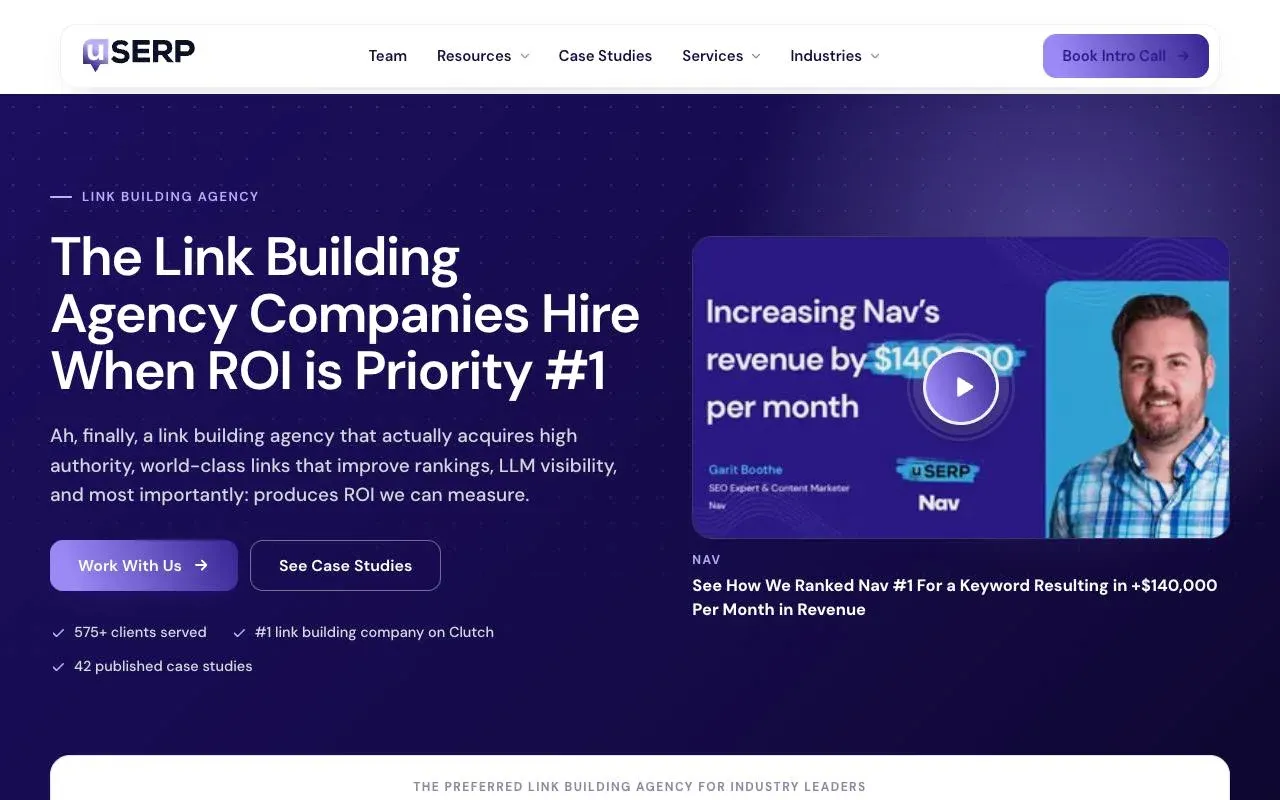
uSERP is an editorial link building and digital PR agency for B2B and SaaS brands. Its homepage lists clients such as monday.com, CrowdStrike, Freshworks and Robinhood.
For AI search, the team earns placements in the publications that ChatGPT, Perplexity and Google AI Overviews tend to cite. The logic is the same one behind citation building in general: when an engine answers a buyer’s question, it names third-party sources, so a mention on those pages puts the brand in the answer. uSERP says it judges links by pipeline impact rather than by volume.
Best for: B2B and SaaS brands that want AI-search visibility through earned editorial links and digital PR.
Notable strengths: a pure link building and PR focus, a named B2B client list, and placements aimed at the publications engines already quote.

About the author
Nadia Mohamed
SEO Engineer, cloro
Nadia is an SEO engineer at cloro, where she leads SEO and generative-engine optimization (GEO) — the technical work and the content behind it. A software engineer by training, she removes the usual bottleneck between strategy and implementation — she ships the ideas she scopes, with no dev handoff.
Frequently asked questions
What is a GEO agency?
A GEO agency is a marketing firm that optimizes your content, entities, and authority signals so AI engines like ChatGPT, Google AI Overviews, Gemini, Claude, and Perplexity can discover, understand, cite, and recommend your brand inside their generated answers. It is the AI-search counterpart to a traditional SEO agency: instead of chasing a ranked blue link, it works to get your brand named in the answer itself. Most GEO agencies combine technical optimization, semantic content strategy, and off-site authority building, then measure lift in citations and mentions across engines. For the mechanics behind that work, see our guide to generative engine optimization.
How is a GEO agency different from a traditional SEO agency?
Traditional SEO earns you a ranked link on a results page; GEO earns you a sentence — a citation or recommendation inside the AI-generated answer itself. The disciplines overlap heavily (crawlability, structured data, and topical authority matter to both), but GEO adds entity optimization, answer-first content structure, and citation building tuned to how large language models retrieve and synthesize sources. The best GEO agencies still do classic SEO; they just also optimize for surfaces where there is no ranked list to climb. In practice most engagements cover both, because AI engines lean heavily on the same pages that rank in organic search.
How much do GEO agencies cost?
Published ranges run from $1,500 to $50,000+ per month. A one-off baseline audit is typically $1,500 to $5,000, mid-market retainers $3,000 to $10,000 a month, and enterprise programs $10,000+. Full-service B2B SaaS retainers that include content production run $10,000 to $40,000 a month. Before signing, get the exact deliverables and the reporting cadence in writing. We break down the build-versus-buy math in our GEO services comparison.
How do I measure whether a GEO agency is working?
Track citation rate (how often engines cite your pages), mention rate (how often your brand is named, cited or not), and share of voice against competitors — measured across ChatGPT, Google AI Overviews, Gemini, Perplexity, and Copilot, not just one engine. Tie those to downstream traffic and leads so the program is accountable to revenue, not vanity metrics. Any agency worth hiring will report on these surfaces on a fixed cadence; if they can only show you rankings, they are selling SEO with a GEO label. See our roundup of AI Overview tracking tools for the measurement stack.
Do I need a GEO agency, or can I do GEO in-house?
If you have an in-house content and technical SEO team, much of GEO is learnable — answer-first structure, schema, entity consistency, and adding citable statistics and quotes to your pages. An agency makes sense when you lack that capacity, need to move fast across many pages, or want senior strategy and authority-building relationships you cannot build overnight. Many teams run a hybrid: an agency sets strategy and does the heavy authority work while the in-house team executes on-page. Start with our GEO checklist to see how much you can cover yourself first.
What are the red flags when hiring a GEO agency?
Four are worth screening for on the first call: guarantees of fixed placement in AI Overviews or a set number of mentions; no prompt library or testing cadence; vague deliverables such as 'AI-optimized content' with no artifacts or timelines; and reports that show keyword rankings and sessions but no AI surfaces or pipeline impact. Credible agencies say what they cannot move and document what they test.
Related reading
What Is Generative Engine Optimization (GEO)?
Generative engine optimization helps AI engines cite your brand. Learn GEO ranking factors, content structure, schema, measurement, and tools.
GEO Services in 2026: 7 Platforms and Agencies Compared
We tested 7 GEO services on real generative engine optimization workflows. Compare measurement platforms, specialist tools, and agency engagements.
AI Overview Tracking Tools: 7 Options Compared
We compared 7 AI Overview tracking tools for citations, brand mentions, competitor visibility, pricing, and reporting. Compare the best options.