
How AI Answers Change by State: A Data Study

On this page
If you monitor AI search from a single national vantage point, you are measuring an answer that many of your customers never see. A dealership, law firm, or dentist can be the top ChatGPT recommendation in one state and completely absent in the next, and until recently most AI-monitoring pipelines had no way to tell.
This is a question we kept hearing. Several teams building AI-visibility products asked for the same capability: the ability to target a specific US state or city when querying AI engines, because their own customers care about local recommendations. One described the exact failure mode. A prompt like “Where can I finance a Chevrolet vehicle near Lackawanna, NY?” returned different results in the ChatGPT UI (queried from New York) than through a national scraping vantage point. The local answer is the real answer, and they couldn’t capture it.
So we built state-level proxy targeting for cloro’s AI monitor endpoints, then ran a study to quantify how much it actually changes what the models say.
What state-level targeting does
Every cloro AI monitor endpoint takes a country parameter. State-level targeting adds an optional state parameter (a two-letter USPS code) that routes the request through residential infrastructure in that state. The AI engine then infers the user’s location from that egress point, exactly as it would for a real person in Sacramento or Buffalo, and localizes its answer accordingly.
curl https://api.cloro.dev/v1/monitor/chatgpt \
  -H "Authorization: Bearer $CLORO_API_KEY" \
  -H "Content-Type: application/json" \
  -d '{
    "prompt": "Where can I finance a Chevrolet vehicle near me?",
    "country": "US",
    "state": "NY"
  }'
State targeting is supported on the non-Google AI answer engines (ChatGPT, Gemini, Perplexity, and Copilot) and costs +2 credits per call. (Google AI Mode and AI Overview already localize via UULE, Google’s own location mechanism; we included AI Mode in the study as a Google-side comparison.) The state parameter is only valid when country is US. As one of our early tests confirmed, an unsupported combination returns a clear validation error rather than silently ignoring the location.
How we tested
We built a set of eight location-neutral but locally-answerable prompts: the phrasing never names a city, so the only geographic signal is the state proxy. This isolates what state targeting alone does to an answer. The prompts span the verticals our customers monitor:
| Vertical | Prompt |
|---|---|
| Auto | “Where can I finance a Chevrolet vehicle near me?” |
| Legal | “Who is the best personal injury lawyer near me?” |
| Insurance | “What is the best homeowners insurance company near me?” |
| Home services | “Find a top-rated HVAC repair company near me” |
| Real estate | “Who is the best real estate agent near me?” |
| Healthcare | “Recommend a highly rated dentist near me” |
| Finance | “What is the best credit union to join near me?” |
| Fitness | “What is the best gym near me?” |
Each prompt was run through five engines (ChatGPT, Gemini, Perplexity, Microsoft Copilot, and Google AI Mode) across six states chosen for regional and market spread: California, Texas, New York, Florida, Illinois, and Washington. We also ran a national baseline (country=US, no state) for every prompt/engine pair to measure the delta between “no location” and “state-targeted.” That’s 279 successful responses, collected on 2026-07-23.
For each response we extracted the set of cited-source domains and measured three things:
- Cross-state divergence. One minus the mean pairwise Jaccard overlap of the cited-domain sets across the six states. A score of 1.0 means no two states cited the same source; 0.0 means every state cited an identical set.
- Overlap with the national baseline. The mean Jaccard overlap between a state’s citations and the no-location answer. Low overlap means state targeting changed the answer a lot.
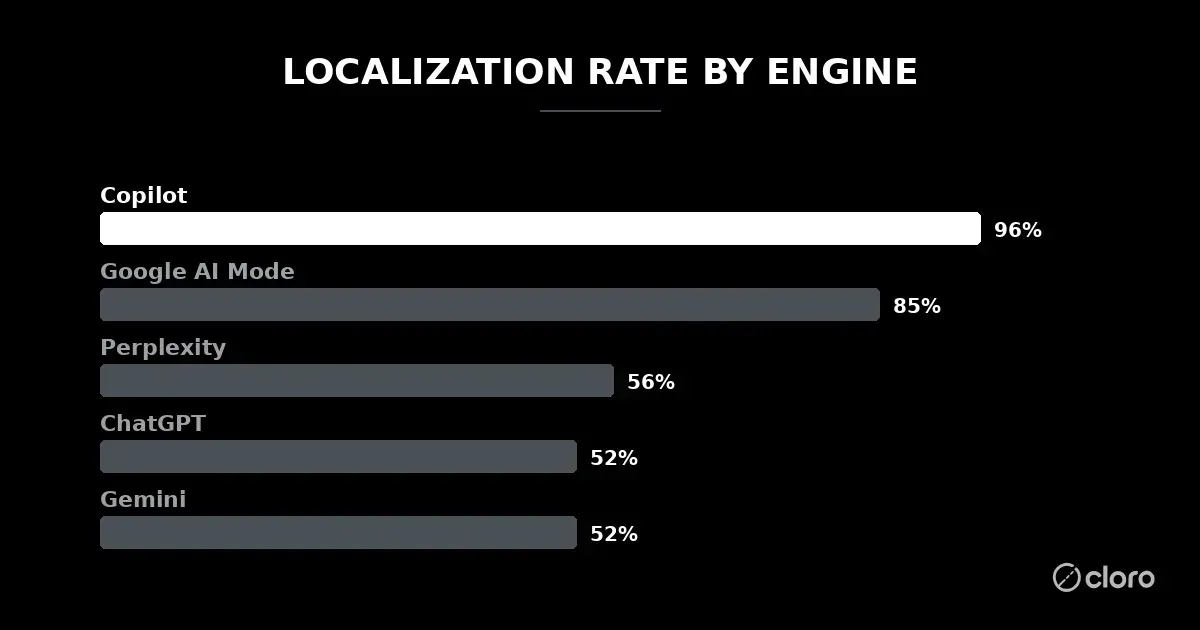
- Localization rate. The share of state responses that cited at least one state-exclusive domain (a source that appeared in exactly one of the six states), a conservative, objective proxy for “the model named something genuinely local.”
We deliberately scored the cited sources rather than trying to parse business names out of prose: domains are unambiguous, and citations are exactly what an AI-visibility team needs to track.
Finding 1: which engine you ask decides how local the answer gets
The headline table. Every metric is computed over the state responses only, except “overlap with national,” which compares each state to the no-location baseline.
| Engine | Localized | Cross-state divergence | Overlap with national | Avg sources |
|---|---|---|---|---|
| Microsoft Copilot | 96% | 1.00 | 0.01 | 5.9 |
| Google AI Mode | 85% | 0.73 | 0.27 | 11.6 |
| ChatGPT | 52% | 0.84 | 0.27 | 4.5 |
| Gemini | 52% | 0.90 | 0.10 | 1.6 |
| Perplexity | 56% | 0.47 | 0.56 | 12.1 |
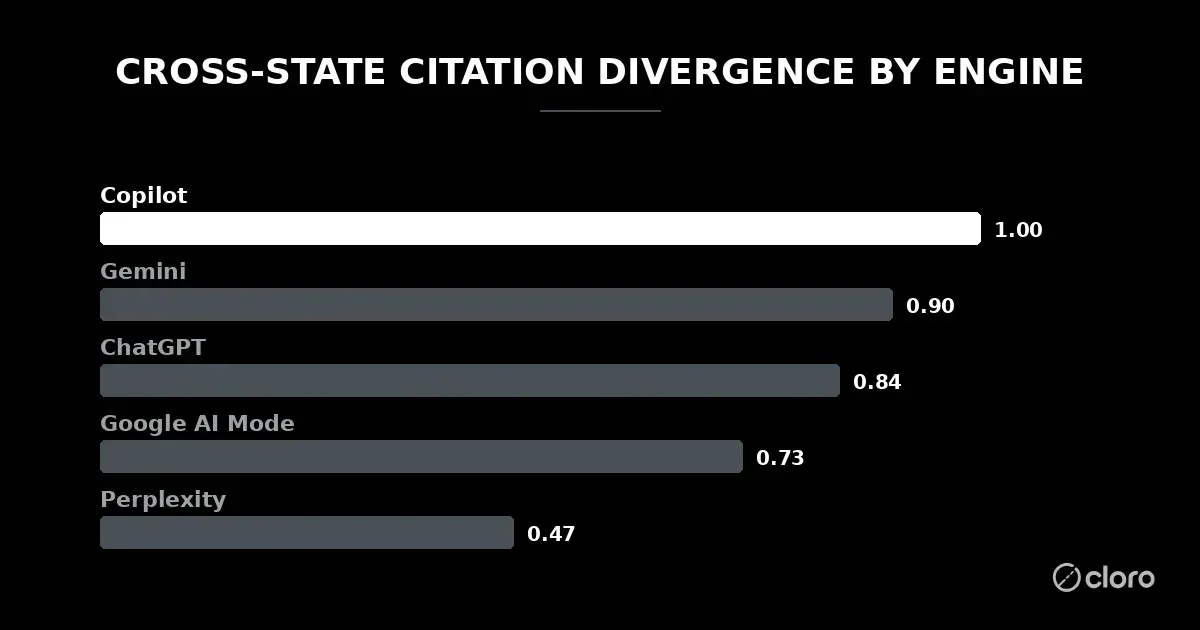
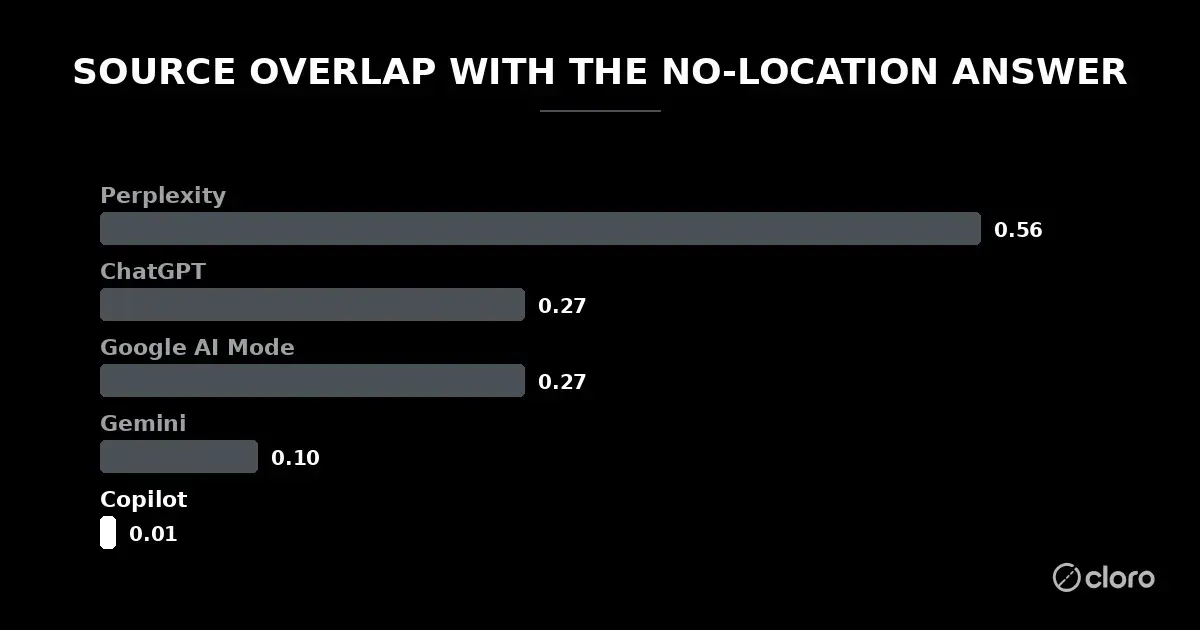
Read the divergence and national-overlap columns together and the story is clear. Copilot’s state answers are essentially unrelated to its national answer (1% overlap) and unrelated to each other across states (1.00 divergence). ChatGPT and Google AI Mode change substantially by state (27% overlap with national). Perplexity barely moves: its state answers still share 56% of their sources with the no-location baseline, more than double any other engine. For anyone deciding where to spend tracking budget, that spread is the finding: a single national query already tells you most of what Perplexity says, but it is nearly blind to what Copilot actually serves.
The localization rate, how often an engine cited a source that appears in only one state, tells the same story from the other direction:
Finding 2: ChatGPT returns a per-state map pack
For the auto prompt, the exact use case a customer flagged, ChatGPT returned a local map pack of named Chevrolet dealerships, and the list was completely different in every state:
- Texas → Galleria Chevrolet, Jupiter Chevrolet, Clay Cooley Chevrolet Dallas, Huffines Chevrolet Plano, Sam Pack’s Five Star Chevrolet
- New York → Lester Glenn Chevrolet, Circle Chevrolet, Seacoast Chevrolet, Ciocca Chevrolet
- Florida → Ferman Chevrolet, Dimmitt Chevrolet, Maher Chevrolet
- Illinois → Advantage Chevrolet of Hodgkins, Marino Chevrolet, Currie Motors, Jennings Chevrolet
- Washington → Jet Chevrolet, Auburn Chevrolet, Chevrolet of Bellevue, Titus-Will Chevrolet
Nationally, the same prompt returns brand and lender pages: chevrolet.com, gmfinancial.com, lendingtree.com. The shift shows up in the source authority too (more on that below): ChatGPT’s mean cited Domain Rating drops from 85.5 nationally to 76.5 at the state level, and the share of citations going to the local long tail rises from 0% to 36%. The model swaps national brand pages for local dealer sites the moment it knows which state you’re in, which is exactly the swap a national-only query never sees.
ChatGPT was not perfectly consistent. In a minority of calls it declined to localize and asked for a precise location instead (for the auto prompt in California, it responded “I need your location first”). Localization is the strong tendency, not a guarantee on every call.
Finding 3: Copilot goes hyper-local
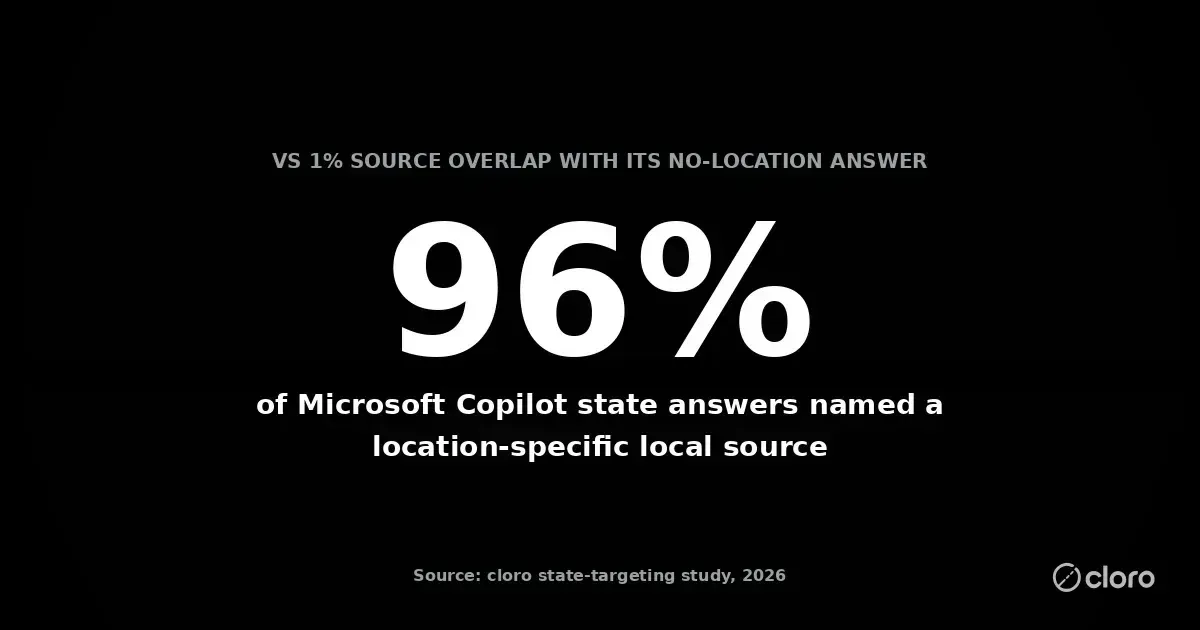
Copilot was the most aggressive localizer by a wide margin. It changed sources by state, and it routinely named a specific metro or neighborhood inside the state, inferred from the proxy:
- Dentist, Texas → “a highly rated dentist in Beaumont, TX, Dr. Angel Rivera at Gulfside Dental”
- Dentist, New York → “Dental Arts of Sayville (15 Foster Ave, rating 4.9)”
- Personal injury lawyer, New York → “the highest-rated personal injury lawyers near you in Brooklyn include Brooklyn Injury Attorneys, P.C.”
- HVAC, Texas → “Top-rated HVAC repair companies near you in San Antonio include Champion AC, Rosenberg Plumbing & Air”
- HVAC, New York → “a highly rated HVAC repair company in Manhattan, American HVAC Corp”
That behavior is why Copilot scores 1.00 on cross-state divergence and 0.01 overlap with its national answer: it is answering a fundamentally different, hyper-local question in each state. For anyone tracking whether a local business appears in Copilot, a national-only query is close to useless.
Finding 4: Perplexity mostly ignores the state proxy
Perplexity is built around citing authoritative aggregators, and that instinct dominated location. For insurance, legal, and real-estate prompts, Perplexity returned an identical set of sources across all six states (cross-state divergence of 0.00), leaning on national directories like NerdWallet, Justia, Avvo, and Insurance.com. It also asked for a city or ZIP more often than any other engine rather than acting on the proxy location.
When Perplexity did localize, it sometimes did so in its citations. A New York query surfaced Justia’s /lawyers/personal-injury/new-york page rather than the generic national one, but the effect was inconsistent. Its 56% overlap with the national baseline (highest of any engine) and 0.47 divergence (lowest) both confirm it is the least location-reactive engine in the set.
Gemini sits in between: it often localized in prose (a New York auto query volunteered “if you are located in the New York City metro area…”) but cited very few sources, 1.6 per response on average, so there is far less citation surface to track than with Perplexity (12.1) or AI Mode (11.6).
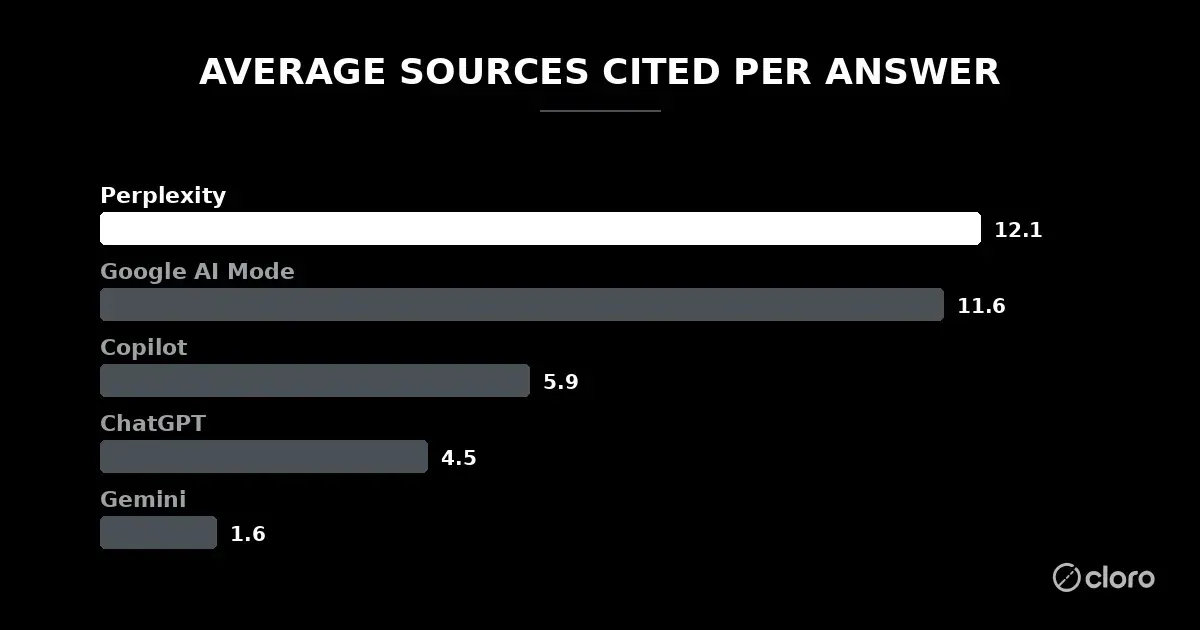
The citation-surface gap matters for tracking: an engine that cites a dozen sources gives you far more brand-visibility signal per query than one that cites one or two.
Finding 5: local citations don’t come from weaker sites, they come from different ones
To characterize what kind of sources state targeting surfaces, we pulled Ahrefs Domain Rating (DR) for the 145 most-cited domains and grouped them into authority tiers: Tier A (DR 80+), B (50+), C (20+), D (below 20).
The aggregators that anchor these answers are overwhelmingly Tier A: NerdWallet (90), Yelp (94), Forbes (94), BBB (93), Angi (90), Justia (90), Realtor.com (91), Healthgrades (86). Median DR of cited, DR-covered domains is 84.
This study is a one-off cut of local queries. For the same source-side question asked weekly of software categories, What AI cites publishes every domain the engines linked, with the long tail included rather than truncated to a head list.
At the aggregate level, state targeting doesn’t crater the authority mix: Tier A share moves only from 57% (national) to 55% (state), and mean DR is essentially flat (66.4 → 65.8). The reason is subtle: even a national, no-location query already pulls in some local businesses. What state targeting changes is not the authority tier so much as which specific entities fill it. There, the rotation is near-total (see the divergence and overlap numbers above).
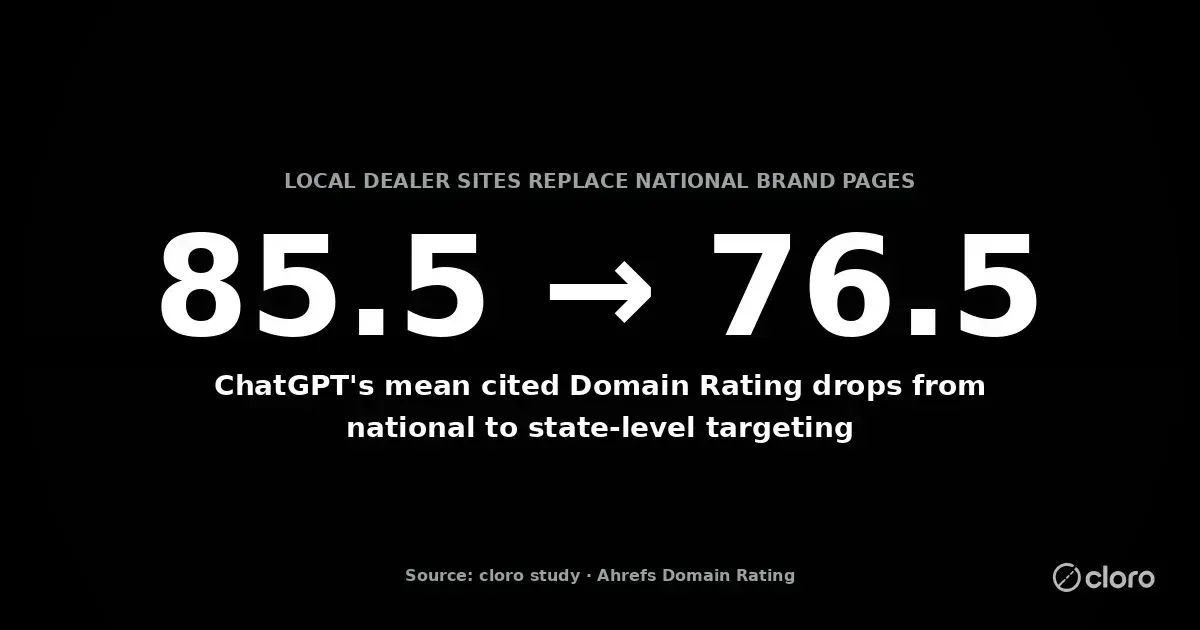
The authority shift is clearest per engine:
| Engine | Mean cited DR (national) | Mean cited DR (state) | Local long-tail share (state) |
|---|---|---|---|
| ChatGPT | 85.5 | 76.5 | 36% |
| Copilot | 49.5 | 54.9 | 94% |
| Google AI Mode | 69.7 | 68.2 | 43% |
| Perplexity | 63.9 | 63.3 | 35% |
| Gemini | 49.2 | 49.7 | 28% |
Copilot is the standout: 94% of its state-level citations point to domains outside the 145 most-cited: the low-DR long tail of individual dealer, clinic, and firm websites. It is the engine most likely to send a citation to a small local business, and the one where appearing in the index is least about traditional domain authority, so scoring citations by DR alone would miss most of what it actually cites.
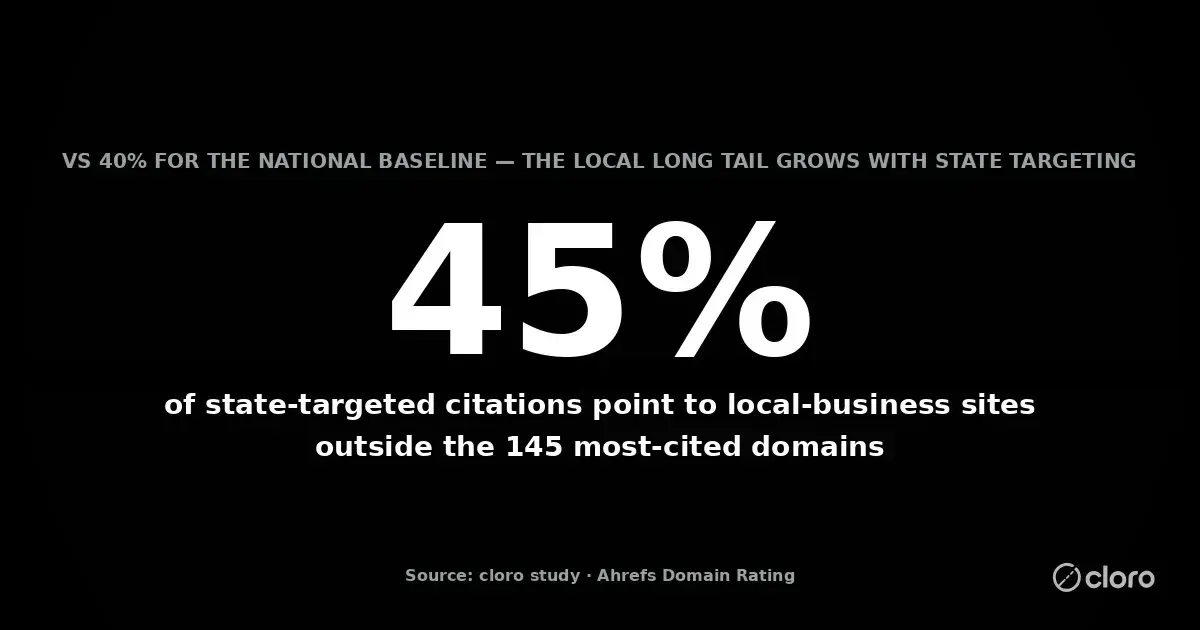
Finding 6: some questions change far more than others
Location sensitivity isn’t uniform across topics. Averaging cross-state divergence over all five engines, the most location-dependent verticals are the ones where the “right” answer is inherently a nearby storefront (dentists, auto financing, credit unions, HVAC repair), while categories dominated by national brands and comparison directories move the least.
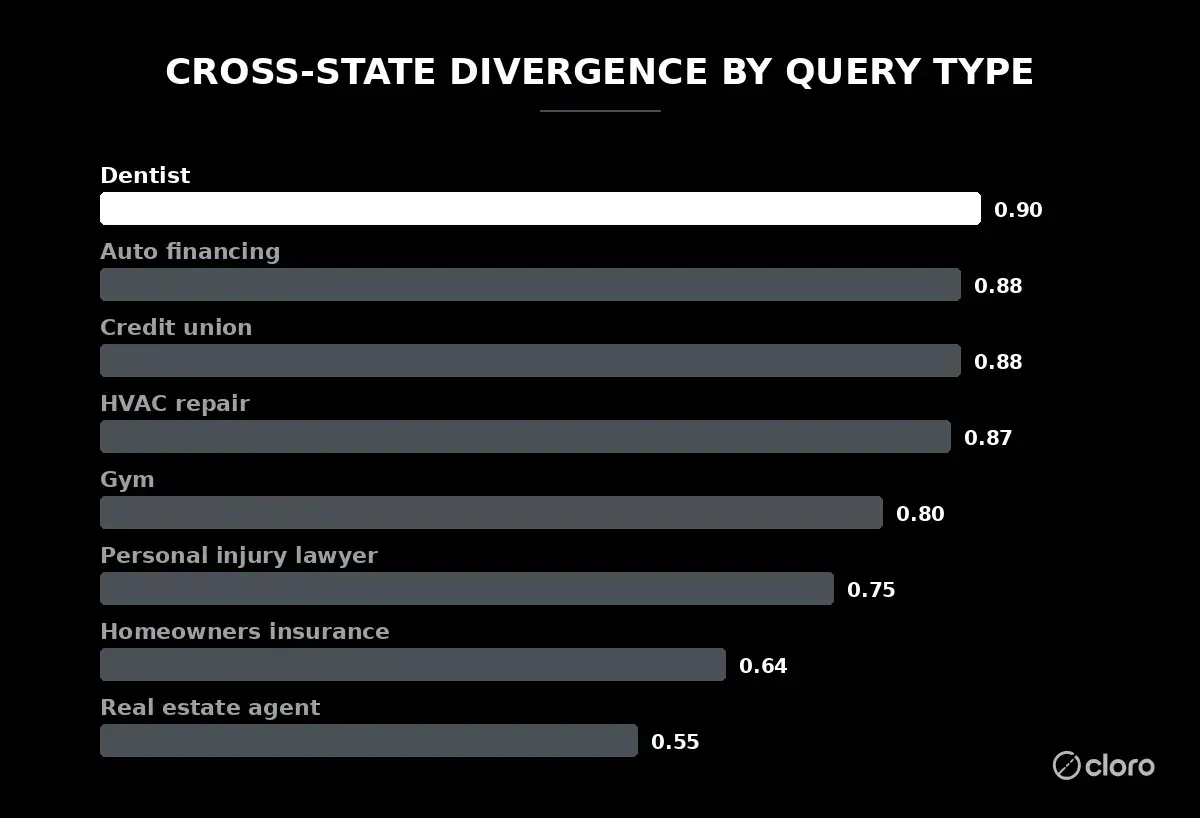
Homeowners insurance (0.64) and real estate agents (0.55) diverge least. Insurance answers lean on national carriers and comparison sites (Allstate, NerdWallet, Insurify), and real-estate answers on national portals (Zillow, Realtor.com, Compass), so the brand set is stable even when the local agent changes. The lesson for tracking: weight your location sampling by how local the buying decision actually is.
Do Google AI Overviews change by state?
Whether an AI Overview appears barely changes; which sources it cites changes on local queries. SE Ranking’s state-by-state AI Overview study ran 100,013 keywords from 5 US locations and found the AI Overview rate ranged only from 27.75% (New York) to 28.66% (Houston).
The citations told a different story. 47.05% of queries cited identical domains in every state, while 6.34% shared no sources at all between states, typically in Legal, Healthcare and Real Estate. Query length moved the rate far more than location did: 10-word queries triggered an AI Overview 69.21% of the time, against 12.78% for 1-word queries.
That fits our result. A broad keyword set is mostly national questions, so the answer holds still across states. Our 8 prompts are all “near me” questions, which is where the rotation concentrates.
What this means for AI visibility tracking
The clearest evidence of the national blind spot is how little a state answer resembles the no-location one. For Copilot, a 1% source overlap means a national-only query captures almost none of what a real in-state user sees:
Three practical takeaways for anyone measuring brand presence in AI answers:
- A national vantage point has a local blind spot, so for multi-location brands, local-service businesses, and the agencies that serve them, location-aware AI monitoring is now table stakes, the same way local rank tracking by city became standard for Google.
- Engine choice matters as much as prompt choice. Track each engine on its own terms, and weight your sampling toward the ones that turn out to be the most location-reactive.
- Local citations are winnable without Tier-A authority. A DR-15 dealership site can be the cited source, provided the model is querying from its metro.
Limitations
This is an honest snapshot, not a longitudinal panel. Each prompt/engine/state cell was a single call, and AI answers are nondeterministic, so exact businesses will vary run to run; we report structural patterns (divergence, overlap, localization), which are far more stable than any individual name. The study covers six states and eight verticals in the United States on one date: directionally representative, not exhaustive.
Proxy-based geolocation can also occasionally misfire: in one California call, Copilot’s answer resolved to out-of-region banks, a sign the request egressed from the wrong location. It’s a good reminder to validate geo-targeted results and to treat any single answer as a sample, not ground truth. The state parameter targets a metro within the state, so which city a model picks (Copilot chose Beaumont for Texas, not Houston) reflects the proxy’s specific location, not a “whole state” average.
Run it yourself
Every number here came from cloro’s public API. Add "state": "<US-STATE>" to any ChatGPT, Copilot, Gemini, or Perplexity monitor call, keep country set to US, and compare the cited sources against your national baseline. If you’re building AI-visibility tracking for local or multi-location brands, that one parameter is the difference between the answer you see and the answer your customers get.
The full methodology (every prompt, state, engine, and metric definition) is described above, and the snippet reproduces any single cell. Start with an API key and run your own verticals.

About the author
Ricardo Batista
Founder, cloro
Ricardo is one of the founders and engineers behind its SERP and AI-search scraping infrastructure. Before cloro he scaled a financial comparison site to $7M ARR and ran the full-country operations of a unicorn to $65M ARR, then went back to building. He writes about search engine scraping, generative-engine optimization, and turning live search and AI-answer data into something teams can act on.
Frequently asked questions
Do AI assistants give different answers in different US states?
Yes. In our study, the same local-intent prompt returned different recommended businesses and cited sources depending on the state we appeared to query from. Microsoft Copilot changed its cited sources in 100% of cross-state comparisons, and ChatGPT's state answers shared only 27% of their sources with a no-location baseline.
Which AI engine is most sensitive to location?
Microsoft Copilot was the most location-reactive engine we tested: it localized 96% of state responses, often naming a specific metro or neighborhood, and its cited sources for a state overlapped just 1% with its national (no-state) answer. ChatGPT and Google AI Mode also localized strongly; Perplexity was the least location-sensitive.
What is state-level targeting in an AI monitoring API?
State-level targeting routes the request through a proxy located in a specific US state, so the AI engine infers the user's location from that egress point. In cloro's API you set country to US and pass a two-letter state code; the engine then answers as if the user were in that state. It costs 2 extra credits per call on the AI monitor endpoints.
Do Google AI Overviews change by state?
Barely in how often they appear. SE Ranking's study of 100,013 keywords across 5 US locations found AI Overview rates between 27.75% and 28.66%. Cited sources vary more: 47.05% of queries cited identical domains in every state, and 6.34% shared none, mostly legal, healthcare and real estate queries.
Why do local AI answers matter for SEO and brand monitoring?
AI assistants increasingly answer 'near me' style questions with a short list of named businesses. If you only monitor AI answers from one national vantage point, you miss the fact that a brand can be recommended in Texas and invisible in New York. Location-aware tracking is needed to measure real AI visibility for local and multi-location businesses.
Does Perplexity use location for local queries?
Less than the other engines we tested. For several verticals (insurance, legal, real estate) Perplexity returned an identical set of national aggregator sources regardless of the state proxy, and it frequently asked for a city or ZIP code instead of localizing. Its state answers overlapped 56% with its national baseline, the highest of any engine.
Related reading
Local Rank Tracking: How Rankings Change by City
The same keyword ranks differently in every city. Here is how much local rankings vary by geography, why the map pack changes week to week, and how to check Google Maps rankings programmatically across a city grid.

AI Grounding: Every AI Engine Grounds Live, Except Gemini
Grounding is when an AI engine answers from live web results instead of training memory. We measured it across six engines on ~2,500 prompts each. Five ground 91–98% of the time, and one, Gemini, grounds just 41%.

ChatGPT Grounding Study: 86% Commercial, 1% Informational
ChatGPT grounds almost every commercial prompt and almost no informational one. We re-ran our study without forcing web search, across 865 queries and 10 countries, and the split is 86.5% versus 0.9%.