
Best Gemini Scraper 2026: 7 Tools Tested (Grounded Sources)

On this page
Gemini is Google’s flagship consumer AI product and the entry point Google is aggressively pushing into Search, Workspace, Android, and Chrome. What Gemini users see is not the same surface the developer APIs expose: the grounded answer with inline Google-search sources, the confidence-scored citations, the place cards for local queries, the shopping data for commercial ones.
If you’re tracking whether Gemini cites your brand, grounds an answer on your content, or names your competitor as the better recommendation, you need the rendered web UI. To get it, you scrape gemini.google.com. This guide ranks the best Gemini scraper for that job.
Google runs one of the most fortified web properties on the internet. Gemini inherits the full Google account model (2FA, device checks, session cookies, and Google’s anti-abuse ML) plus a UI that ships updates on a rolling cadence. Picking the best Gemini scraper in 2026 comes down to one trade-off: managed APIs survive Google’s UI changes; DIY scripts you patch every deploy. We tested 7 tools across that spectrum.
Scope. This roundup is about scraping the Gemini web UI (
gemini.google.com). For Google AI Overview scraping, see Best SERP APIs 2026 which covers the AIO panel. For general Google Search results, see Best Google Scraper 2026. For ChatGPT scraping, see Best ChatGPT Scraper 2026.
The 7 Gemini scrapers at a glance
| Tool | Tier | Auth handling | Grounded sources | Anti-bot | Starting price |
|---|---|---|---|---|---|
| cloro | Managed AI API | Built-in session | ✅ parsed | ✅ | Free (500 credits/mo), then $30/mo |
| Bright Data | Managed scraper | Google-account rotation | ✅ via headful | ✅ | Pay-as-you-go from $1.50/1k |
| ScrapingBee | Anti-bot scraper | DIY cookies | DIY parsing | ✅ | $49/mo (100k credits) |
| Oxylabs | Proxy + scraper | Cookie-based | DIY parsing | ✅ | Custom (from ~$99/mo) |
| Apify | Actor marketplace | Cookie-based (manual export common) | ✅ partial | ✅ | $49/mo + per-actor compute |
| DataForSEO | LLM Scraper API | Managed | ✅ text + sources | ✅ | Pay-as-you-go |
| Playwright | DIY framework | Build yourself | Build yourself | DIY stealth plugins | Free + your time |
The takeaway: every tool with a ✅ in Grounded sources can fetch a grounded Gemini response, but only cloro parses citation-pill metadata (label, URL, domain, position) into structured fields out of the box. The rest hand back text and a source list, and pulling out the citation-level detail is your parser’s job.
There are two Geminis. There’s the AI Studio / Vertex API that developers use, and the web interface at gemini.google.com that consumers use. They are not the same. Only the web interface gives you grounded Google-search sources, inline citation pills, place cards, and the shopping data that matters for AI SEO and brand monitoring.
How we tested
We picked 25 representative queries across the use cases that drive real Gemini scraping work:
- Brand monitoring: “best CRM for B2B sales”, “best running shoes for flat feet”, “best Gemini scraper tool”. These test whether a tool captures how Gemini describes brands in a category
- Grounded citation tracking: informational queries that trigger Gemini’s Google-search grounding, like “how does an LLM work”
- Local queries such as “best coffee shops in Austin” to test place-card extraction
- Commercial queries such as “best 27-inch monitor under $500” to test shopping-data extraction
For each query, we ran the same prompt through gemini.google.com via each tool. We graded each tool on six axes:
- Auth handling. Does the tool manage Google account cookies and session state, or do you refresh them manually?
- Grounded-source extraction. Are cited source URLs returned as structured fields, or only as raw HTML?
- Citation-pill parsing. Does the tool return the inline citation metadata (label, position, source URL), or just the answer text?
- Anti-bot survival. What’s the success rate against Google’s TLS fingerprinting and device checks?
- Selector stability. How often does the tool break when Google ships Gemini UI updates?
- True cost per query at 1,000 queries/day production volume
Where pricing shifted since we tested, we’ve noted it. Google ships UI changes faster than vendor docs update, so re-check the numbers yourself before you commit to a vendor.
What made the list, and what didn’t
The 7 tools above passed three filters. (1) They can scrape gemini.google.com in 2026 with documented support or proven community workflows. (2) They’re available to small and mid-market teams without enterprise-only contracts. (3) They’re under active development as of 2026.
A few categories are deliberately out of scope:
- The AI Studio and Vertex AI APIs, covered in the FAQ. Different surface entirely; they don’t return the web-UI grounded response
- Google Search scrapers. Serper, SerpApi, and general Google SERP tools are covered in Best SERP APIs 2026. They scrape the SERP, not Gemini’s chat UI
- AI Overview scrapers. AIO is a Google Search feature; it’s different from Gemini even though both are Google AI products
- Generic AI search APIs. Tavily, Exa, and the Perplexity API return synthesized answers, not rendered Gemini UI. Different product category
Why the AI Studio API isn’t enough
Why scrape when Google gives you the AI Studio and Vertex AI Gemini APIs? Four reasons.
- Grounded sources are UI-only. The web UI grounds answers on live Google Search results and returns inline citation pills with the source URLs. The base API doesn’t, so you’d need to build your own RAG pipeline that mimics what the UI does automatically. For brand monitoring, the raw API is structurally incapable of telling you which sources Gemini cited.
- Citation-pill behavior. Gemini’s UI decides when to cite and what to cite. That routing decision is itself information. Knowing which queries trigger Google-search grounding matters for AI SEO and AI visibility tracking.
- Place cards and shopping data. For local and commercial queries, Gemini surfaces structured business data (address, hours, rating) and product cards. None of that exists in the API response.
- Reality check. You want to know what Gemini users see, not what a raw model outputs. Google is aggressively pushing Gemini into Search, Workspace, Android, and Chrome, and the UI is where the actual usage lives.
If you’re doing Gemini brand monitoring, scraping is the only way. That’s why the best Gemini scraper reads the rendered UI, not the API.
Four technical challenges that decide whether your Gemini scraper survives production
They matter more than which logo you pick.
1. Google’s 2026 anti-bot stack
Google’s anti-abuse infrastructure profiles TLS fingerprints, browsing behavior, and device signals across every property including Gemini. Datacenter IP ranges are blocked aggressively; residential and mobile proxies are the practical baseline. Login flows include device checks that flag headless browsers unless you spoof the right combination of user-agent, viewport, WebGL fingerprint, and cookie history. General Cloudflare-bypass techniques don’t fully apply. Scrapfly’s 2026 anti-bot analysis covers the fingerprinting layer that overlaps with Google’s stack.
2. Google-account session management
Gemini requires a signed-in Google account. That means each scraping session needs a real Google account, working cookies, and often 2FA persistence. Account rotation at production volume requires either a pool of aged Google accounts or a managed service that handles the account layer for you. Naive account creation gets flagged immediately.
3. Grounded-response parsing
Gemini’s answers weave the response text, inline citation pills, source URLs, and Google-search-derived context together in the rendered markup. Clean extraction requires knowing where each artifact lives in the DOM, and the DOM changes between deploys. A scraper that only returns the top-level text loses the grounded citations, which are the highest-value fields for AI SEO work.
4. UI change velocity
Google ships Gemini UI updates on a rolling cadence. Class names, DOM structure, and even the citation-pill markup can change between visits. Selector-based scrapers break with every deploy; that’s a full-time maintenance job at production volume.
Tier 1: Managed AI API
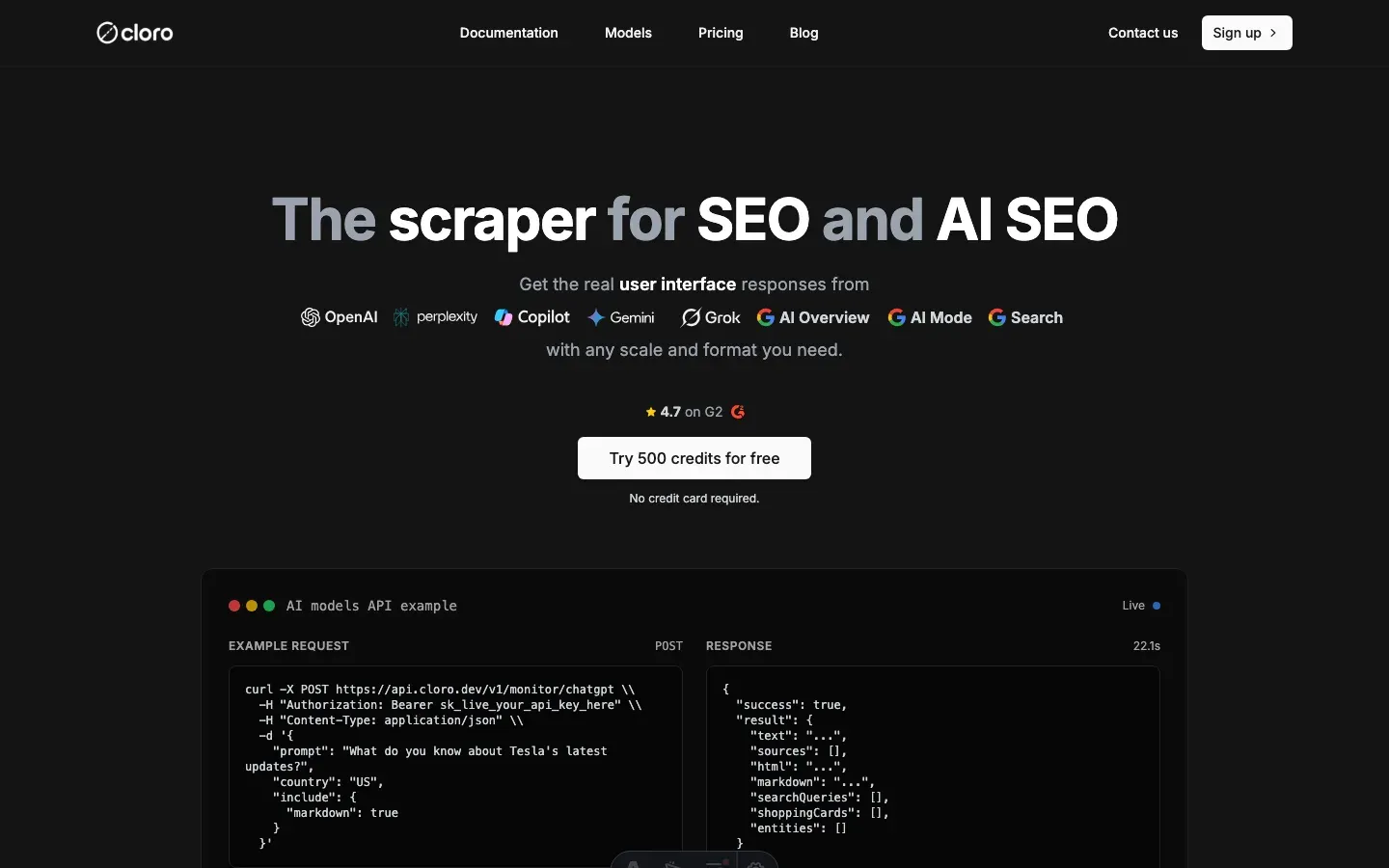
1. cloro: best for parsed Gemini grounding + citation pills
Best for: monitoring & structured data.
A Gemini scraper API purpose-built for AI search. Most scrapers treat Gemini like any other web target. cloro treats it like a grounded search engine. The response is parsed into structured fields (text, markdown, grounded sources, citation pills, per-citation metadata) instead of raw HTML.
It’s the tool architected to parse Gemini’s grounded-response DOM into structured intelligence, including the inline source URLs and citation-pill positions. You get meaning, not just HTML. That’s what makes it the best Gemini scraper for brand monitoring.
Key features
- Grounded-source extraction returns every URL Gemini cites, with source metadata and position, so you know exactly which pages fed an answer, not just that Gemini cited something
- Citation-pill parsing turns inline citations into structured objects (label, URL, domain, position), so you can trace a specific claim back to the source it came from
- Multi-country targeting lets you scrape Gemini’s response from any country to see localised grounding
- Managed auth handles Google session cookies, device checks, and rotation, so your team isn’t the one keeping a pool of Google accounts alive
- Rich formats: text, markdown, and raw HTML for the same response
- Cross-surface coverage. The same API also returns parsed responses for ChatGPT, Perplexity, Copilot, AI Overview, and AI Mode
Pros
- No maintenance. Google iterates the Gemini UI; cloro fixes selectors on its end
- Grounded-source signal. Tells you not just what Gemini said, but which sources it grounded on
- Compliance. Enterprise brand monitoring under strict data-privacy controls is the design target
- One API, all engines. Migrate from Gemini-only monitoring to full AI-search coverage without integration work
Cons
- Aimed at monitoring and intelligence work rather than free-tier chat generation
- Per-query pricing tracks monitoring volume, so occasional use gets expensive
- Younger than the scraping platforms that have been around longest
Pricing. The Hobby tier costs $100/month and carries 250,000 credits, with 500 credits a month free so you can try it first. Growth and Enterprise tiers price by volume.
Quick integration guide: the gemini-scraper README walks through Python, cURL, and Node.js requests with the full response schema including grounded sources and citation pills.
Tier 2: Scraping platforms with Gemini support
Established platforms that ship dedicated Gemini support, whether through purpose-built endpoints, dedicated products, or documented workflows. If you already run one of these platforms, that is the natural place to start.
2. Bright Data: most complete Gemini product line
Best for: teams already on Bright Data infrastructure.
Bright Data ships a dedicated Gemini scraper product plus a Gemini-as-a-scraping-brain Python tutorial and a Gemini scrapers roundup. The product handles Google-account session state, TLS fingerprinting, and residential-proxy routing. That access layer holds up under measurement: AIMultiple’s LLM scraper benchmark calls Gemini its hardest target, and Bright Data was the provider that cleared its 90% reliability threshold there (about 100% success, 14 fields), using Scraping Browser.
Response format is closer to raw HTML with the response text pulled out. Structured citation-pill extraction is not a first-class field. You get the answer and the sources list, but the position-level citation-pill metadata requires your own parser.
Best for: teams already using Bright Data’s proxy or Scraping Browser and wanting Gemini support inside the same account and billing.
3. ScrapingBee: anti-bot layer with a Gemini feature
Best for: teams using ScrapingBee for other targets.
ScrapingBee’s Gemini feature handles the Cloudflare-and-adjacent anti-bot layer that Google shares with the wider CDN ecosystem. You send a prompt, ScrapingBee returns the Gemini response.
The trade-off: parsing is your job. ScrapingBee returns the rendered response as text/HTML; grounded-source extraction and citation-pill parsing require your own DOM traversal. That’s manageable at low volume; it breaks every time Google ships a UI update. See our ScrapingBee alternatives breakdown if you are pricing that parsing work against a managed option.
Best for: teams already invested in ScrapingBee’s anti-bot infrastructure who want a single account for Gemini plus other scraping targets.
4. Oxylabs: Google-scraping expertise applied to Gemini
Best for: teams comfortable with a scraping-SDK workflow.
Oxylabs publishes a Gemini web scraping guide and offers proxy + scraper infrastructure that pairs with the walkthrough. The tutorial uses Gemini as a browsing-agent brain rather than a target. The more common pattern is running an Oxylabs scraping session against gemini.google.com and parsing the response yourself.
Oxylabs’ proxy pool is the strongest asset. If your Gemini scraping is bottlenecked by Google-account or IP quality, the Oxylabs residential pool is a differentiator. If you’re bottlenecked by parsing effort, less so, and our Oxylabs alternatives breakdown covers the vendors that parse for you.
Best for: teams with existing Oxylabs contracts who can absorb the parsing work in-house.
5. Apify: actor marketplace with community Gemini scrapers
Best for: actors and serverless.
Apify is a scraping platform with a marketplace of “actors,” containerised scrapers with fixed input schemas. Several actors target Gemini, ranging from Apify-maintained scrapers to community contributions.
The model is powerful when target diversity matters. The trade-off is reliability. Community actors break whenever Google changes a class name, and you depend on whoever still maintains the actor. Grounded-source parsing varies by actor: some parse citations, most return raw text. Our Apify alternatives breakdown compares that variance against vendors shipping a fixed response schema.
Best for: teams doing multi-target scraping across many properties who want one billing surface, and who can tolerate per-actor variance in output quality.
6. DataForSEO: Gemini LLM Scraper in AI Optimization API
Best for: teams already on DataForSEO’s SERP API.
DataForSEO added a Gemini LLM Scraper to its AI Optimization API. You send a prompt, get the Gemini response back as JSON. Sources appear in a list; the pay-as-you-go pricing model fits low-to-medium monitoring volume.
DataForSEO’s strength is breadth: Google SERP, AIO, ChatGPT, and Gemini all under one API. If you’re already running DataForSEO for SERP scraping, adding Gemini is a small config change. If you’re picking a Gemini scraper from scratch, the tighter response shape from a dedicated tool tends to win.
Best for: teams consolidating multi-engine monitoring on DataForSEO’s infrastructure.
Tier 3: DIY
7. Playwright: the DIY baseline everyone tries first
Best for: proof-of-concept work and single-account low-volume monitoring.
Playwright is a modern browser-automation framework. With stealth plugins, a real Google account, residential proxies, and a stable session cookie, you can scrape Gemini. For a proof-of-concept or a single-account monitoring script, this is the fastest path in.
At production volume the math turns. Residential proxies at $5-15/GB, one aged Google account per session slot, ongoing selector maintenance every time Google ships a Gemini UI update, and infrastructure for headless Chromium at scale. Total cost of ownership at 1,000 queries/day is 3-8× a managed API.
Best for: teams with strong scraping-infra engineering who can amortise the maintenance work across many targets, or teams doing single-account low-volume monitoring where the cost math still favours DIY.
Is scraping Gemini legal in the US?
Web scraping is not illegal in the US by itself. In hiQ Labs v. LinkedIn, the Ninth Circuit held that automated access to publicly available data is not “hacking” under the CFAA, and Van Buren v. United States narrowed “exceeds authorized access” to entering areas of a computer that are off-limits.
Gemini adds a contract layer because it requires a signed-in Google account, and Google’s terms bind that account. The risk from account-based scraping is a banned account or a breach-of-contract claim, not a computer crime. The same rules apply to AI data scraping in general: public output is treated like other public web data, while bypassing a login or collecting personal data raises the risk. Our web scraping legality guide covers the cases and seven jurisdictions in detail.
Which Gemini scraper should you pick?
For most teams monitoring how Gemini responds to their category and brand queries, a managed API is the right answer. cloro is the top pick because it’s the only tool on this list that parses grounded sources and citation pills into structured fields, the two artifacts that actually matter for AI SEO measurement.
For teams already invested in a scraping platform, staying on that platform is often the correct call. Bright Data, ScrapingBee, Oxylabs, and Apify all give you Gemini access alongside your existing targets. Trade-off is that grounded-source parsing is your job.
For teams consolidating multi-engine monitoring, DataForSEO’s breadth and cloro’s per-engine depth are the two natural picks depending on whether you optimise for surface area or output quality.
For DIY teams, Playwright with a real Google account and residential proxies is a proven pattern, but only at proof-of-concept or low volume. The economics turn against you fast.
For any of these paths, the pattern is the same as we cover in Best ChatGPT Scraper 2026 and Best Google Scraper 2026: match the tool to the maintenance model you can actually sustain, not to the initial-integration cost.

About the author
Ricardo Batista
Founder, cloro
Ricardo is one of the founders and engineers behind its SERP and AI-search scraping infrastructure. Before cloro he scaled a financial comparison site to $7M ARR and ran the full-country operations of a unicorn to $65M ARR, then went back to building. He writes about search engine scraping, generative-engine optimization, and turning live search and AI-answer data into something teams can act on.
Frequently asked questions
Can I scrape Gemini in 2026?
Yes, Gemini's web UI at gemini.google.com is scrapable, though it sits behind Google's full anti-bot stack. The practical route for production teams is a managed scraper API that handles session persistence, TLS fingerprinting, and grounded-source parsing. DIY scrapers work for low volume but require ongoing maintenance because Google iterates the Gemini UI on a rolling basis and the class names change between deploys.
Why not just use the Google AI Studio API?
The AI Studio API and the Vertex AI Gemini API give you raw model outputs, but they don't return what a Gemini web-UI user sees: the grounded Google-search sources, the citation pills with source URLs, the place cards for local queries, or the shopping data for commercial queries. If you're monitoring how Gemini cites your brand or which sources it grounds an answer on, the API is not enough. You need the rendered UI.
What are the technical challenges of scraping Gemini?
Four challenges compound: (1) Google's anti-bot stack profiles TLS fingerprints, browsing behavior, and datacenter IP ranges; (2) authentication and session persistence, since Gemini requires a Google account and the login flow includes device checks that break naive automations; (3) grounded-response parsing, because Gemini's answers weave inline citations, sources, and Google-search-derived context into the rendered markup, and clean extraction requires knowing where each artifact lives; (4) UI change velocity, as Google ships Gemini UI updates frequently, and DOM-selector-based scrapers break with every deploy.
What does it cost to scrape Gemini at production volume?
At 1,000 queries per day, a managed scraper API runs roughly $100-400/month all-in with grounded-sources parsing included. DIY at the same volume costs $400-1,200/month once you factor in residential proxies at $5-15/GB (datacenter proxies get blocked quickly), Google-account rotation, CAPTCHA solving on the login flow, headless browser compute, and 8-15 engineer-hours per month for selector maintenance. The DIY math worsens at scale because the proxy line item grows linearly while the managed-API per-call rate stays flat.
Which Gemini scraper returns grounded sources as structured fields?
Among the tools tested, cloro returns Gemini's grounded sources and citation pills as structured fields out of the box, including source URLs, per-citation confidence signals, and the Google-search-integrated context. Bright Data and ScrapingBee return the rendered response and leave source-URL extraction to your parser. DataForSEO returns raw text with source lists. Apify actors vary in what they parse depending on the specific actor. Most DIY setups return the HTML and require you to build the parser yourself.
Is web scraping illegal in the US?
No, not by itself. The Ninth Circuit's hiQ Labs v. LinkedIn ruling held that automated access to publicly available data is not hacking under the CFAA, and the Supreme Court's Van Buren decision limited 'exceeds authorized access' to entering off-limits areas of a computer. The risk rises when you bypass a login, break a site's terms while signed in, or collect personal data.
Is scraping Gemini legal?
Scraping your own session data or publicly accessible content is generally permissible, but bypassing authentication or violating Google's terms of service can lead to account suspension or legal exposure. See our dedicated piece on web scraping legality for the full breakdown. The practical rule: read Google's terms, scrape your own observed UI rather than other users' sessions, and use managed services that handle the access layer in a compliant way.
Related reading
Best ChatGPT Scraper 2026: 8 Tools Tested (Web UI)
We tested 8 ChatGPT scrapers against Cloudflare TLS fingerprinting, SSE streaming, and weekly-changing class names to find the best ChatGPT scraper for 2026.
Best Google Scraper 2026: 10 Tested Across 5 Verticals
Benchmark of 10 Google scrapers across SERP, Maps, Jobs, Images, Business Profile. Real cost per call, AI Overview depth, vs SerpApi + Bright Data.
Best SERP APIs 2026: 9 Tested on Cost, AI and Tracking
9 SERP APIs tested head to head on AI Overview parsing, engine breadth, rank-tracking depth, and true cost per 1,000 calls. Full benchmark table inside.