
Apify Alternative: 5 Scraping & SERP APIs Tested (2026)
We tested 5 Apify alternatives in 2026 — managed SERP APIs vs actor marketplaces, AI Overview, and real pricing. See which fits without maintaining actors.
4.7 · 53 reviews
Why teams switch from Apify
Issues users run into with Apify
No built-in Google extended parsing
Apify has no native AI Overview or citation parsing. You'd need to find, configure, and maintain custom actors that ship with the modern SERP envelope baked in. cloro returns AI Overview with its cited sources by default.
Actor maintenance overhead
Scraping actors break when sites change. You're responsible for maintenance, updates, and fixing broken actors. cloro is a managed API, so parser upkeep is ours.
Hidden costs for advanced features
Platform fees plus actor costs plus compute. cloro returns AI Overview, citations, and knowledge panels in the default response at $1.25–$2.00 per 1,000 (n=10 + AIO), with nothing to assemble from a marketplace.
Quick comparison
How cloro compares to Apify
cloro
Apify
Apify is a scraping-actor marketplace. Instead of one managed endpoint, you browse a store of “actors” — containerized scrapers, mostly community-built — then pick, configure, and run them on Apify’s compute. Community actors cover Google SERP and even AI Overview, so you can assemble a pipeline without writing every scraper yourself.
That flexibility is the whole pitch, and it works when target diversity is what you’re buying. It’s also where the search for an Apify alternative usually starts: for a repeating Google SERP workload, you don’t want to own third-party actors that break when Google’s layout shifts. Most teams shopping Apify alternatives in 2026 want the opposite of a marketplace — one managed SERP endpoint with an SLA, AI Overview parsed in the default response, and a bill that isn’t stitched together from subscription + compute + proxy + per-run fees.
The alternatives below split on that fork: cheaper or broader scraper platforms on one side, and managed parsed SERP APIs that remove the actor-maintenance problem entirely on the other. We tested five.
The 5 best Apify alternatives at a glance
| Tool | Model | Entry price | Google SERP rate (~1k) | AI Overview |
|---|---|---|---|---|
| cloro | Parsed AI-native SERP API | $30/mo (free tier: 500 credits/mo) | $1.25–$2.00 /1k (n=10 + AIO) | ✅ deep, default |
| Bright Data | Proxy + SERP layer | PAYG; Business ~$999/mo | ~$1–$1.50 /1k (Google, high end) | ⚠️ Web Unlocker, DIY parse |
| Oxylabs | Proxy + SERP Scraper API | $49/mo | ~$2 /1k results | ⚠️ parsed SERP, limited AIO |
| ScraperAPI | Credit-based scraper | $49/mo (1k free credits) | ❌ no AIO | |
| ScrapingBee | Headless-browser scraper | $49/mo (1k free credits) | credit multipliers (JS ×5+) | ❌ no AIO |
| Apify | Actor marketplace | ~$39/mo + compute + per-actor | actor-dependent | ⚠️ via community actor |
The alternatives split on two axes that matter for an Apify replacement: whether you get parsed SERP JSON or scraper access you assemble and maintain yourself, and whether onboarding is self-serve or an enterprise sales motion. Apify sits at the assemble-it-yourself end. Every alternative below moves you toward a managed endpoint, cheaper proxies, or both.
How we tested, and what these numbers rest on
Comparison pages are easy to write and hard to trust, so here is the basis for every claim above.
The cloro rows are measured. On 2026-08-19 we ran 15 AI-Overview-prone commercial and informational queries through cloro’s Google endpoint. 14 of the 15 returned a fully parsed AI Overview object, carrying the answer text, a markdown rendering, sources, citationPills, relatedLinks and videos, at a mean of 8.5 sources per overview. That run is the evidence behind cloro’s AI Overview column. One implementation detail if you benchmark us yourself: the field populates only when include.aioverview is sent, and without that flag it is absent whether or not Google rendered an overview, which produces a convincing-looking zero.
The Apify and other vendor rows come from each vendor’s own documentation and pricing pages, linked inline throughout. We did not run those APIs under our own keys for this comparison. So read a ❌ or ⚠️ as “not documented as a first-class parsed field” rather than as a test we ran and they failed. Where a vendor has shipped something since we last checked, their documentation is the authority and this page is not.
Pricing moves and none of these figures are quotes. List prices change without notice and promotional rates are common, so treat the per-1,000 rates as the shape of the market rather than a number to budget against, and open the linked pricing page before you commit.
We make one of the products in this table. cloro is listed first because this is our site, not because a neutral panel ranked it there. The measurements above are reproducible and the competitor links go to primary sources; use both to discount our framing.
What Apify is actually built for
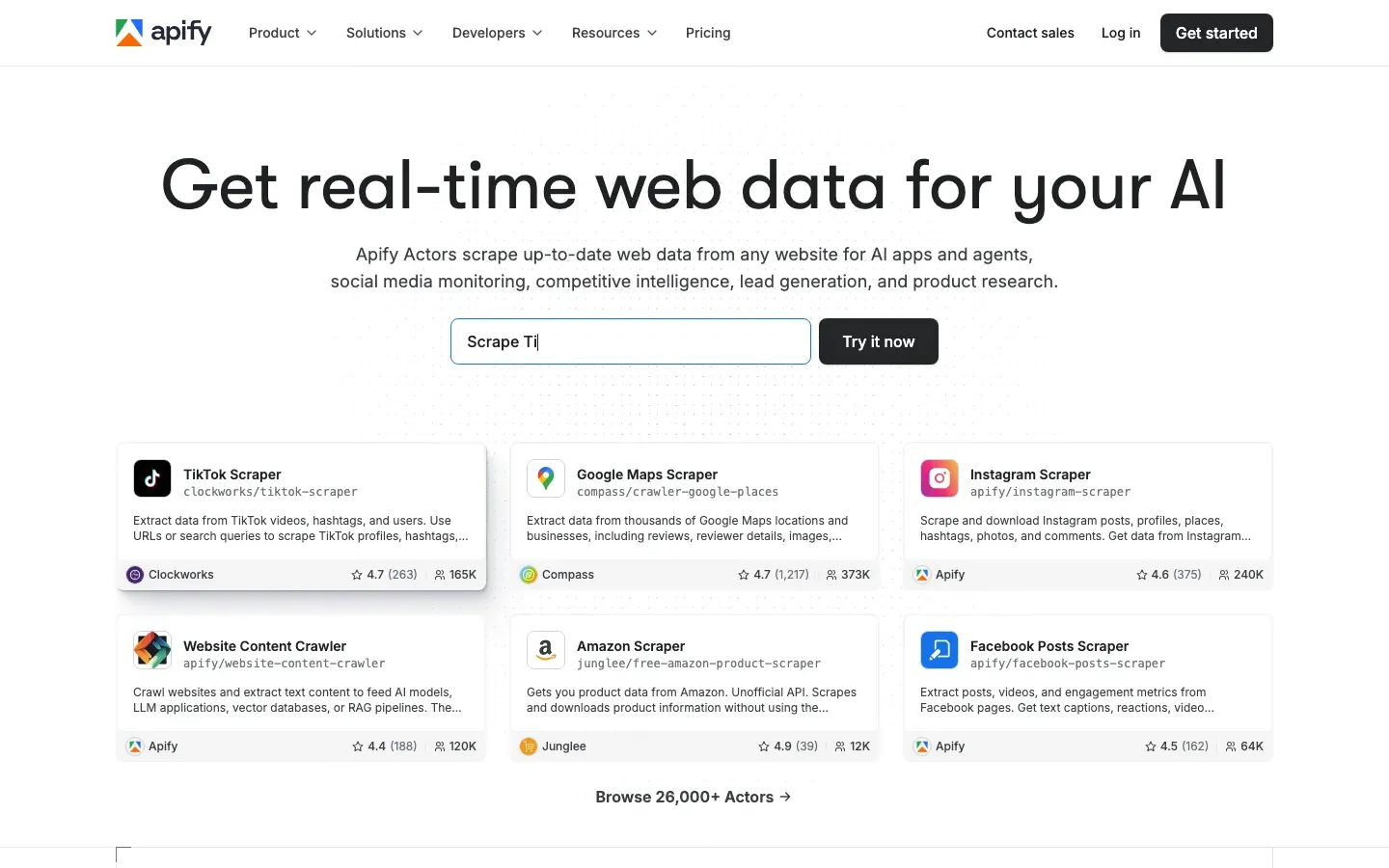
Apify is a runtime for arbitrary scrapers. An actor is a containerized scraper with a fixed input schema, an output dataset shape, and its own runtime behavior; you pick one from the Apify Store, configure it in Apify Console, run it on the platform’s compute, and pull the results by API or webhook. The Store covers a lot of public sites, and that breadth is the product. Pricing reflects the composition: a platform subscription (Starter around $39/month) plus compute units, proxy bandwidth on actors that need it, and per-run fees on paid actors. There is no single managed SERP endpoint with an SLA — a SERP is whatever community actor you wire up.
Where the actor marketplace earns its keep
For the right workload, nothing in this list replaces Apify one-for-one:
- Aggregator scraping that spans hundreds of different sites under one platform.
- Vertical or rare targets — legal records, real-estate filings, niche marketplaces — where no vendor ships a ready API.
- Teams already running Apify for adjacent jobs, adding SERPs to a pipeline they already operate.
- Cases where rolling your own actor is genuinely cheaper than buying any managed API.
If your bottleneck is “how many different site types can we reach,” the actor library is a real advantage and you should keep it.
Where actor maintenance becomes overhead
For a repeating Google SERP workload, most of that model is cost you carry without the benefit:
The maintenance is third-party but the pager is yours. When Google ships a SERP layout change, the actor that scrapes it breaks, and the author may patch it the same day, in three weeks, or never. Community actors carry no SLA, so that wait is entirely on you.
AI Overview isn’t first-class either. The Google SERP actors on the Store don’t return a structured AI Overview field, which leaves citation extraction and People Also Ask hydration as custom work on top of whatever the actor gives you.
The bill is composed rather than flat. Subscription + compute + proxy + per-run fees usually total more than a flat per-call SERP API at the same call count, and the effective Google rate depends on which actor you picked.
The alternatives below close that gap in one of two ways: by being a cheaper scraper, or by removing the actor-and-parser problem entirely.
The 5 real Apify alternatives, tested
1. cloro — best for parsed, AI-native SERP data
cloro’s SERP API is the inverse of an actor marketplace. You don’t browse a store, adopt somebody else’s actor, or think about compute at all. One endpoint family returns parsed JSON for Google Search and News, Google AI Overviews and AI Mode, plus ChatGPT, Perplexity, Copilot, Gemini, and Grok. Each carries the cited source URLs that surface used, useful whether you’re tracking how your brand and competitors show up across AI answers or feeding structured SERP data straight into a product you’re building. Where a community actor hands you a raw dataset to shape, cloro returns organic results, ads, AI Overview (with citations), People Also Ask, and related searches in a single response.
Cross-surface coverage is what separates the 2026 tools from the ones built a few years earlier. Track classic rank without tracking AI citations and you now miss half the SERP. cloro also drops into existing pipelines through n8n, Zapier, LangChain, and MCP, with no service to build first. Sync calls cover single lookups; async/batch with webhook delivery pushes large query sets back, so nothing sits polling.
Pros: AI Overview parsed by default, with block text and cited source URLs. One managed API across Google and every major AI surface — no actors to pick or patch. Self-serve signup with a free 500-credit trial.
Cons: Focused on search intelligence — it doesn’t run arbitrary site scrapers the way Apify’s marketplace does. Newer than the longest-running scraper platforms.
Pricing: Credit-based from $30/month (Lite, 37,500 credits at $0.80 per 1,000 credits), with Hobby at $100/month for 250,000 credits at $0.40 per 1,000 and rates scaling down to $0.31 per 1,000 on the largest self-serve tier and $0.25 on a custom Enterprise contract. A Google call is 3 credits at n=10, +2 with AI Overview — see the comparison card above for the per-1,000-call cost, and the pricing page for full tiers. The entry-tier rate is a ceiling, not what you settle at.
2. Bright Data — largest proxy network with a SERP layer
Bright Data is a different escape hatch from actor maintenance: instead of community scrapers you get one of the largest proxy networks on the planet (72M+ residential IPs across 195+ countries) with a SERP API riding on top. It’s the pick when the proxy layer matters as much as the parsing, but onboarding is an enterprise motion: KYC, an MSA, and a sales conversation before access, with committed plans (Business lands near $999/month) where the effective rate drops. AI Overview isn’t a clean parsed field — you’re back to a DIY parse via Web Unlocker.
Pros: Proxy scale and country coverage nobody here matches. Rigorous compliance posture for regulated buyers. SERP API around $1–$1.50 per 1,000 for Google at the high-volume end.
Cons: Enterprise procurement (KYC, MSA) means days to first call. No structured AI Overview — you build the parser. Multi-axis billing across bandwidth, CPM, and geo premiums.
Pricing: Pay-as-you-go available; committed Business tier ~$999/month. Google SERP ~$1–$1.50 per 1,000 at the high end (Bright Data SERP pricing).
3. Oxylabs — closest like-for-like proxy + SERP infrastructure
Oxylabs is the nearest match to Bright Data’s core offering, and a solid Apify alternative when you want infrastructure rather than a marketplace: a 100M+ residential and datacenter IP pool with a dedicated SERP Scraper API on top. The entry tier is self-serve from around $49/month (~$2 per 1,000 results), so you skip most of the sales motion while keeping enterprise-grade scale.
Pros: Proxy scale in Bright Data’s league. Self-serve entry tier. Parses SERP results rather than handing back raw HTML.
Cons: Still fundamentally proxy-first; AI Overview parsing is limited versus a purpose-built SERP API. Higher tiers drift back toward enterprise pricing.
Pricing: SERP Scraper API from $49/month; roughly $2 per 1,000 results at the entry tier (Oxylabs SERP Scraper pricing).
4. ScraperAPI — developer-friendly scraper with structured endpoints
ScraperAPI is closer to a developer product than a marketplace: one API key, proxy rotation and retries handled for you, and structured JSON endpoints for popular targets including Google Search. There are no actors to audit and no compute to reason about, but the credit model bites on Google. The structured Google endpoint bills at 25 credits per request, so the $49/month Hobby plan (100,000 credits) is about 4,000 Google calls — an effective rate near $12 per 1,000. There’s no structured AI Overview field.
Pros: Self-serve, developer-first, with a free 1,000-credit tier and a 7-day trial. Structured Google endpoints (organic, ads, PAA, related) out of the box.
Cons: Credit weighting makes Google SERP calls expensive relative to a flat per-call API. No AI Overview parsing. Costs vary by target difficulty.
Pricing: Hobby $49/month (100,000 credits; Google = 25 credits/call). Free 1,000 credits plus a 7-day trial (ScraperAPI pricing).
5. ScrapingBee — headless-browser scraper for JS-heavy targets
ScrapingBee is a headless-browser scraping API: it renders JavaScript, rotates proxies, and returns the page, with a Google Search endpoint on top. Like ScraperAPI it removes the actor-maintenance problem, but pricing runs on credit multipliers — JavaScript rendering ×5, premium proxy ×25, stealth mode up to ×75 — so the effective cost depends heavily on how hard your target is. There’s no AI Overview parsing.
Pros: Handles JS-heavy and interactive pages well. Self-serve with a free 1,000-credit trial. Simple single-API integration.
Cons: Credit multipliers make cost hard to predict on difficult targets. No structured AI Overview field. SERP is one endpoint on a general scraper, not the core product.
Pricing: Discovery $49/month (150,000 credits) up to Enterprise $599/month (8M credits); credits multiply by rendering, proxy, and stealth options (ScrapingBee pricing).
Apify alternatives: price and parsing compared
Headline rates mislead here, because the number that matters is total delivered cost: the per-1,000 rate plus the engineering you spend turning a community actor’s output (or raw proxy access) into parsed SERP rows. An actor at “$0.50/1k” that you patch every time Google shifts is not cheaper than a managed API that returns structured JSON.
| Vendor | Model | Google SERP rate (~1k) | You maintain scrapers? | AI Overview |
|---|---|---|---|---|
| cloro | Parsed SERP API | $1.25–$2.00 (n=10 + AIO) | No | ✅ default |
| Apify | Actor marketplace | actor-dependent + compute | Yes (third-party actors) | ⚠️ community actor |
| Bright Data | Proxy + SERP layer | ~$1–$1.50 (Google, high end) | Parser only | ⚠️ DIY / Web Unlocker |
| Oxylabs | Proxy + SERP Scraper API | ~$2 /1k results | No | ⚠️ limited |
| ScraperAPI | Credit scraper | ~$12 /1k Google (25 cr/call) | No | ❌ |
| ScrapingBee | Headless-browser scraper | credit multipliers (JS ×5+) | No | ❌ |
Headline takeaways:
- Removes the actor-maintenance problem entirely: cloro, Oxylabs, ScraperAPI, and ScrapingBee are all managed — no third-party actors to patch when Google shifts. Apify is the only option here where you own that maintenance.
- Lowest total delivered cost for parsed Google + AI Overview: cloro, because the AI Overview parser, citation extraction, and PAA hydration are already done — nothing to build.
- Closest infrastructure swap if you need proxies too: Oxylabs at self-serve scale, or Bright Data at enterprise scale.
- Most expensive for Google specifically: ScraperAPI, where the 25-credit weighting pushes the effective Google rate near $12/1k.
For the price-only view see Cheapest SERP API 2026; for the full managed-API roundup see Best SERP APIs in 2026.
Decision tree: which Apify alternative to pick
- Never wanted to maintain scrapers — you just need parsed Google SERPs with AI Overview, plus ChatGPT/Perplexity/Gemini citations through one API? cloro.
- Need a raw proxy pool alongside SERP scraping? Oxylabs for self-serve enterprise scale, or Bright Data if you need its compliance posture and country breadth.
- Want proxy-backed scraping with a developer-first API and structured Google endpoints? ScraperAPI.
- Scraping JS-heavy or interactive pages, not just SERPs? ScrapingBee.
- Genuinely need to scrape many site types and don’t mind owning actors? Stay on Apify — the marketplace is the point.
Which Apify alternatives are cheaper for LLM scraping APIs?
Apify’s actor model prices generalized automation; for LLM-surface scraping a purpose-built API is usually cheaper because you stop paying for compute you orchestrate. cloro prices per result, success-billed: ChatGPT 5 credits, Gemini, AI Mode, and Perplexity 4, from $0.80 down to $0.31 per 1,000 credits self-serve. Compare one month of Apify LLM spend divided by successful results against that effective per-result cost.
The bottom line
Apify is a runtime for arbitrary scrapers, and the best Apify alternative depends on why you’re leaving. If your bottleneck is “how many different site types can we reach,” the actor marketplace is the right tool and you should keep it. If it’s “how reliably can we read Google SERPs at scale,” the actor framework is overhead, and you end up maintaining third-party scrapers for a problem managed APIs already solved.
If you need proxies under the scraping, Oxylabs and Bright Data are the like-for-like swaps, one self-serve and one enterprise-scale. If you want proxy-backed scraping with a friendlier API, ScraperAPI or ScrapingBee fit. But if the reason you’re leaving is that you never wanted to own actors and SERP parsers in the first place, the answer is a parsed SERP API rather than another scraper. cloro returns organic results, ads, AI Overview with citations, and People Also Ask in one self-serve call, across Google and every major AI surface, with a free 500-credit trial to baseline your own keywords before you commit.
Feature comparison
How the two stack up, feature by feature
| Feature | cloro | Apify |
|---|---|---|
| Platform Support | ChatGPT, Perplexity, Copilot, Google, Gemini, Grok | Any site via community actors |
| AI Overview Scraping | Native support with parsed citations | Need to find/build custom actor |
| Maintenance Model | Fully managed, we handle updates | DIY actor maintenance |
| Flexibility | Optimized for AI platforms | Can scrape anything with actors |
| Response Format | Clean parsed objects | Varies by actor |
| Pricing Model | Credit-based by AI model | Platform credits + per-actor costs |
| AI Platform Monitoring | Built-in ChatGPT, Perplexity, Copilot tracking | Not available out of box |
| Setup Time | Instant API access | Find and configure actors |
The verdict
If you need to scrape diverse websites and want the flexibility of a marketplace, Apify is excellent. Costs add up, though, because platform fees stack on top of individual actor costs. If what you actually run is AI scraping and monitoring, cloro is purpose-built for that and there are no actors to maintain.
Frequently asked questions
What's the difference between Apify and cloro?
Apify is a runtime for arbitrary scrapers — you compose or buy actors from a marketplace to scrape almost any site. cloro's SERP API is a managed Google SERP endpoint with one response shape and one parser-update SLA. Apify fits when target diversity is the value; cloro fits when reliable Google SERP reads at scale are the goal.
Do I have to maintain actors with cloro?
No. Community and official actors break when sites change, and you inherit that maintenance: guard layers, fallback paths, and swapping actors when one stops working. cloro is fully managed: when Google ships a SERP change, cloro updates the parser and the JSON keys your code reads stay the same.
Does Apify parse AI Overview out of the box?
No. The Google SERP actors on the Apify Store don't return a structured AI Overview field, so AI Overview parsing is custom work on top. cloro returns AI Overview with cited sources as a first-class field in the default Google monitoring response.
Is Apify or cloro cheaper for SERP scraping?
For a SERP-only workload, Apify's bill is composed from a platform subscription, compute units, proxy bandwidth, and per-run actor fees, which typically totals more than a flat per-call SERP API at the same call count. For mixed workloads across many target types, the actor model can be cheaper because you only pay for what each actor consumes.
Can I use both Apify and cloro?
Yes, they coexist cleanly at different layers of the stack. Many teams run Apify for the long tail of diverse or rare targets and cloro for the Google SERP slice, so SERP monitoring runs on a managed endpoint while Apify handles everything that isn't a search engine.
Related comparisons
Each page maps cloro's SERP API against one alternative on pricing, AI Overview coverage, and developer experience. Compare Apify with the rest of the field:
Best Bright Data Alternatives: 5 Proxy and SERP APIs (2026)
We tested 5 Bright Data alternatives in 2026 on parsed Google SERPs, AI Overview, real per-1,000 pricing, and setup time. See which proxy or SERP API fits.
Best DataForSEO Alternatives: 5 SERP APIs Tested (2026)
We tested 5 DataForSEO alternatives in 2026 on AI Overview support, real per-call pricing, and developer experience. See which SEO data API fits.
Oxylabs Alternatives: 5 Proxy & SERP APIs Tested (2026)
We tested 5 Oxylabs alternatives in 2026 — proxy scale, parsed SERPs with AI Overview, real per-1,000 pricing, and setup time. See which fits your workload.
ScrapeDO Alternatives: 5 SERP & Scraping APIs Tested (2026)
We tested 5 Scrape.do alternatives in 2026 — parsed SERPs with AI Overview vs cheap raw HTML, reliability, and real per-1,000 pricing. See which fits.
ScraperAPI Alternatives: 5 SERP APIs Tested (2026)
We tested 5 ScraperAPI alternatives in 2026 — parsed SERPs, AI Overview, real credit-vs-per-call pricing, and success rates. See which scraping API fits.
ScrapingBee Alternatives: 5 SERP APIs Tested (2026)
We tested 5 ScrapingBee alternatives in 2026 — JS rendering vs parsed SERPs, AI Overview, and real credit-vs-per-call pricing. See which scraper fits.
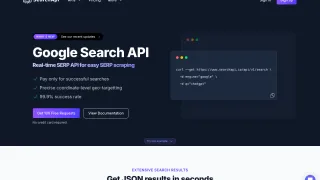
SearchApi Alternatives: 5 SERP APIs Tested (2026)
We tested 5 SearchApi alternatives in 2026 on Google feature depth, AI Overview parsing, engine breadth, and real per-call pricing. See which fits.
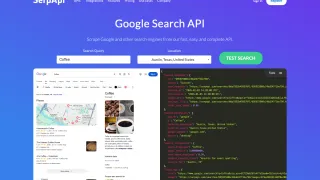
SerpApi Pricing vs 5 SerpApi Alternatives Tested (2026)
SerpApi pricing in 2026: published tiers, the real per-1,000 cost at n=10 and n=100, and 5 SerpApi alternatives tested on price and AI Overview support.
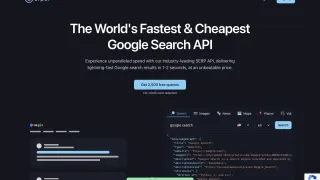
Serper Alternative: 5 SERP APIs Tested (2026)
We tested 5 Serper alternatives in 2026 on AI Overview parsing, structured SERP depth, and real per-call pricing. See which SERP API actually fits.