
Best SERP APIs 2026: 9 Tested on Cost, AI and Tracking

On this page
Every team running on Google’s official Custom Search JSON API has until January 1, 2027 to migrate. Per Google’s developer docs, the API is closed to new customers, leaving existing customers on a 13-month sunset clock. It was never a real SERP product: 10 results per request, no ads, no AI Overview, no People Also Ask. But it was cheap enough that thousands of teams built on it, and every one of them needs a migration plan. That is the single biggest forcing function for SERP API adoption in 2026. If that is you, the Custom Search API shutdown guide is the dedicated walkthrough: what Google actually recommends, why both official options are site-restricted, and the field mapping to a SERP API.
Three other pressures set the baseline. AI Overviews are a majority-of-SERP feature: 85% of US results in cloro’s SERP feature census, roughly 48% of BrightEdge’s broader tracking, 475% YoY mobile growth per seoClarity, so an API that skips the generative block returns a partial page. Citation is decoupling from rank: position-1 organic CTR fell 58% under AIO per Ahrefs, and only 38% of AIO-cited pages still rank in the organic top 10, down from 76%, per Ahrefs’ 4M-URL study. Multi-engine is a requirement: ChatGPT drives 87.4% of AI referral traffic per Conductor, and Gemini’s 750M+ MAU is a separate citation pool. Underneath it, Google removed &num=100 on September 11, 2025 per Locomotive Agency, roughly 10x-ing infrastructure costs at top-100 depth and resetting category pricing.
We benchmarked 9 tools head to head against SerpApi, the category default. Every one returns parsed JSON rather than raw HTML. Scope is multi-engine SERP APIs.
Four categories are out of scope, each covered elsewhere. Bright Data is a proxy business sold on committed volume, so it sits in Best Google Scraper 2026. General scrapers like ZenRows and ScrapingBee get our ScrapingBee alternative breakdown. Apify reaches Google through community actors, and AI search APIs like Tavily and Exa return synthesized answers, not a parsed results page. For pricing alone see Cheapest SERP API 2026; for the DIY route, scraping Google with Python.
How do the best SERP APIs compare on benchmark data?
Measured head to head on the same 50 queries, the tools split cleanly: cloro leads on AI Overview parsing depth and AI-surface breadth, SerpApi on engine count, DataForSEO on bulk cost, and Serper on raw latency. A ”—” means the axis is not where that tool competes.
| Tool | AI Overview parsing | AI surfaces beyond Google | Engines | Starting price |
|---|---|---|---|---|
| cloro | Deep: sources, citation positions, videos, ads | AI Mode, ChatGPT, Perplexity, Gemini, Copilot, Grok | Free 500 credits/mo, then from $30/mo | |
| SerpApi | Parsed, cited sources | — | 80+ incl. Bing, Baidu, Yandex, eBay, YouTube | $25/mo (1k searches) |
| Serpent API | Parsed, included at base rate | Citation tracking only: ChatGPT, Claude, Gemini, Perplexity | Google, Bing, Yahoo, DuckDuckGo, Brave | $0.60/1k, or $0.03/1k after a one-time $500 deposit |
| DataForSEO | Parsed, +$2/1k first page | — | Google, Bing, Yahoo, Yandex, Baidu, Naver | $2/1k |
| SearchApi | Parsed | ChatGPT Search, Perplexity | Google, Bing, YouTube | $40/mo (10k searches) |
| Serper | Partial | — | Google, Bing | $50 for 50k credits (2.5k free) |
| Scrapingdog | Parsed, included | — | Google Search, Maps, Images | $40/mo |
| ScrapeBadger | Parsed into text blocks with cited source URLs | ChatGPT, Perplexity, Gemini, AI Mode | Google, Bing, Yahoo, Baidu, DuckDuckGo, Yandex | Free 1,000 credits, then $0.15/1k credits PAYG |
| CatchAll | n/a | n/a (open-web recall, not SERPs) | Open web | Usage-based |
The other three axes sit per tool below rather than in the table, because they barely separate the field: every tool but CatchAll returns the same full SERP envelope, and only cloro (city-level via location or uule) differs materially on geolocation. Full cost math at every depth is in the cost table. One caveat no table carries: structured results are only as usable as their schema is stable, so ask how schema changes are versioned before you build parsers against sample payloads.
This ranking is ours. For a second opinion that nobody edits, the SERP APIs leaderboard tracks which of these providers ChatGPT, Perplexity, Gemini, Copilot and Google AI Mode actually name and cite when asked to recommend one, refreshed weekly.
How we tested structured search results from 9 APIs
We ran 50 queries across four classes (commercial head terms, AI-Overview-eligible informational queries, local and maps-heavy queries, and long tail) through every API with the same request shape, scoring six axes:
- AI Overview parsing fidelity — cited sources with URLs, inline videos and ads as structured fields, or text-only.
- Multi-engine coverage — Google alone, or Google plus Bing, ChatGPT, Perplexity, Gemini and Copilot.
- SERP envelope completeness — ads, People Also Ask, related searches, knowledge panel, shopping.
- Geolocation precision — country-level vs city-level vs UULE-precise.
- True cost per 1,000 requests at n=10 + AIO and n=100 + AIO depth.
- Latency — sync response at p50 and p95, plus async webhook delivery.
The market is in flux post-n=100, so vendor pricing pages should be the final reference in every case.
Which search API type fits my use case?
Four product categories answer to “search API”, and picking the wrong one costs more than picking the wrong vendor inside it:
- SERP scraper APIs (this roundup). They return the real results page, ads and AI Overview included, as structured JSON. Choose this when you track rankings, SERP features, AI Overview citations, or competitors as users actually see them.
- AI-native retrieval APIs (Tavily, Exa, the LLM vendors’ own endpoints). Synthesized, relevance-ranked content for agent grounding, not the canonical SERP. Choose this when your LLM needs context and nobody will ask where you rank.
- Search-plus-extraction scrapers (ZenRows, ScrapingBee, Firecrawl). General pipelines where search is the URL-discovery step. Choose this when the deliverable is page content at scale.
- Official search APIs (Google Custom Search, Microsoft Bing Search). The sanctioned route, closing on both sides: Bing’s APIs retired in August 2025, Custom Search sunsets January 1, 2027. Choose this only when a curated index subset is enough and you have an exit plan.
Is a SERP API safe to use from a legal standpoint?
Google sued SerpApi on December 19, 2025. The complaint, announced on Google’s own blog, alleges SerpApi circumvented Google’s SearchGuard anti-bot protections at the scale of hundreds of millions of queries a day, framed as a DMCA Section 1201 circumvention claim rather than a scraping claim (Search Engine Land has the detail). SerpApi moved to dismiss in February 2026, arguing it returns only what any signed-out user sees. The case is unresolved as of August 2026.
No court has ruled that scraping public SERPs is unlawful, and the suit targets circumvention rather than scraping itself. But every scraper-model API here, cloro included, returns data from results pages Google serves rather than from an official feed, so the outcome shapes the whole category. Vendor posture is fair to weigh in procurement: SerpApi sells a Legal US Shield indemnification on paid plans, proxy vendors lean on compliance teams, and smaller vendors mostly say nothing. Our guide to web scraping legality covers the case law.
So the durable question is provenance. All of the best SERP APIs sit in one of three postures: an official feed (retired or sunsetting), scraped results pages (most of this roundup), or an own index over the open web, which sidesteps the Google question but does not return the canonical SERP. Ask which one a vendor is before you ask its price.
How to choose the best SERP API for your stack
The best SERP APIs do not compete on every axis. Match the tool to your primary constraint:
- Citation data across AI Overview, AI Mode, ChatGPT, Perplexity, Gemini and Copilot plus classic SERP, or migrating off Custom Search before Jan 2027? cloro.
- 80+ engines (Baidu, Yandex, Naver, eBay)? SerpApi.
- Low per-call SERP plus keyword and backlink data from one vendor? DataForSEO at $2/1k Live.
- Multi-engine plus AI search at mid-tier pricing? SearchApi.
- A lightweight agent needing fast, cheap Google SERP? Serper.
- Anything narrower (AI Overview parsing on a $40 budget, recall-first web search)? See Also considered below.
The best SERP APIs in 2026 parse the full post-AIO page across every surface your buyers use. To see parsed responses for your keyword set, start with cloro: 500 free monthly credits baselines your top 100 priority queries. Every vendor named here also has a head-to-head write-up in our comparisons index.
What do users say about choosing a SERP API?
Vendor pages argue over engine counts. Buyers in public threads argue over four other things, and those decide the migration. Quoted as written.
Price is a unit problem before it is a rate problem (ian_k93 on r/WebScrapingInsider, April 2026):
I’d start with two filters before I even look at “best.” First, unit semantics.
That is what the cost table below exists to expose: a per-1,000 rate says nothing until you know what counts as one call at n=100, whether AI Overview is an add-on, and whether failed requests bill.
In production, reliability outranks the feature matrix (Aggrno on r/WebScrapingInsider, May 2026):
Most pain I’ve seen comes from inconsistency and anti bot changes, so I bias toward providers that handle that well
No vendor publishes a block rate, so the only public proxy is the service commitment: SerpApi states a 99.95% SLA on every plan with credits up to the full monthly fee. Most of the field states nothing.
A free tier is read as an evaluation budget (60finch on r/n8n, November 2024):
I find the limit of 100 queries per month for SerpAPI quite challenging.
SerpApi’s free plan is 250 searches a month at 50 an hour today, and at that size a rank-tracking pilot ends on day one. Free allowances decide which tools get tested, not which get bought.
Some of the people evaluating a SERP API need a different product (Bigrob1055 on r/WebScrapingInsider, April 2026):
The actual stakeholder question is often “is demand going up?” or “how is our site doing?” and suddenly someone is evaluating SERP APIs when they needed Trends or Search Console.
The category breakdown above answers that more cheaply: if nobody will ask where you rank, you are buying retrieval, not a SERP.
Tier 1: AI-native multi-surface SERP APIs
1. cloro SERP API — best for AI-native cross-surface SERP intelligence
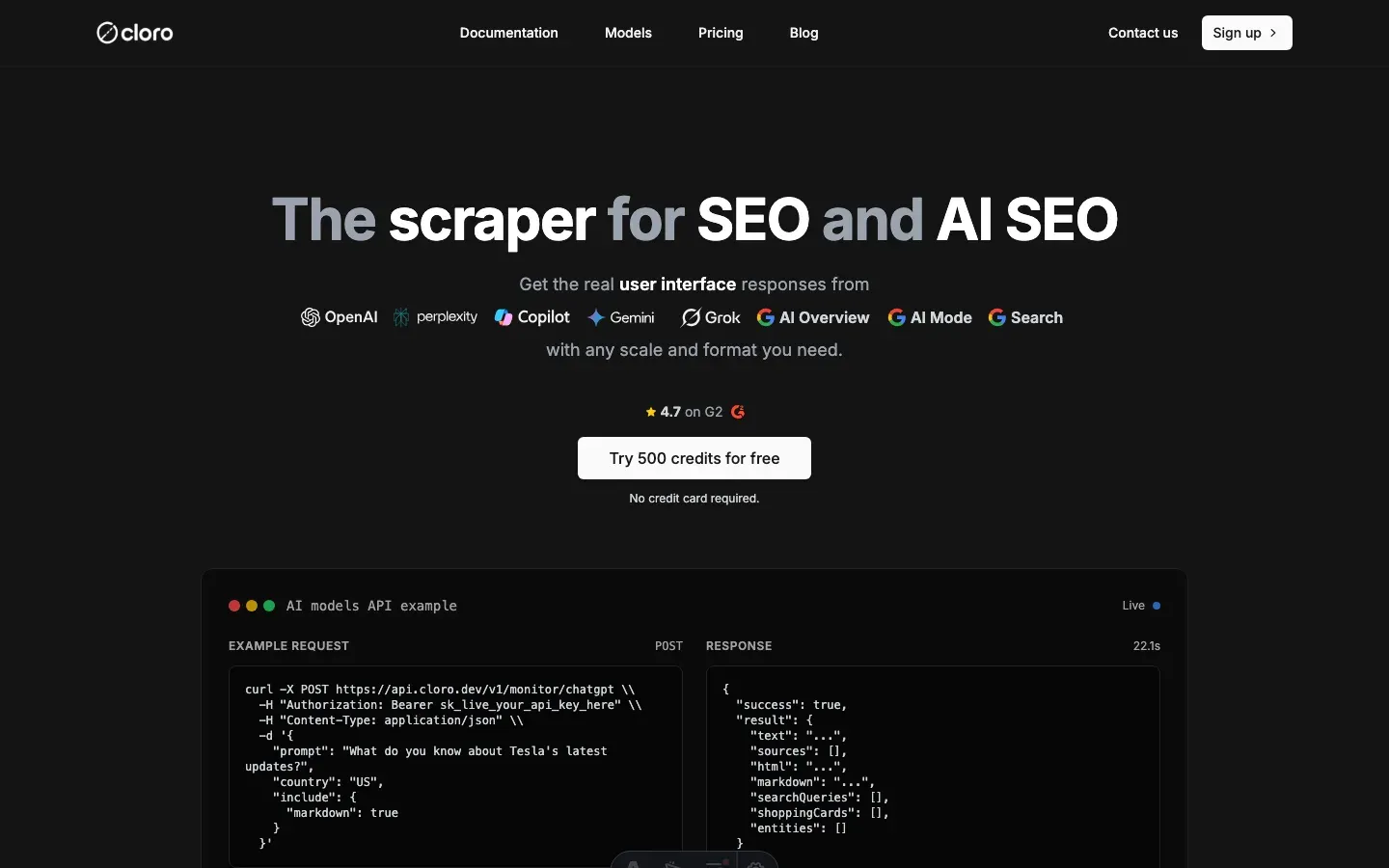
Best for: SEO, AI search and brand-monitoring teams that need parsed JSON for Google SERP plus AI Overview, AI Mode, ChatGPT, Perplexity, Gemini and Copilot through one API.
One endpoint family returns structured search results as typed JSON for Google Search (with AI Overview and AI Mode), ChatGPT Search, Perplexity, Copilot, Gemini and Grok, each response carrying the cited source URLs that surface used. Tracking rank without tracking AI citation captures half the modern SERP, which is what makes cloro one of the best SERP APIs for AI-native work in 2026.
- Strengths: AI Overview parsed by default (full source list, citation positions, videos, injected ads); full SERP envelope with ads, PAA and related searches; city-level geo via
locationor pre-encodeduule, so rank checks match what a searcher in that city actually sees; async webhooks over a credit pool shared across every surface, so you size one budget instead of one per surface. - Limitations: plans are monthly rather than pay-as-you-go, so spiky or very low-volume workloads may be cheaper metered elsewhere, and it is a newer product in procurement. cloro does not scrape Bing; for Bing SERP data, SerpApi or DataForSEO fit better.
- Pricing: a free tier of 500 credits/month, then Lite $30/month (37,500 credits), Hobby $100/month (250,000), Growth $500/month (1,350,000). Google Search costs 3 credits per call (n=10) or 23 credits (n=100 with AIO), so the effective rate falls from $0.80 per 1,000 credits on Lite to $0.37 on Growth, reaching about $0.31 on the largest self-serve tiers.
Quick integration guide: the google-search-scraper README walks through Python, cURL, and Node.js requests for organic results, PAA, related searches, and AI Overview.
Tier 2: Established multi-engine SERP APIs
2. SerpApi — best breadth of search-engine coverage
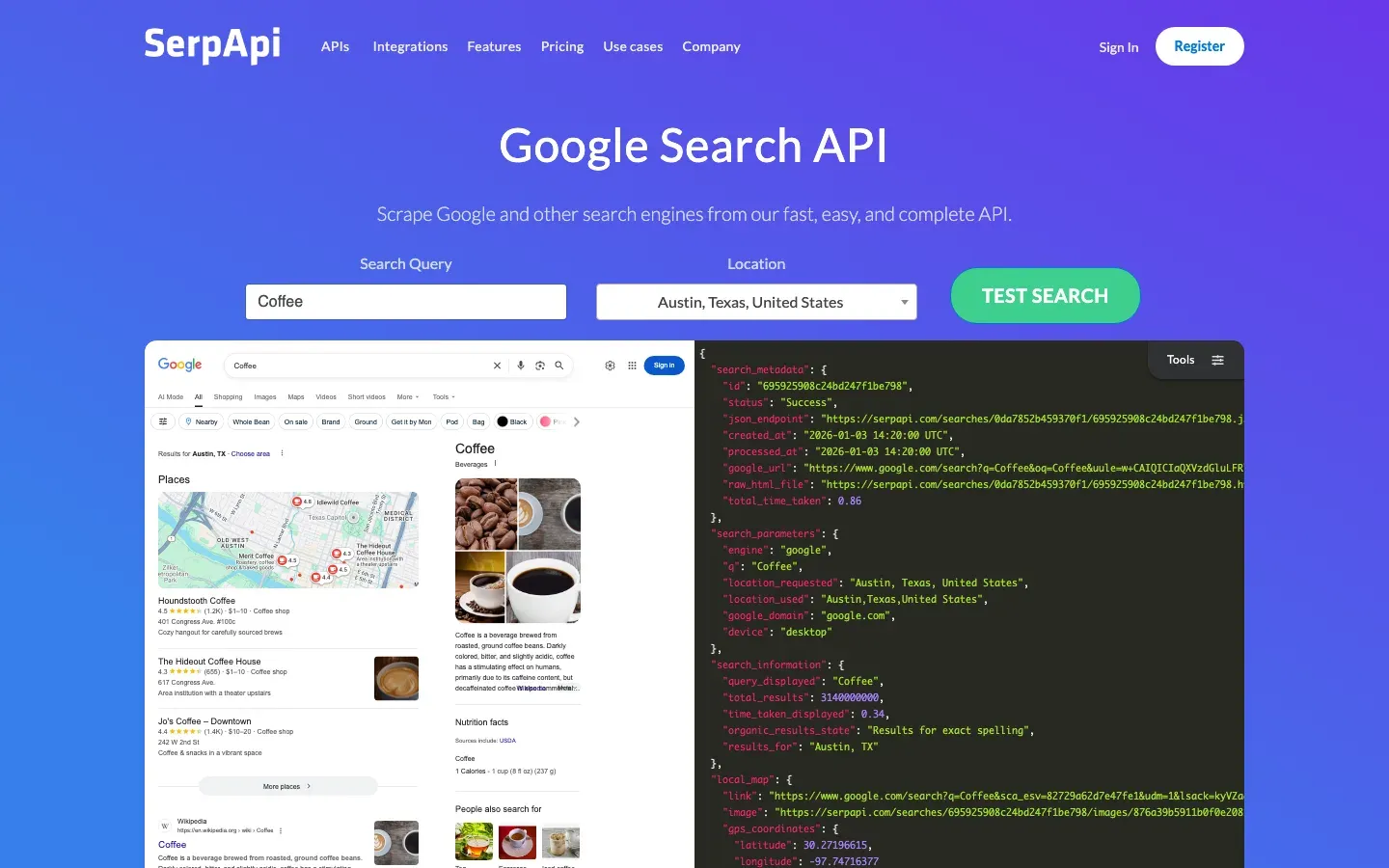
Best for: developers who need parsed JSON across the widest set of engines under one API.
SerpApi is among the best SERP APIs for raw engine breadth, covering a long tail of vertical and regional engines at the same parsing depth. Documentation is the category gold standard and the platform ships selector fixes within hours of Google UI changes.
- Strengths: 80+ engines including Google, Maps, Images, Jobs, Shopping, News, Scholar, Bing, Baidu, Yandex, eBay, YouTube, Amazon and Naver; AI Overview parsing with cited sources; strong client libraries; archive access to historical SERP snapshots, so you can show how a page looked on a past date; a published 99.95% SLA on every plan, with service credits up to 100% of the monthly fee.
- Limitations: highest per-call rate at entry ($15/1k effective), and per apiserpent’s 2026 benchmark roughly $7,000 at 1M searches/month, where DataForSEO Live lists $2,000. No ChatGPT Search or Perplexity endpoints. See our SerpApi alternatives breakdown.
- Pricing: Starter $25/month (1,000 searches), Developer $75/month (5,000), Production $150/month (15,000), Big Data $275/month (30,000, ~$9.17/1k). Free tier of 250 searches/month.
3. Serpent API — cheapest published per-call rate across five engines
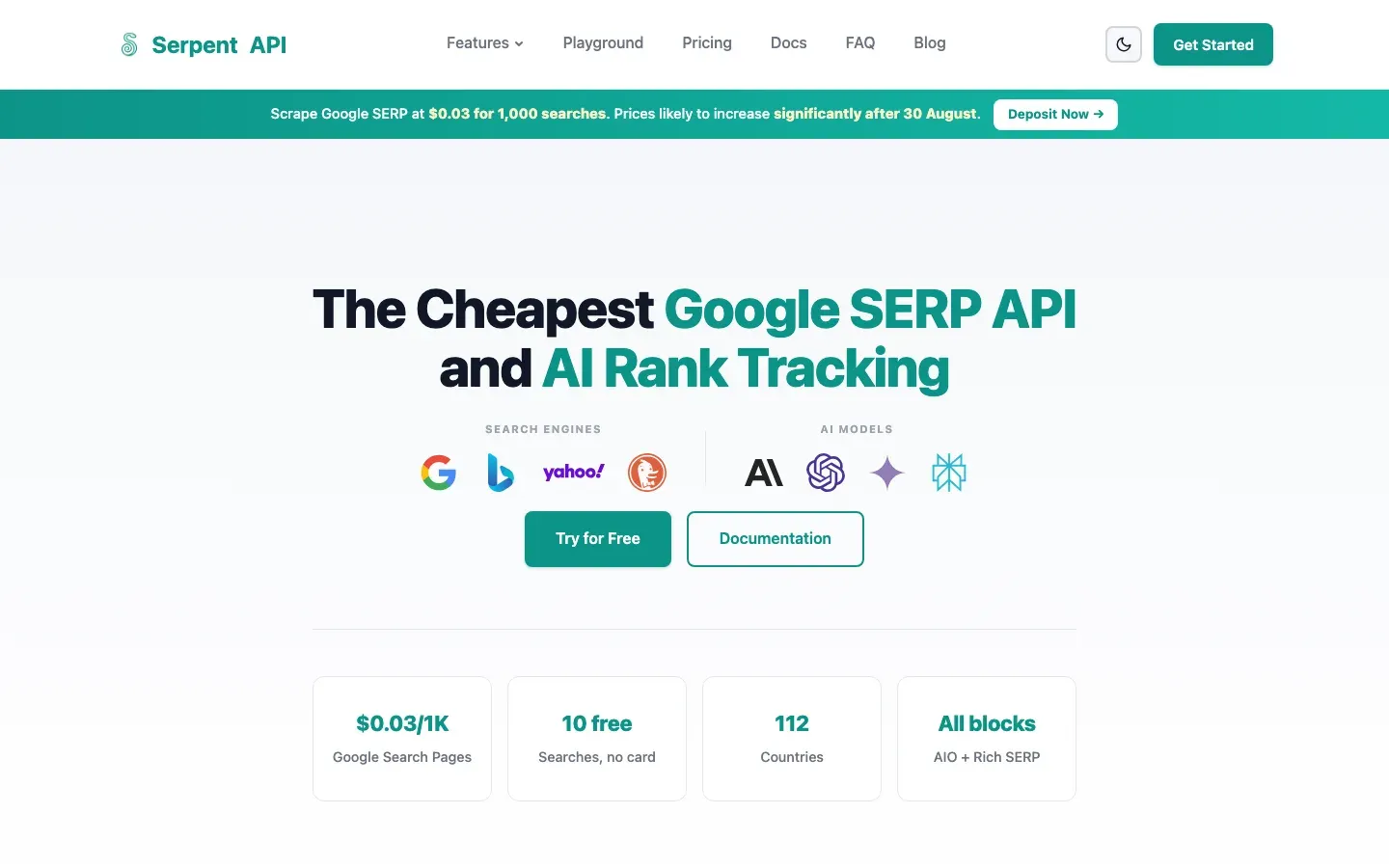
Best for: high-volume teams that want AI Overview and rich SERP parsing at the lowest published per-call rate, and can pre-fund an account to unlock it.
Serpent API sells one flat rate across five engines and returns the AI Overview block in the base response instead of charging a surcharge for it, which is rare below $1 per 1,000.
- Strengths: Google, Bing, Yahoo, DuckDuckGo and Brave under one key with the engine chosen per request; AI Overviews, featured snippets, People Also Ask, ads, shopping and related searches in the base response; Deep Search bills a single request for up to 10 pages (roughly 100 results), so depth does not multiply cost the way per-page billing does; 112 countries; server-error requests refunded automatically; a beta
pixel_positionflag that returns pixel geometry for every SERP element. - Limitations: the headline rate is deposit-gated, so $0.03/1k needs a one-time $500 deposit and $0.06/1k a $100 one, against $0.60/1k at default; the free tier is 10 calls rather than a recurring monthly allowance; AI coverage is citation tracking across ChatGPT, Claude, Gemini and Perplexity, which answers who got cited rather than returning the model’s parsed answer, so it is not a substitute for an AI-surface endpoint; no MCP server and no native SDKs, only cURL, Python and Node examples in the docs.
- Pricing: $0.60/1k web requests at default, $0.06/1k at Growth (one-time $100 deposit), $0.03/1k at Scale (one-time $500 deposit). AI Ranking runs $20/1k queries per model at default, falling to $1/1k at Scale. 10 free calls, no card. Their pricing page warns rates are likely to rise after 30 August 2026.
4. DataForSEO — best for bulk SERP alongside keyword and backlink data
Best for: teams that need low per-call cost at scale and want SERP data alongside backlinks and keyword research from one vendor.
DataForSEO is one of the best SERP APIs for bulk collection, though SERP-only consumers pay for the platform breadth in integration overhead.
- Strengths: a $2/1k Live rate after the September 2025 price cut (~80% reduction); 60+ endpoints covering SERP, Keywords, Backlinks, On-Page and Business Data; async task model that scales well for large keyword batches.
- Limitations: depth bills per 10-result page, so n=100 costs 10x the base rate; 60+ endpoints with varying auth and rate limits carry real integration overhead; AI Overview enrichment doubles first-page cost. See our DataForSEO alternatives breakdown.
- Pricing: $2.00/1k Live. AIO adds $2/1k per call; n=100 is $20.00/1k, or $22.00/1k with AIO.
5. ScrapeBadger — best no-commitment pay-as-you-go across engines and AI surfaces
Best for: teams pulling several search engines and AI platforms without committing to a monthly plan, and anyone whose volume is too spiky to size a subscription against.
ScrapeBadger returns structured JSON from six engines — Google, Bing, Yahoo, Baidu, DuckDuckGo and Yandex — with Google split across Search, Images, Shopping, News, Scholar, Trends, Maps, Flights and Jobs. ChatGPT, Perplexity, Gemini and Google AI Mode come off the same key. It is a general web scraping API underneath, so the search endpoints inherit the platform’s anti-bot bypass and JavaScript rendering rather than being a purpose-built SERP product, which cuts both ways depending on what else you scrape.
- Strengths: six engines and the widest Google surface list here on one key; AI Overview returned as structured text with source URLs; an official hosted MCP server for Claude, Cursor and other clients; no monthly minimum, which no other entry in this tier offers.
- Limitations: location targeting is coarser than city-level
locationoruule, so precise local rank tracking fits cloro or DataForSEO better. No Copilot or Grok coverage. Plan pricing sits behind signup rather than on the pricing page, so the metered rate is the only figure you can check before creating an account. - Pricing: 1,000 free credits, no card, then pay as you go at $0.15 per 1,000 credits with a $10 minimum top-up. A Google search is about 3 credits plus 0.1 per returned result, an AI Overview 1 credit, and AI Mode 7. Monthly plans run Starter $49, Growth $129, Pro $299 and Scale $699, cutting the effective rate by up to 64% against pay-as-you-go on the larger tiers.
6. SearchApi — best mid-tier multi-engine + AI search
Best for: teams that want broader coverage than Serper, lower cost than SerpApi, and native ChatGPT Search and Perplexity in the same API.
SearchApi is one of the best SERP APIs at mid-tier pricing, sitting between Serper and SerpApi on cost and between SerpApi and cloro on AI-surface coverage.
- Strengths: Google, Bing and YouTube native endpoints plus ChatGPT Search and Perplexity parsed responses, one of the few at this tier; AI Overview parsing included; a cleaner API than DataForSEO.
- Limitations: narrower engine catalog than SerpApi (no Baidu, Yandex or Naver), a less established procurement profile, and bundle pricing that creates launch-spike friction. See our SearchApi alternatives breakdown.
- Pricing: from $40/month for 10,000 searches; Production $100/month for 35,000 ($2.86/1k effective), around $2.50–$3 per 1,000 at production scale per the searchcans index.
7. Serper — best lightweight Google SERP
Best for: developers building lightweight tools or agents that need fast Google results at the lowest credible entry price.
- Strengths: fast Google Search, Images and News JSON with sub-200ms median response at scale; a genuinely generous 2,500-search free tier; clean single-purpose API design. Prepaid credit packs run from $50 (50,000 credits, $1/1k) down to $0.30/1k on the largest pack, which keeps it among the cheapest in the credible-quality tier.
- Limitations: narrower vertical coverage than SerpApi or DataForSEO (no Jobs, Shopping or Maps), more limited AI Overview and dynamic-element parsing, and a smaller ecosystem. See our Serper alternatives breakdown.
- Pricing: free tier of 2,500 searches; paid plans from $50/month.
Also considered: two that missed the main lineup
Both sit in the tables above. Each is here with the one reason it misses the top tier.
One is capable but narrower than the top seven. Scrapingdog parses AI Overviews from $40/month, rare at that price, across Search, Maps and Images on one key, but its PAA, related-search and ad parsing is less mature, it has no ChatGPT or Perplexity coverage, and it stays Google-centric.
One is a different product category. CatchAll is built for recall rather than rank: wide result sets across the open web, structured enrichment, event extraction and real-time monitoring. It will not track your Google position, and it is slower than a plain search call because coverage-first means more latency. It belongs in a RAG or research pipeline that needs broader source coverage than Google’s index alone, not in a rank-tracking stack.
How much does a SERP API really cost per 1,000 calls?
Headline pricing is misleading. Real cost turns on depth (n=10 vs n=100), AI Overview enrichment and bundle vs per-call billing. AIO usually carries a surcharge: DataForSEO doubles the first-page price with it enabled, SerpApi includes it, cloro adds 2 credits. Depth compounds, since every extra 10-result page costs 75–100% of the base.
The table assumes mid-tier volume (~30,000 searches/month). The free-tier column is what you can evaluate with before paying:
| API | Free tier | n=10 | n=10 + AIO | n=100 | n=100 + AIO |
|---|---|---|---|---|---|
| cloro (Hobby, $0.40 per 1k credits) | 500 credits/mo, recurring | $1.20/1k | $2.00/1k | $8.40/1k | $9.20/1k |
| cloro (Growth, $0.37 per 1k credits) | same pool | $1.11/1k | $1.85/1k | $7.78/1k | $8.52/1k |
| DataForSEO (Live) | trial credit on signup | $2.00/1k | $4.00/1k | $20.00/1k | $22.00/1k |
| SerpApi (Big Data tier) | 250 searches/mo | $9.17/1k | $9.17/1k | $91.70/1k | $91.70/1k |
| SearchApi (Production tier) | 100 requests | $2.86/1k | $2.86/1k | varies | varies |
| Serper | 2,500 queries, one-time | $0.30–$1/1k | partial AIO | $0.60–$2/1k | n/a |
| Scrapingdog | 200 credits, no card | $40/mo entry | ✅ included | scales with plan | ✅ included |
| ScrapeBadger (pay as you go) | 1,000 credits, no card | ~$0.60/1k | ~$0.75/1k | ~$1.95/1k | ~$2.10/1k |
| Serpent API (Default tier) | 10 calls, no card | $0.60/1k | ✅ included | $0.60/1k (Deep Search bills one request for up to 10 pages) | ✅ included |
The ranking inverts with depth. At n=10 without AIO, Serpent API is cheapest at $0.60/1k, ScrapeBadger sits about there on its published credit math, and Serper is close at $1/1k entry, falling to $0.30/1k only on the largest prepaid pack. Serpent is the outlier at depth: one Deep Search request bills once and returns up to 10 pages, so its n=100 rate does not climb the way per-page billing does. That figure is its own published claim rather than a benchmarked result, and the rate is deposit-gated below $0.60/1k. At n=100 with AIO, cloro Growth runs $8.52/1k against $22.00/1k for DataForSEO Live and $91.70/1k for SerpApi, because both bill each batch of 10 results as a separate SERP. ScrapeBadger again looks an order of magnitude cheaper at that depth, but those figures are arithmetic on a published credit table (3 credits base plus 0.1 per returned item, at $0.15 per 1,000 credits) rather than a benchmark, and its AI Mode endpoint bills 7 credits against 1 for an AI Overview. For the price-only analysis with hidden-fee adjustments, see our Cheapest SERP API 2026 breakdown.
Which SERP APIs ship an MCP server?
For an agent, MCP support decides whether the API is a native tool or an integration project: the server lets Claude, Cursor and other clients call it directly, with auth and tool schemas handled. As of August 2026, six of the nine ship an official server, so the real differences are hosted vs self-run and which endpoints are exposed.
| Tool | MCP server | Notes |
|---|---|---|
| cloro | ✅ Official, hosted | cloro.dev/docs/mcp, covering the same surfaces as the API |
| SerpApi | ✅ Official, hosted | mcp.serpapi.com, unified multi-engine search tool |
| DataForSEO | ✅ Official, open source | TypeScript server over selected endpoints |
| SearchApi | ✅ Official, hosted | Remote server with OAuth connect flow |
| Serper | Community only | Several third-party servers; none published by Serper |
| Scrapingdog | None found | No official or notable community server as of August 2026 |
| ScrapeBadger | ✅ Official, hosted | mcp.scrapebadger.com, add as a connector and query in natural language |
| Serpent API | None found | REST only; no official or community server as of August 2026 |
| CatchAll | ✅ Official, hosted | Hosted endpoint documented by NewsCatcher |
A hosted server with the full SERP surface behind it (cloro, SerpApi) is agent-ready today; a self-run open-source server trades setup time for control; community-only coverage means you own the maintenance when the vendor’s API changes.
Who are the main SERP API providers in 2026?
The main SERP API providers in 2026 are cloro, SerpApi, DataForSEO, Bright Data, Serper, ScraperAPI, and ScrapingBee, with Apify and Zenserp in narrower niches. The field splits by what you optimize for: AI-surface coverage (cloro), engine breadth (SerpApi, DataForSEO), proxy scale (Bright Data), or entry price (Serper). Each is compared in detail above.

About the author
Ricardo Batista
Founder, cloro
Ricardo is one of the founders and engineers behind its SERP and AI-search scraping infrastructure. Before cloro he scaled a financial comparison site to $7M ARR and ran the full-country operations of a unicorn to $65M ARR, then went back to building. He writes about search engine scraping, generative-engine optimization, and turning live search and AI-answer data into something teams can act on.
Frequently asked questions
What is a SERP API?
A SERP API is a service that scrapes search engine results pages (Google, Bing, and increasingly ChatGPT Search and Perplexity) and returns the data as structured JSON — organic results, sponsored ads, AI Overview content with citations, People Also Ask, related searches, and rich-result blocks. Compared to running your own headless-browser scraper, a SERP API handles the proxy network, CAPTCHA solving, layout-change maintenance, and AI Overview parsing as a managed service.
What is the difference between a SERP API and a proxy network?
A structured SERP API returns parsed JSON — organic results, ads, AI Overview with citations — so your pipeline consumes fields, not HTML. A proxy network (Bright Data) sells access: it returns raw HTML or near-raw results over a rotating IP pool, and you build and maintain the parser. Proxy vendors now bolt a SERP endpoint onto that infrastructure, but the number that matters is total delivered cost — the per-1,000 rate plus the engineering to turn raw access into parsed rows. A $0.25/1k proxy that needs a parser you maintain is not cheaper than a $2/1k API that returns structured JSON in real time.
Why is the Google Custom Search JSON API being deprecated?
Google has closed the Custom Search JSON API to new customers as of 2025. Existing customers have until January 1, 2027 to migrate. The API was always a curated subset of Google's index — no ads, no AI Overview, no People Also Ask, capped at 10 results per request and 10,000 paid queries per day. Teams that built on it now need a real SERP API as their migration path. Our Custom Search API shutdown guide covers the official replacements, why both are site-restricted, and the field-level move to a SERP API.
Do SERP APIs support AI Overviews?
The modern tier supports AI Overview parsing natively — cloro, SerpApi, DataForSEO and SearchApi all return parsed AI Overview content with citations and source URLs as structured fields. Coverage depth varies: cloro and SerpApi return the full source list with citation positions; some providers return text-only summaries. Budget-tier APIs (basic Serper, older rank-tracking endpoints) often skip AI Overview entirely or return it as raw HTML.
Do SERP APIs track ChatGPT Search and Perplexity?
A growing subset does. cloro and SearchApi return parsed responses for ChatGPT Search, Perplexity, Gemini, Copilot, and Grok through the same API surface as Google. SerpApi, DataForSEO, and Serper remain Google-and-Bing-focused as of mid-2026. Cross-surface coverage matters more in 2026 than it did in 2024 because AI-mediated search now drives a meaningful share of buyer-research traffic.
Why is rendering important for a SERP API?
Google's SERP is now JavaScript-heavy. AI Overviews, People Also Ask expansions, sponsored ad sitelinks, shopping carousels, and related searches all render after the initial page load. A SERP API that does static HTML parsing misses 30-60% of the page content depending on query class. Browser-based rendering (or carefully reverse-engineered API calls that replicate the same payloads) is now table stakes for any provider claiming to return the full SERP.
Is using a SERP API legal?
No court has ruled that scraping public search results pages is unlawful, but the question is now actively being tested: Google sued SerpApi on December 19, 2025, alleging circumvention of its anti-bot protections under DMCA Section 1201, and SerpApi moved to dismiss in February 2026, arguing it accesses only what any signed-out user can see. The case is unresolved as of August 2026 and its outcome matters for every scraper-model SERP API, since they all return data from Google's results pages rather than an official feed. Vendor posture varies: SerpApi bundles a Legal US Shield indemnification on paid plans, while official alternatives are disappearing (Bing Search APIs retired August 2025, Custom Search sunsets January 2027). Our web scraping legality guide covers the broader case law.
Which SERP APIs have a free tier?
Four of the tools here let you test without a card. cloro gives 500 credits a month, refreshed monthly, which is roughly 166 Google calls at n=10 or 21 at n=100 with AI Overview. ScrapeBadger gives 1,000 credits once. Serper gives 2,500 credits once. SerpApi gives 250 searches a month, capped at 50 an hour. Read those numbers as evaluation budget rather than as a plan: 250 searches covers a day of a rank-tracking pilot, not a month of one. DataForSEO and SearchApi start paid.
Do SERP APIs offer MCP servers?
Most now do. As of August 2026, cloro, SerpApi, DataForSEO, SearchApi, ScrapeBadger and NewsCatcher all ship official MCP (Model Context Protocol) servers, letting agents in Claude, Cursor, and other MCP clients call the SERP API as a native tool without custom integration code. Serper is covered by community-built servers only. The differences worth checking are whether the server is hosted or self-run, and which endpoints it actually exposes: some cover the full SERP surface while others wrap a single search tool.
How did Google's n=100 deprecation affect SERP APIs?
Google quietly removed the &num=100 parameter on September 11, 2025, forcing every SERP API to paginate 10 results at a time instead of 100. Per Locomotive Agency and Optimizely's coverage, infrastructure costs increased roughly 10× overnight at top-100 depth. The change also dramatically dropped GSC impression counts between September 10-12 as bot-driven impressions from rank trackers vanished from reporting. Pricing tiers across the SERP-API category have been adjusted to reflect the new economics.
Related reading
How to Track SERP Features in 2026 (Free + API Methods)
How to track SERP features in 2026 — the seven that move traffic, the free ways to start monitoring today, and the API method that scales to millions of keywords.
Cheapest SERP API 2026: True Cost-per-Call Compared
The cheapest SERP API in 2026, ranked by true cost-per-call. Compare cloro, DataForSEO, Serper, and SerpApi, plus the hidden fees that flip rankings.
Best Google Scraper 2026: 10 Tested Across 5 Verticals
Benchmark of 10 Google scrapers across SERP, Maps, Jobs, Images, Business Profile. Real cost per call, AI Overview depth, vs SerpApi + Bright Data.