
ChatGPT Grounding Frequency Study: Web Search Runs in 80%+ of Prompts

On this page
Conventional wisdom says ChatGPT includes web search results in only 20-40% of queries. After testing 5,200 queries across 52 countries, we found that number is wrong.
This ChatGPT grounding frequency study measures how often the model actually reaches for the live web when it answers a real question. ChatGPT uses grounding (linking to sources and citations via web search) in 80.5% of successful responses when queried from independent, non-rate-limited sessions.
Key findings at a glance
The table below summarizes the headline numbers from the ChatGPT grounding frequency study before we walk through the methodology and the country-by-country breakdown.
| Metric | Value |
|---|---|
| Total queries tested | 5,200 (100 prompts × 52 countries) |
| Test window | Q4 2025 (mid-November through December) |
| Successful responses | 5,042 (97% success rate) |
| Web search / grounding rate | 80.5% |
| Average citations per grounded response | 31 sources |
| Highest national rate | Ukraine (92%) |
| Lowest national rate | Serbia (46%) |
| U.S. rate | 64% (below global average) |
The finding matters because the dominant assumption in the SEO community — that ChatGPT grounds on a minority of queries — produces conservative AI SEO strategies that under-invest in citation optimization. If ChatGPT actually grounds 4 out of 5 responses in production, the surface area for being cited is roughly 2-4× larger than most teams plan for.
This has real implications for businesses investing in AI SEO and Generative Engine Optimization. Per Conductor’s 2026 AEO/GEO Benchmarks — 13,770 enterprise domains, 3.3B sessions — ChatGPT now drives 87.4% of all AI referral traffic to websites, and OpenAI reports 900M weekly active users as of February 2026. The volume of queries where citation behavior matters has approximately doubled in the year since most prior grounding-frequency studies were published.
The grounding problem
Grounding is how ChatGPT verifies information. When web search is enabled in a conversation, ChatGPT runs searches and includes citations to the sources it used to generate the response.
Why this matters for businesses:
- Traffic driver. Citations generate clicks to cited websites.
- Authority signal. Being cited establishes domain authority.
- Competitive intelligence. Knowing who gets cited reveals positioning.
- SEO strategy. If you’re not being cited, you’re invisible in AI search.
There’s been a lot of confusion about how often ChatGPT actually uses web search in organic use.
The common belief: SEO practitioners report seeing web search results in only 20-40% of responses, and conclude that ChatGPT doesn’t force grounding when it doesn’t know the answer.
What we found: those observations are biased by rate-limiting, not by ChatGPT’s organic behavior. When ChatGPT runs without restrictions, it uses web search and grounding at much higher rates.
Why existing studies are flawed
Most studies of ChatGPT’s web search behavior have flaws that systematically underestimate its frequency. We’ve reviewed the methodology behind the commonly cited “20-40% grounding rate” figure — including SEO industry estimates, academic surveys, and SaaS-vendor benchmarks — and the same five errors recur:
- Sequential testing from a single account. Researchers fire 100+ prompts from one logged-in account, which triggers OpenAI’s pattern-detection systems. Within the first 5-15 sequential queries, web search starts dropping.
- Low-quality proxies. Cheap datacenter IPs are aggressively flagged by OpenAI’s bot defenses. Per Cloudflare’s 2026 bot detection documentation, datacenter IP ranges are scored differently from residential and mobile IPs at the WAF layer — and OpenAI uses Cloudflare aggressively.
- Altered browsers. Headless or automation-flagged browsers (
navigator.webdriver=true, modified user-agent strings, missing browser features) trigger anti-bot challenges. Per Scrapfly’s 2026 Cloudflare bypass analysis, TLS JA4 fingerprinting catches most automation libraries by default. - OpenAI’s response: web search is silently disabled. Once a session is flagged, the model still responds but stops grounding. The researcher sees text without citations and concludes “no grounding.”
- Researchers conclude “ChatGPT rarely uses web search.” The published frequency is rate-limited behavior, not organic behavior.
These studies measure throttled behavior, not the organic baseline. Our methodology controls for all five.
Prior public estimates
For context, here is how the published-but-likely-rate-limited estimates compare to our finding:
| Source | Reported grounding rate | Sampling approach |
|---|---|---|
| Common SEO-community estimates | 20–40% | Sequential testing from a single account/IP |
| Various vendor demos | 35–50% | Sampled subsets, often with browser automation |
| Academic surveys (2024–2025) | 25–45% | Lab settings, limited geography |
| ConvertMate analysis of 10,000 domains | Roughly 40% (ChatGPT answers 60% from training without web search per their published research) | Domain-level inference, not direct UI measurement |
| This study (5,200 queries × 52 countries, residential infra) | 80.5% | Independent sessions, residential IPs, clean fingerprints |
The gap isn’t disagreement about what ChatGPT does. It’s disagreement about whose ChatGPT — the rate-limited researcher’s, or the unflagged user’s. We argue the unflagged baseline is the right number for SEO planning.
Our independent testing methodology
The design goal for the ChatGPT grounding frequency study was simple: measure the model’s organic behavior, not the throttled behavior a flagged researcher sees. To remove rate-limiting bias, we built infrastructure where every query runs from an independent session using high-quality proxies and organic browser fingerprints.
Each query runs in a fresh browser instance with:
- No shared state (no cookies, cache, or auth carried between requests)
- Residential IPs in the target country
- Natural browser fingerprints that evade detection
- Varied prompts and realistic timing
This mirrors how real users hit ChatGPT: individual queries from independent contexts with legitimate infrastructure.
Test scope
Total queries: 5,200 (100 prompts × 52 countries)
Countries tested (52):
United Arab Emirates (AE)
Argentina (AR)
Austria (AT)
Australia (AU)
Azerbaijan (AZ)
Bangladesh (BD)
Belgium (BE)
Brazil (BR)
Canada (CA)
Czech Republic (CZ)
Germany (DE)
Denmark (DK)
Egypt (EG)
Spain (ES)
Finland (FI)
France (FR)
United Kingdom (GB)
Greece (GR)
Croatia (HR)
Hungary (HU)
Indonesia (ID)
Ireland (IE)
Israel (IL)
India (IN)
Italy (IT)
Japan (JP)
South Korea (KR)
Kazakhstan (KZ)
Morocco (MA)
Mexico (MX)
Malaysia (MY)
Nigeria (NG)
Netherlands (NL)
Norway (NO)
New Zealand (NZ)
Peru (PE)
Philippines (PH)
Pakistan (PK)
Poland (PL)
Portugal (PT)
Romania (RO)
Serbia (RS)
Saudi Arabia (SA)
Sweden (SE)
Singapore (SG)
Slovenia (SI)
Slovakia (SK)
Thailand (TH)
Turkey (TR)
Taiwan (TW)
Ukraine (UA)
United States (US)
Prompt categories (100 total):
- E-commerce. Product comparisons, shopping recommendations, best-in-class queries.
- Health and wellness. Nutritional information, diet compatibility, wellness products.
- Technology. Software comparisons, AI platforms, optimization tools.
- Legal and compliance. GDPR requirements, certification standards, data privacy.
- Consumer services. Travel preparation, insurance decisions, financial services.
- Social media management. Account cleanup tools, automation features, compliance.
Example prompts:
What is the best laundry detergent for hard water?Is getting TSA PreCheck worth it?Is cream of wheat keto friendly?¿El seguro de auto cubre pérdida total?(Does car insurance cover total loss?)Best AI platforms for visibilityMost popular answer engine optimization toolsWhich twitter cleanup tool supports GDPR requests?For GDPR compliance, I need to purge DMs and unfollow everyone older than 30 days
Overall results: the 80.5% finding
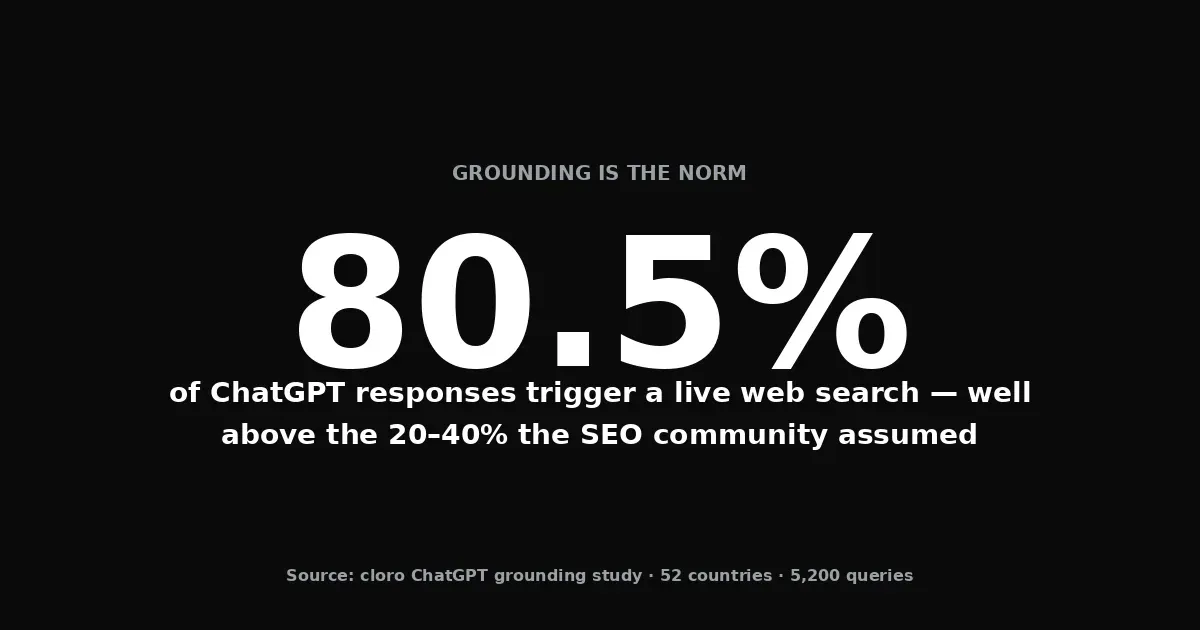
Across the full ChatGPT grounding frequency study, ChatGPT used grounding via web search in 80.5% of all responses across 52 countries and 100 prompts when operating in an unrestricted state.
How often does ChatGPT trigger a web search?
The short answer from the ChatGPT grounding frequency study is: about four times out of five. Once a session runs on clean residential infrastructure, web search stops being an occasional feature and becomes the default path for answering commercial, health, technology, legal, and consumer-services questions. The 19.5% of responses that stayed ungrounded skewed toward prompts with strong cached priors — well-known facts, definitional questions, and queries the model has effectively memorized. In practice, if a prompt has any commercial or time-sensitive angle, you should expect grounding rather than hope for it.
Overall statistics:
| Metric | Count | Percentage |
|---|---|---|
| Total queries | 5,200 | 100% |
| Successful responses | 5,042 | 97% |
| Responses with web search | 4,191 | 80.5% |
| Responses without web search | 1,009 | 19.5% |
Average sources per response (when sources present): 31 citations.
That’s well above the 20-40% commonly reported in the SEO community.
Sources count distribution
When ChatGPT does include sources, it rarely stops at one. Typical distribution:
- Most common: 15-25 sources per response.
- Complex queries: 40-80 sources.
- Straightforward questions: 9-14 sources.
ChatGPT’s default leans toward over-citing, with extensive attribution attached to most answers.
Implications for SEO
If 80.5% of responses include web search citations, the surface area for being featured in ChatGPT responses is large — and growing.
The math is sobering:
- A category receives 1M queries daily via ChatGPT.
- 805,000 of those responses include grounded sources.
- If you’re one of the ~31 cited sources on average (per our measurement), that’s roughly 25,000-80,000 potential citations.
- ChatGPT mentions brands far more often than it provides clickable links per Conductor’s enterprise benchmarks, but the citation surface still drives meaningful brand-recognition lift even when the click rate is modest.
This is why GEO (Generative Engine Optimization) is now a distinct discipline from classic SEO. And per Frase’s measured study, FAQPage schema makes a page 3.2× more likely to be cited inside Google AI Overviews — a comparable structural signal likely applies to ChatGPT’s source-selection too.
There’s also a measurement-adoption gap. Per a Globe Newswire industry report, only 14% of marketers currently track AI-search citations — even though 89% of brands already appear in AI-generated answers. Teams that build the tracking layer first have a measurable head start on optimization.
Results by country
One of the clearest patterns in the ChatGPT grounding frequency study is geographic: grounding rates vary by country, from 46% to 92%.
Top performing countries
Ukraine leads at 92%, with nearly all responses including sources:
| Country | Grounding Rate |
|---|---|
| Ukraine | 92% |
| United Arab Emirates | 91% |
| Turkey | 91% |
| Austria | 90% |
| Italy | 90% |
| Netherlands | 90% |
| Poland | 90% |
| Sweden | 90% |
High performers (85-89%):
- Australia, Great Britain, Indonesia, Mexico, Taiwan: 89%
- Argentina, Bangladesh, Belgium, Brazil, Germany, Spain, Croatia: 88%
- Egypt, Malaysia, Philippines, Singapore: 87-88%
United States performance
The US showed a 64% web search and grounding rate, below the global average but still well above the commonly reported figures.
| Country | Grounding Rate |
|---|---|
| United States | 64% |
The lower rate may reflect AI maturity. Higher ChatGPT adoption probably means more cached results and knowledge.
Lower performing countries
Canada, India, and Serbia showed reduced web search rates:
| Country | Grounding Rate |
|---|---|
| Serbia | 46% |
| India | 50% |
| Canada | 53% |
Geographic patterns
Europe runs high (85-90% in most countries). Asia-Pacific varies widely (70-89%). The US sits below average at 64%. Latin America and the Middle East also perform well (70-91%).
The U.S.-specific drop has a plausible mechanism. Higher ChatGPT adoption per user (the U.S. is OpenAI’s largest market by usage) means OpenAI has more cached training data and prior conversational context for U.S.-origin queries, which can substitute for web search on a meaningful share of prompts. The reverse holds for countries with less training-data density: more prompts trigger web search because the model has weaker priors.
Study limitations and caveats
A study is only as useful as its disclosed limitations, and the ChatGPT grounding frequency study is no exception. Ours:
- Single-vendor measurement. All measurements ran through cloro’s infrastructure. Studies run with different proxy providers or different stealth implementations may produce different numbers; the 80.5% figure should be read as the organic baseline our measurement layer observes, not as a universal constant.
- Q4 2025 sampling window. OpenAI ships product changes frequently. The grounding rate measured in November–December 2025 may differ from the rate in May 2026 or later. Per OpenAI’s public disclosures, ChatGPT user volume nearly doubled (400M to 800M weekly users) over the year — model behavior may have shifted with that scale.
- Prompt-set selection bias. Our 100-prompt set leans toward commercial-investigation, health/wellness, technology, legal, and consumer-services queries — the categories most relevant to SEO and AI SEO work. Prompts in other categories (creative writing, code generation, math reasoning) likely ground less frequently because the answer doesn’t require web verification. We do not claim 80.5% is the rate across all prompts ChatGPT receives — we claim it’s the rate across SEO-relevant prompts.
- Language and locale variance. The bulk of our prompts were English-language with occasional Spanish (the
¿El seguro de auto cubre pérdida total?example). Country-level results are partially confounded with English-vs-local-language behavior; a deeper study would isolate language as a separate variable. - Web-search detection method. We classified responses as “grounded” if they contained at least one structured citation or source URL parsed from the rendered UI. Edge cases (responses that mention sources in-text without formal citations) are not counted as grounded in our methodology; teams reading our findings should treat this as a conservative floor rather than a complete count.
We chose to publish the methodology in enough detail that other researchers can replicate or extend it. The 80.5% figure is our best estimate of the organic baseline; it is not the final word.
What this means for your SEO strategy
The practical payoff of the ChatGPT grounding frequency study is a recalibrated baseline: an 80.5% grounding rate changes how to approach AI search optimization.
How to check whether ChatGPT used web search on your query
You do not need our infrastructure to sanity-check the finding on prompts that matter to you. In the ChatGPT interface, a grounded answer renders inline source citations and a “Sources” or link list beneath the response; an ungrounded answer returns prose with no clickable references. Run a handful of your own commercial queries from a clean browser session and count how many surface citations — most teams are surprised to see the same four-out-of-five pattern the ChatGPT grounding frequency study reports. For systematic tracking rather than spot checks, a monitoring layer that logs citations at scale removes the guesswork.
1. Web search and grounding are the norm, not the exception
Old thinking: “ChatGPT rarely uses web search, so being cited is lucky.”
What cloro measured: 4 out of 5 responses include web search citations. Being cited is the expected outcome.
If 80.5% of responses include sources, not being cited is the exception. This is ChatGPT’s organic behavior when rate-limiting isn’t in the way. So:
- Your competitors are likely being cited regularly.
- Your absence from citations is noticeable.
- GEO strategies need to be prioritized.
2. Geographic targeting matters
If you’re a US-based business, you face a double challenge:
- Lower overall grounding rate (64% vs. 80.5% global).
- A more competitive citation landscape.
Strategic implications:
- International businesses. Optimize for high-grounding countries first (Europe, Middle East).
- US businesses. You need stronger SEO for AI to compete for fewer citations.
- Global strategy. Target queries that perform across multiple countries.
3. Content optimization for citations
To be one of the ~31 sources ChatGPT typically includes:
Structure content for extraction:
- Use schema markup so ChatGPT can parse your content.
- Write guides that answer questions completely.
- Include clear headings, lists, and structured data.
- Publish original research and data.
Build authority signals:
- Get cited by authoritative sources in your niche.
- Build quality backlinks from high-DA sites.
- Create shareable research and infographics.
- Maintain an llms.txt file for AI crawlers.
4. Monitoring and iteration
Use ChatGPT visibility tracking to:
- Track when your brand is cited in responses
- Monitor competitor citation rates
- Identify queries where you should be cited but aren’t
- Measure the impact of optimization efforts
5. The new SEO hierarchy
Traditional SEO. Rank #1 in Google = win.
AI SEO. Be cited in ChatGPT responses = win.
You need both:
- Traditional rankings still matter (ChatGPT cites high-ranking pages).
- Ranking alone isn’t enough. You also need to be structured for AI extraction.
- Schema markup and GEO are now as important as keywords and backlinks.
Conclusion
The ChatGPT grounding frequency study, spanning 5,200 queries across 52 countries, points to one thing: ChatGPT uses web search far more often than the commonly cited 20-40%.
The 80.5% global grounding rate makes citations a core part of ChatGPT’s organic behavior, not an occasional add-on. Without rate-limiting in the way, ChatGPT runs web search and includes sources in 4 out of 5 responses.
Competition for inclusion will keep intensifying as more businesses catch on. Start by measuring your current ChatGPT visibility, optimize your content for AI crawling, and track your progress over time.
The ChatGPT grounding frequency study used cloro’s infrastructure and independent session testing to eliminate rate-limiting bias. For access to our ChatGPT endpoint, visit our page.

About the author
Ricardo Batista
Founder, cloro
Ricardo is one of the founders and engineers behind its SERP and AI-search scraping infrastructure. Before cloro he scaled a financial comparison site to $7M ARR and ran the full-country operations of a unicorn to $65M ARR, then went back to building. He writes about search engine scraping, generative-engine optimization, and turning live search and AI-answer data into something teams can act on.
Frequently asked questions
What is ChatGPT grounding?+
Grounding is when ChatGPT includes sources and citations in its responses to verify information. This connects AI-generated answers to real web content via web search.
How often does ChatGPT use web search?+
Our study found ChatGPT uses web search and grounding in 80.5% of responses across 52 countries, contrary to the common belief that it's used in only 20-40% of queries.
Does OpenAI rate-limit web search?+
Yes, OpenAI disables web search entirely when detecting unusual patterns, low-quality proxies, or altered browsers. Our study used high-quality residential infrastructure to eliminate this bias.
Which countries have the highest grounding rates?+
Ukraine (92%), UAE (91%), Turkey (91%), Austria (90%), Italy (90%), Netherlands (90%), Poland (90%), and Sweden (90%) had the highest rates.
Why does grounding matter for SEO?+
Grounding determines which websites ChatGPT cites as sources. Being cited drives traffic and establishes authority, making it critical for AI SEO strategies.
Related reading
ChatGPT Ads Penetration Study: 51% in the US
ChatGPT ads over the last 7 days measure 51.0% of US responses, 53.6% CA, 49.8% AU, and — new since May — 18.8% JP. Everywhere else remains near zero. The surface reverted then re-spiked in June and now looks structural, not transient.

Query Fan Out: How AI Search Expands One Prompt Into Many
Query fan-out turns one AI search prompt into many sub-queries. Learn how ChatGPT and AI Mode retrieve sources and how to optimize for it in 2026.
ChatGPT Visibility Tracker: Track Your Brand Mentions
Learn how a ChatGPT visibility tracker works, run a free manual baseline, and compare the best tools to monitor your brand mentions in AI search.