
The rise of AI Search Engines
The era of “Googling it” is ending.
For 25 years, search meant typing a keyword and hunting through a list of blue links. It was a retrieval task. You were the researcher, and Google was the librarian.
In 2026, the paradigm has shifted. AI search engines read the links, synthesize them, and hand you the answer directly.
Perplexity, ChatGPT Search, and Google’s own Gemini-powered AI Overviews now dominate the landscape, and user behavior is changing faster than at any point since the iPhone launch.
If your content strategy is still built for 2015’s Google, you are invisible to 2026’s user. The fix is to adapt to Generative Engine Optimization (GEO).
Table of contents
- What defines an AI search engine?
- The major players of 2026
- How they work: RAG explained
- The death of the click
- Optimizing for the new gatekeepers
- The future of discovery
What defines an AI search engine?
An AI search engine is more than a chatbot. It is a hybrid system that pairs the real-time index of a traditional search engine with the reasoning capabilities of a Large Language Model (LLM).
Key characteristics:
- Conversational context. You can ask follow-up questions (“What about for a vegan diet?”) without restating context.
- Synthesis. The engine combines facts from multiple pages into a new answer rather than quoting one source.
- Citation-first. Unlike creative writing bots, AI search engines cite their sources, often with clickable footnotes.
- Multi-modal. They can read images and PDFs, and sometimes parse videos to find answers.
The shift in one line:
- Old search. “Show me documents that contain these keywords.”
- AI search. “Read these documents and tell me the answer.”
The major players of 2026
The market has fragmented. It is no longer just Google vs. Bing.
1. Perplexity AI
The prosumer choice. Perplexity positions itself as a research engine, not a generic search engine.
- Best for. Deep research, academic sourcing, and fact-finding.
- Standout feature. “Deep Research Mode” runs multiple structured queries to produce a mini-report.
- SEO impact. High visibility for authoritative, citation-dense content.
2. ChatGPT Search (OpenAI)
The mainstream giant. By bolting real-time web access onto the world’s most popular chatbot, OpenAI turned millions of casual chatters into searchers.
- Best for. Casual queries, lifestyle questions, and coding help.
- Standout feature. Personalization. It remembers your preferences across sessions.
- SEO impact. The main force driving the shift to GEO (Generative Engine Optimization).
3. Google AI Overviews (Gemini)
The incumbent’s defense. Google hasn’t been idle. Gemini sits at the top of the SERP for most informational queries.
- Best for. Shopping, local queries (“restaurants near me”), and quick facts.
- Standout feature. Ecosystem integration (Maps, Flights, Hotels).
- SEO impact. Pushes organic links further down the page, which makes AEO (Answer Engine Optimization) critical.
4. Bing Copilot
The enterprise workhorse, deeply integrated into Windows and Office.
- Best for. Corporate research and intranet-connected queries.
Comparison Table:
| Feature | Perplexity | ChatGPT Search | Google Gemini |
|---|---|---|---|
| Primary Goal | Research / Accuracy | Conversation / Utility | Ecosystem / Speed |
| Citations | Prominent & granular | Inline links | Expandable cards |
| Real-Time | Yes (Aggressive) | Yes (Partner-based) | Yes (Google Index) |
| Ad Model | Sponsored Questions | Subscription / Ads | Sponsored Links |
How they work: RAG explained
To understand how to rank, you need to understand the technology powering these engines: Retrieval-Augmented Generation (RAG).
It works in three steps:
- Retrieval. The engine searches its index (or the live web) for documents relevant to the query. This is the traditional search part.
- Augmentation. It takes the text from the top results (your blog post, say) and feeds it into the LLM’s context window along with the user’s question.
- Generation. The LLM reads your content and writes an answer, citing you as the source.
Why this matters for content creators. If your page is hard to parse (heavy JavaScript, popups, fluff), retrieval may succeed but generation will fail. The LLM will skip your messy content and read a competitor’s clean llms.txt instead.
The death of the click
This is the hardest pill for digital marketers to swallow.
In the AI search era, traffic is a vanity metric.
If Perplexity reads your article and gives the user the answer, there is no reason to click your link. You served the user, but you didn’t get the session.
Does this mean SEO is dead? No. The goal of SEO has changed.
You are no longer optimizing for clicks. You are optimizing for influence.
- Being cited in an AI answer builds brand authority.
- Being the source of truth trains the model to prefer your brand in future answers.
- Zero-click attribution is the new measurement challenge.
Optimizing for the new gatekeepers
How do you survive in a world where the search engine does the reading for the user?
- Be the primary source. AI engines lean on data. If you publish original statistics, studies, or contrarian viewpoints, you become the source node that others cite.
- Structure for machines. Use clear headings, bullet points, and schema markup.
- Welcome the bots. Don’t block
GPTBotorClaudeBotunless you have a paywall. They are the scouts for the new search engines. Our guide on AI crawlers covers how to manage them.
The future of discovery
We are moving from a query-based web to an intent-based web.
Soon, users won’t ask “best running shoes.” They will ask “Find me a pair of running shoes under $150 that are good for flat feet, available nearby, and have a return policy.”
The AI search engine will go out, read reviews, check inventory, and come back with a single recommendation.
Will your brand be that recommendation?
You can’t know if you aren’t tracking it. Traditional tools like Google Search Console are blind to this traffic. They can’t tell you what ChatGPT thinks of your brand.
That is why we built cloro. It monitors your visibility across the new AI search engines and tells you:
- Are you being cited?
- What is the sentiment?
- Which competitors are ranking above you in AI answers?
The search landscape is rewriting itself. Old maps won’t get you through new territory. Start optimizing for the answer engines today.
Frequently asked questions
What is an AI search engine?+
An AI search engine uses Large Language Models to read, synthesize, and answer user queries directly, rather than just providing a list of links like traditional search engines.
How do I optimize for AI search engines?+
Focus on 'Generative Engine Optimization' (GEO). Use clear structure, authoritative citations, unique data, and schema markup to make your content easy for AI models to parse and verify.
Will AI search replace Google?+
AI search is capturing a significant share of informational queries, but Google is also adapting with its own AI Overviews. It's likely a hybrid future where both coexist.
How is an AI search engine different from a chatbot?+
AI search engines are typically connected to a real-time web index and prioritize citations, making them more factual. Chatbots might generate answers from their training data, which can be less current.
What is RAG in the context of AI search?+
RAG (Retrieval-Augmented Generation) is the core technology. It means the AI retrieves relevant documents (like your blog post) from the web, augments its context with that information, and then generates an answer, citing its sources.
Related reading

Best SERP APIs in 2026: 6 Tested for AI & Google Search
We tested 6 SERP APIs against AI Overviews, modern Google layouts, and Bing — see which handles AI search and which is stuck on the old SERP.

A Guide to the Bing Search API Key for 2026
Learn how to get and use your Bing Search API Key. This guide covers setup, authentication, and advanced queries with code examples for SEO professionals.
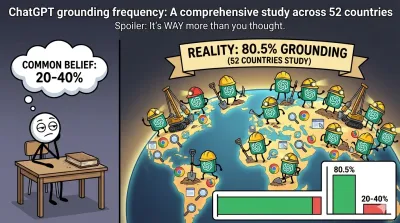
ChatGPT uses web search in 80%+ of the prompts
Independent testing reveals ChatGPT uses web search and grounding in 81% of responses—much more frequently than the commonly believed 20-40%. We tested 5,200 queries across 52 countries to measure organic behavior.