
Best Google Scraper 2026: 10 Tested Across 5 Verticals

On this page
Google’s anti-bot stack is the hardest sustained engineering problem on the public web, and 2025 made it worse. Three things changed at once, and together they reshape how you pick the best Google scraper.
The &num=100 parameter was deprecated on September 11, 2025. SERP scrapers now paginate 10 results at a time. Per Locomotive Agency and Optimizely, the change roughly 10בd infrastructure costs for rank trackers overnight. Semrush, Ahrefs, and every SERP-API provider now make ten times more requests to retrieve the same top-100 dataset.
AI Overviews now dominate the SERPs teams actually scrape. In cloro’s own ~4,000-result SERP census — skewed toward commercial and conversational queries — AI Overviews appeared on 70% of results and People Also Ask on 92%.
BrightEdge’s broader tracking puts AIO at roughly 48% of all tracked queries. seoClarity measured 475% YoY growth in AIO presence on U.S. mobile search between September 2024 and September 2025. A scraper that skips the generative block misses the most important part of the page.
And the candidate pool widened. Per Ahrefs’ 4-million-URL study, only 38% of pages cited inside Google AI Overviews also rank in the top 10 — down from 76% seven months earlier. Ranking is no longer the same business outcome it was. Tracking rank without tracking AI Overview citation captures only half the picture.
We tested 10 tools head-to-head against SerpApi and Bright Data — the category defaults — across 5 verticals (SERP, Maps, Images, Jobs, Business Profile) at production volume, to find the best Google scraper for each job.
Scope of this post. This roundup covers tools tested for scraping Google’s surfaces (Search, Maps, Images, Jobs, Business Profile, Shopping). For a multi-engine SERP API spanning Google + Bing + ChatGPT Search + Perplexity through one parsed-JSON interface, see Best SERP APIs in 2026. For pricing specifically, see Cheapest SERP API 2026.
The 10 Google scrapers at a glance
| Tool | Tier | SERP | Maps | Images | Jobs | Business Profile | Starting price |
|---|---|---|---|---|---|---|---|
| cloro | SERP API | ✅ + AIO | — | — | — | — | $30/mo (500 free monthly credits) |
| SerpApi | SERP API | ✅ + AIO | ✅ | ✅ | ✅ | ✅ | $75/mo (Developer) |
| DataForSEO | SERP API | ✅ + AIO | ✅ | ✅ | ✅ | ✅ | Pay-as-you-go (~$2/1k) |
| Serper | SERP API | ✅ partial | — | ✅ | — | — | $50/mo (2.5k searches free) |
| Bright Data | Proxy + SERP | ✅ + AIO | ✅ | ✅ | ✅ | ✅ | Pay-as-you-go from $1.50/1k |
| Oxylabs | Proxy + SERP | ✅ + AIO | ✅ | ✅ | ✅ | ✅ | $99/mo (Pro plan) |
| Outscraper | Vertical specialist | — | ✅ | — | — | ✅ | $3/1k records (free tier) |
| Apify | Actor marketplace | ✅ | ✅ | ✅ | ✅ | ✅ | $0–$49/mo + per-actor compute |
| ZenRows | General + anti-bot | ✅ partial | — | — | — | — | $69/mo |
| ScrapingDog | General + SERP | ✅ + AIO | ✅ | ✅ | — | — | $40/mo |
The verticals matter because 2026 demand fans out well beyond “scrape Google.” Real workloads split into Maps, Images, Jobs, and Business Profile. Each has its own structural quirks and its own preferred specialist, so the best Google scraper for one surface rarely wins on another.
How we tested
We picked 30 representative queries — six per vertical — that match the most common 2026 use cases:
- General SERP: commercial head terms (“best laptops for programming”) and informational queries (“how to deduct home office expenses”) in U.S. English.
- Maps: city-scoped business queries (“dentists near Brooklyn NY”).
- Images: product searches (“herman miller aeron”) and visual-research queries (“modernist living room interiors”).
- Jobs: location + role queries (“senior product manager remote”).
- Business Profile: brand + service queries (“Joe’s Pizza Manhattan reviews”).
For each query and tool we scored five axes:
- Coverage — parsed JSON for the vertical, raw HTML, or nothing.
- AI Overview parsing — structured generative block with citations and inline videos, or text-only.
- Geolocation precision — country-level, city-level, or UULE-precise.
- True cost per 1,000 requests at production depth.
- Survival of the
&num=100deprecation — transparent 10×-pagination, or a September 2025 price change.
Where pricing has moved since we tested, we note it. The market is in flux, so re-check vendor pricing pages before committing.
What we focused on (and what’s out of scope)
The 10 tools passed three filters: real Google-specific functionality (not a generic scraper with a Google example), availability to small and mid-market teams, and a shipping product as of May 2026. A few categories are deliberately out of scope:
- The official Google Custom Search JSON API — a curated index with no ads, AI Overview, People Also Ask, or related searches, capped at 10,000 paid queries per day. Not a production option for SERP intelligence.
- Headless browser frameworks (Playwright, Selenium, Puppeteer) — libraries you’d use to build a Google scraper, not scrapers themselves. We cost DIY against managed APIs in the DIY vs buying section.
- Generic data brokers — fine for a one-time pull, but unsuitable for daily or weekly freshness on your keyword set.
- Rank-only tools — position-only tracking misses AI Overview presence, ads, PAA, and related searches. The post-AIO SERP is the unit, and partial coverage isn’t enough.
The four hard truths of Google scraping in 2026
Four constraints shape every production decision — and every honest answer to “what is the best Google scraper for me.”
1. The &num=100 cost shock is permanent
Until September 11, 2025, scrapers pulled 100 results in one request. Now they paginate 10 at a time — a 10× request multiplier that flows straight to per-call cost and rate limits. Per Logical Position’s coverage, every major rank-tracking platform absorbed similar infrastructure increases and updated pricing tiers.
The practical implication is simple. Need top-100 results, and you should expect to pay 5–10× more than 2024-era quotes from the same vendor. Need only top-10, and pricing held roughly flat.
2. AI Overview parsing is now table stakes
cloro’s SERP census puts AI Overview presence at 70% of sampled results and People Also Ask at 92% across a commercially-skewed monitoring corpus (directional, not a full-traffic census). seoClarity measured 475% YoY growth in AIO mobile presence between September 2024 and September 2025, and BrightEdge puts AIO at 48% of tracked queries across all query types. Worse for SEO teams, per Ahrefs’ 4M-URL study only 38% of pages cited inside AIOs also rank in the organic top 10 — down from 76%.
A SERP scraper that skips the generative block returns a stale page. The best Google scraper for search intelligence treats AI Overview, its cited sources, and inline videos as first-class fields.
3. Vertical fragmentation: one tool rarely fits all
Tools that win SERP cleanly often lose on Maps — different envelope, different pagination, different anti-bot pattern. Maps specialists frequently ship no SERP product at all. The realistic production setup is two tools, a SERP API plus a vertical specialist, rather than one all-in-one.
4. Residential proxy economics dominate DIY math
Per Databay’s 2026 pricing breakdown, residential proxies cost roughly $3–$15 per GB, dropping to ~$0.50/GB at deep enterprise volume and $5.50+/GB for small buyers. A naïve scraper at 10,000 queries/day burns 5–15 GB of residential bandwidth per month, plus CAPTCHA credits and headless compute. The proxy line item alone often exceeds a managed SERP API subscription within the first month.
Tier 1: SERP APIs with parsed JSON
These return structured JSON for Google out of the box — no proxy management, no headless browsers to maintain. Best for teams whose primary need is search intelligence rather than bulk extraction.
1. cloro — best for AI-native SERP intelligence
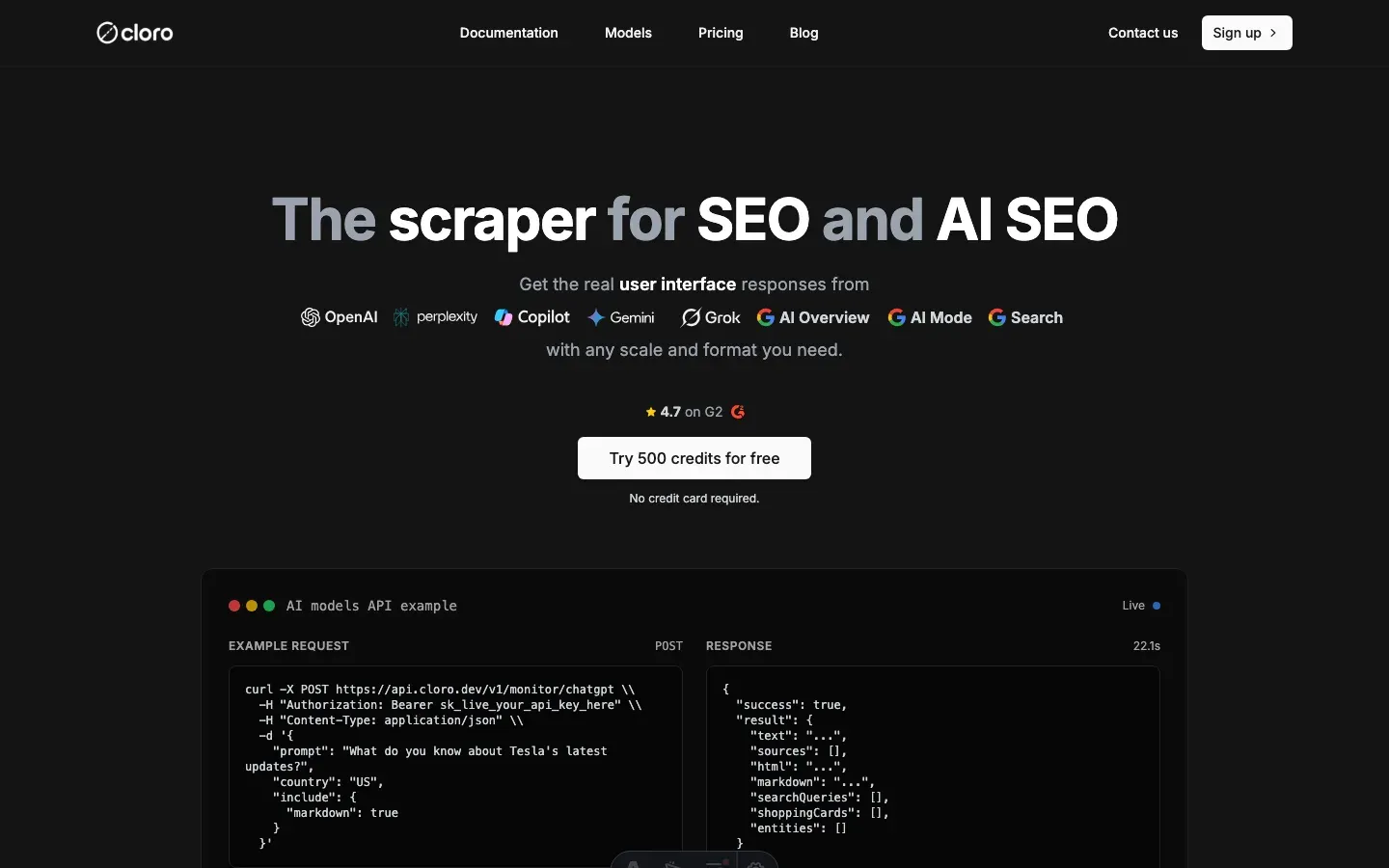
Best for: teams that need parsed JSON for organic results plus AI Overview, AI Mode, ChatGPT, and Perplexity through one API.
cloro’s SERP API treats Google as one surface in a larger AI-search ecosystem rather than a standalone target. The same endpoint family returns parsed responses for Google Search, Google AI Mode, Google AI Overview, ChatGPT Search, Perplexity, Copilot, Gemini, and Grok — with the actual cited source URLs each surface used. That cross-surface coverage is the 2026 differentiator. A brand can be cited heavily in ChatGPT and absent from Google AI Mode for the same query, and the only fix is instrumenting every surface from one tool.
Key features
- One endpoint family with a stable response shape across SERP, AI Overview, AI Mode, ChatGPT, Perplexity, Gemini, and Copilot.
- Parsed AI Overview with text, markdown, citations, sources, inline videos, and any injected ads.
- People Also Ask, related searches, and sponsored blocks with sitelinks.
- City-level geo via canonical
locationstrings or a pre-encodeduule. - Multi-page pagination that handles the post-
num=100reality transparently.
Pros
- Deepest AI Overview parsing on this list, with the full source list.
- Modern API design — typed responses, clean error semantics, single auth.
- One vendor for SERP plus AI-search visibility.
Cons
- No vertical Maps, Jobs, or Images endpoints — pair with a specialist if those matter.
- Built for ongoing monitoring at scale, less suited to one-off spot checks.
Pricing. Hobby starts at $100/month for 250,000 credits with 500 free monthly credits to test. Growth is $500/month for 1.35M credits at a lower per-call rate. See cloro’s SERP API pricing for current tiers.
Open-source examples: github.com/cloro-dev/google-search-scraper — Python, cURL, and Node.js quick-start covering organic results, PAA, related searches, and AI Overview.
For teams weighing the field, cloro is the best Google scraper when AI Overview depth and cross-engine visibility are the point rather than raw page volume.
2. SerpApi — best for breadth across Google verticals
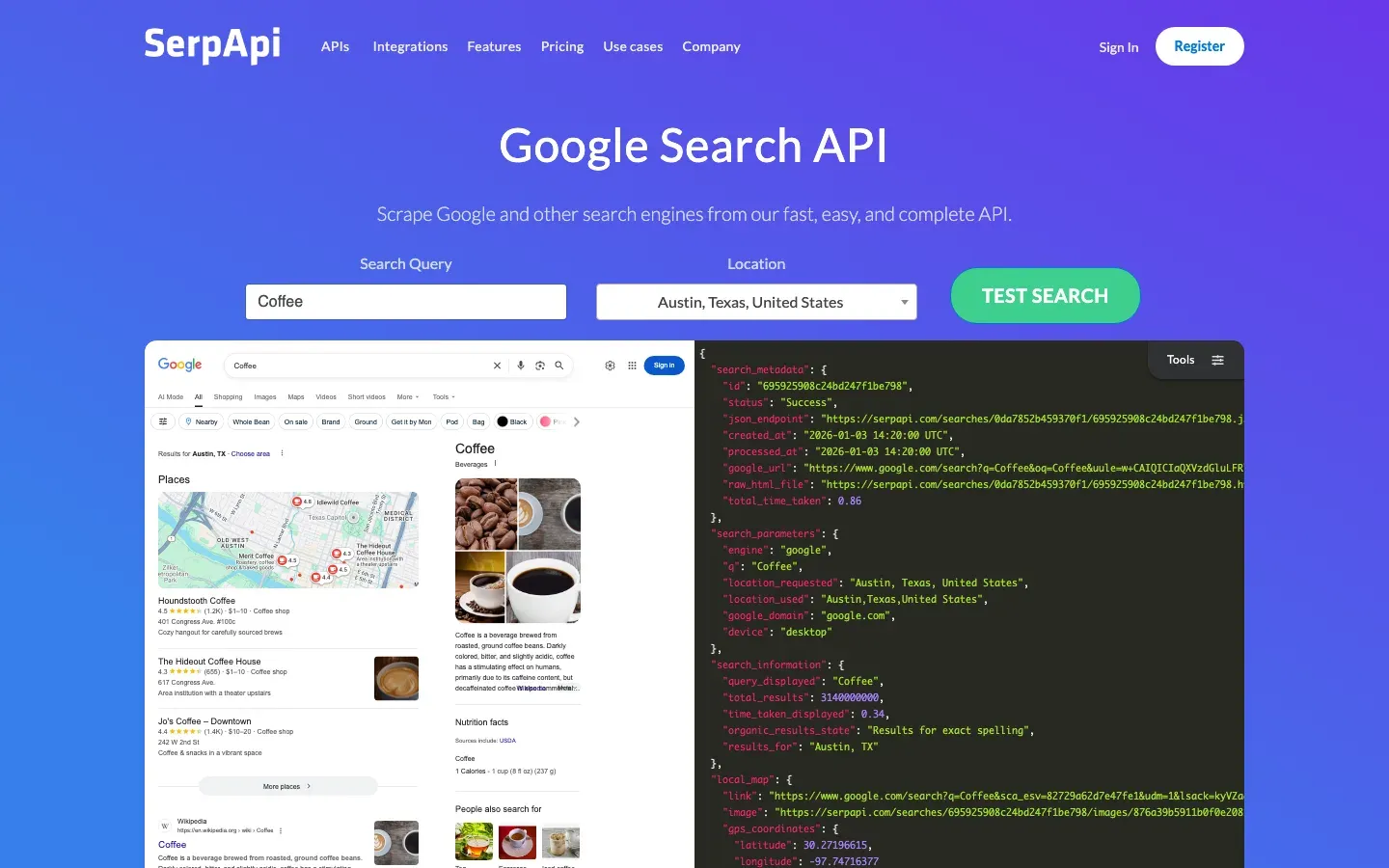
Best for: developers who need parsed JSON across Google’s vertical surfaces (SERP, Maps, Images, Jobs, Shopping, News) under one API.
SerpApi is the broadest Google-vertical coverage in a single SERP API. It spans Google Search, Maps, Images, Jobs, Shopping, News, and Scholar, plus Bing, Baidu, Yandex, DuckDuckGo, and eBay through the same surface. The trade-off is bundle pricing — monthly plans rather than pay-per-call — which suits steady volume but chafes during launch spikes or ad-hoc projects.
Key features
- Native Search, Maps, Images, Jobs, Shopping, News, and Scholar endpoints.
- AI Overview parsing with cited sources.
- Active selector maintenance, typically fixed within hours of a Google UI change.
- Client libraries for Python, Node, Go, Java, Ruby, and PHP.
Pros
- Widest Google-vertical coverage in the SERP-API category.
- Mature platform with a long track record (founded 2015).
Cons
- Monthly bundles are less efficient for spiky workloads than per-call billing.
- Higher effective per-search rate at the entry tier ($15/1k at Developer).
Pricing. Developer $75/month (5,000 searches). Production $150/month (15,000 searches). Big Data $275/month (30,000 searches).
3. DataForSEO — best pay-as-you-go SERP at the lowest base rate
Best for: teams wanting low per-call SERP cost with no monthly minimum, and able to absorb a horizontal-platform integration.
DataForSEO is a horizontal SEO data platform with 60+ endpoints — SERP, Keywords, Backlinks, On-Page, Domain Analytics, and more. The breadth is genuinely useful for a full SEO program. The September 2025 SERP price cut (~80%) made it the lowest base rate in the category. AI Overview enrichment doubles the first page from $2 to $4 per 1,000 calls.
Key features
- SERP API with Live and Standard variants across Google, Bing, Yahoo, Yandex, Baidu, and more.
- Google Maps, Jobs, News, and Shopping endpoints.
- Business Data API covering Google Business Profile, hotels, and reviews.
Pros
- Lowest base SERP rate post-September 2025 price cut.
- One vendor for SERP plus backlinks, on-page, and keyword research.
Cons
- 60+ endpoints with varying auth and rate limits — integration overhead is real.
- Async task model requires polling or a webhook layer.
- For a deeper breakdown see our DataForSEO alternatives comparison.
Pricing. Live SERP $2/1,000 base; AIO-enriched first page $4/1,000; n=100 with AIO works out to roughly $17.50/1,000 including surcharges.
4. Serper — best lightweight Google SERP
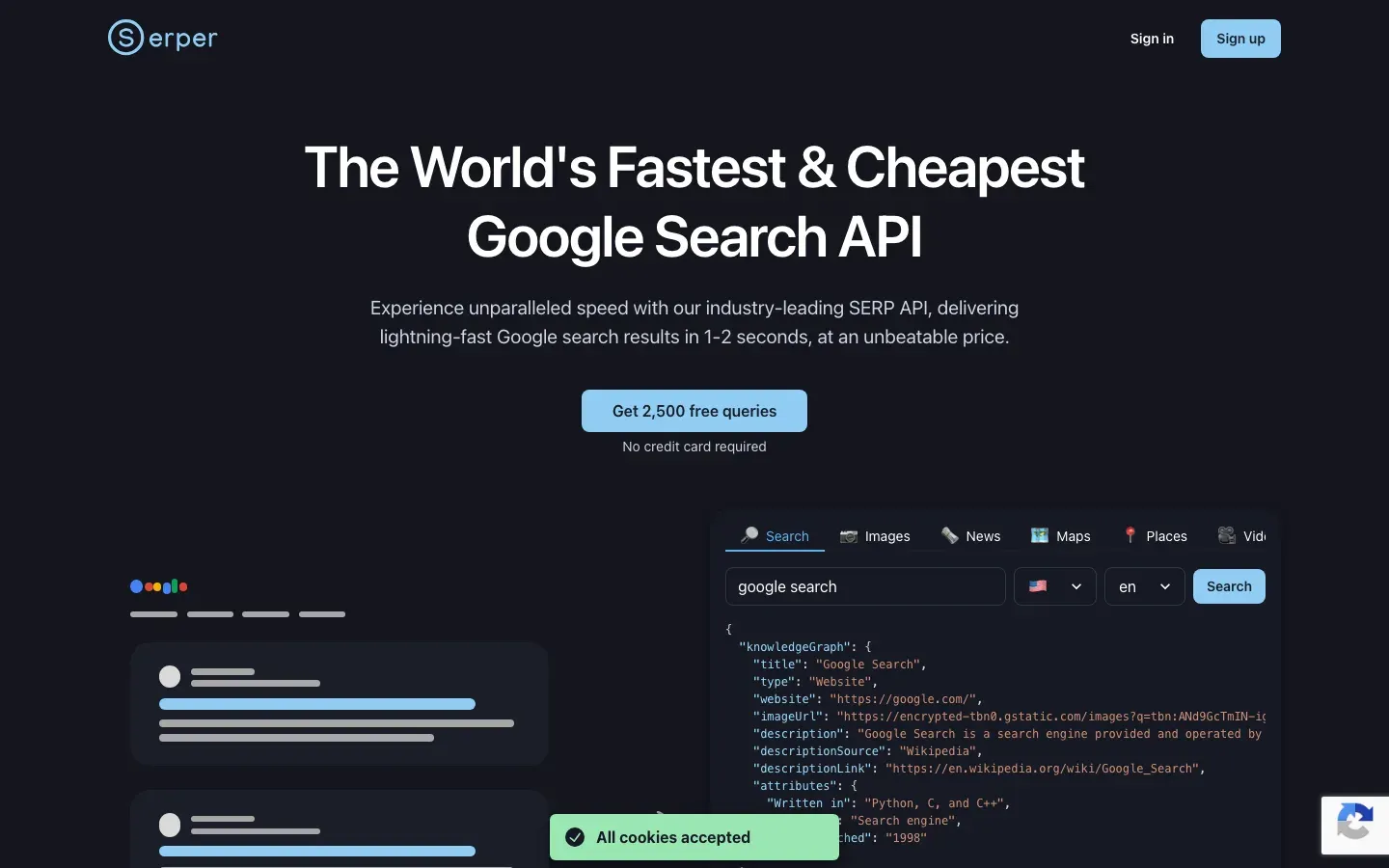
Best for: developers building lightweight tools or research projects who need a fast Google SERP at the lowest entry price.
Serper positions on speed and simplicity, with clean JSON and sub-200ms median response at scale. The focus is Google Search and a narrower set of verticals (Images, News). For buyers comparing it against multi-engine managed APIs, see our Serper alternatives breakdown.
Pros
- Lowest entry price among credible SERP APIs.
- Fast response times even at peak load.
- Free tier of 2,500 searches is generous enough to evaluate.
Cons
- Narrower vertical coverage than SerpApi or DataForSEO — no Jobs, no Shopping.
- AI Overview and dynamic-element parsing is more limited.
- For a deeper comparison see our SerpAPI alternatives breakdown.
Pricing. Free tier (2,500 searches). Paid plans from $50/month.
Tier 2: Proxy networks with SERP scraping layered on top
These vendors began as residential proxy providers and layered SERP APIs on top of their infrastructure. They fit very high volume, datasets, or workloads where the proxy layer matters as much as the parsing layer.
5. Bright Data — best for enterprise scale
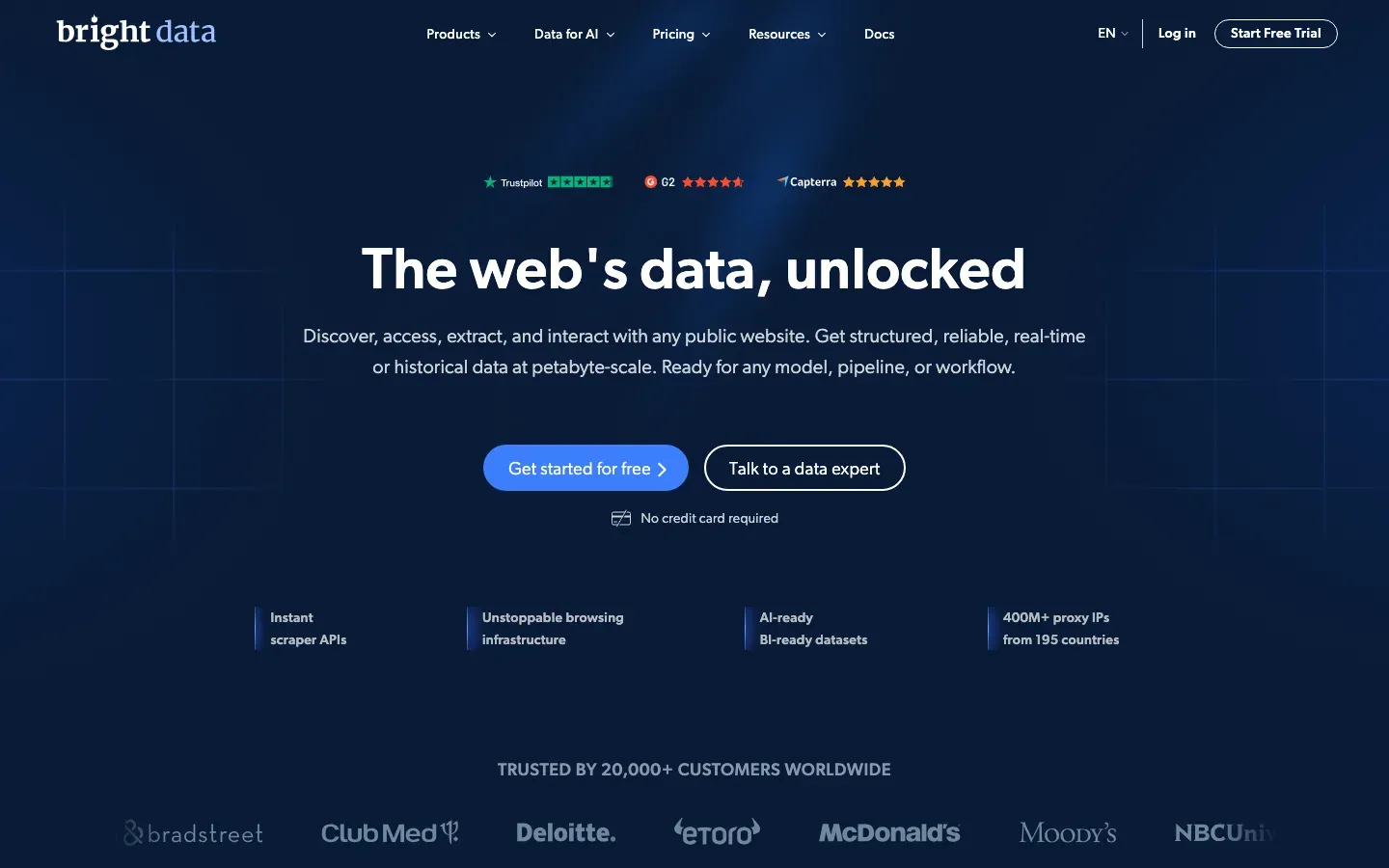
Best for: enterprise teams scraping Google at millions-of-pages-per-day volume, or wanting prepackaged datasets alongside the live API.
Bright Data runs one of the largest residential proxy networks on the planet — 72M+ IPs across nearly every country and city — and layers a dedicated SERP API on top. Its Web Unlocker product solves CAPTCHA challenges and rotates fingerprints to look like real user traffic.
Key features
- SERP API for Google Search, Maps, Images, Jobs, Shopping, News, and Scholar.
- AI Overview parsing and Web Unlocker automated CAPTCHA solving.
- Pre-scraped datasets purchasable as an alternative to live queries.
Pros
- Unmatched scale and infrastructure.
- Dataset offering fits use cases that don’t need real-time freshness.
Cons
- Sprawling product catalog and a steep learning curve.
- Enterprise pricing is unfriendly to small teams or one-off projects.
- For a deeper comparison see our Bright Data alternatives breakdown.
Pricing. SERP API from ~$1.50/1,000 requests at higher volume tiers; small-volume entry is meaningfully more expensive.
6. Oxylabs — best premium proxy alternative
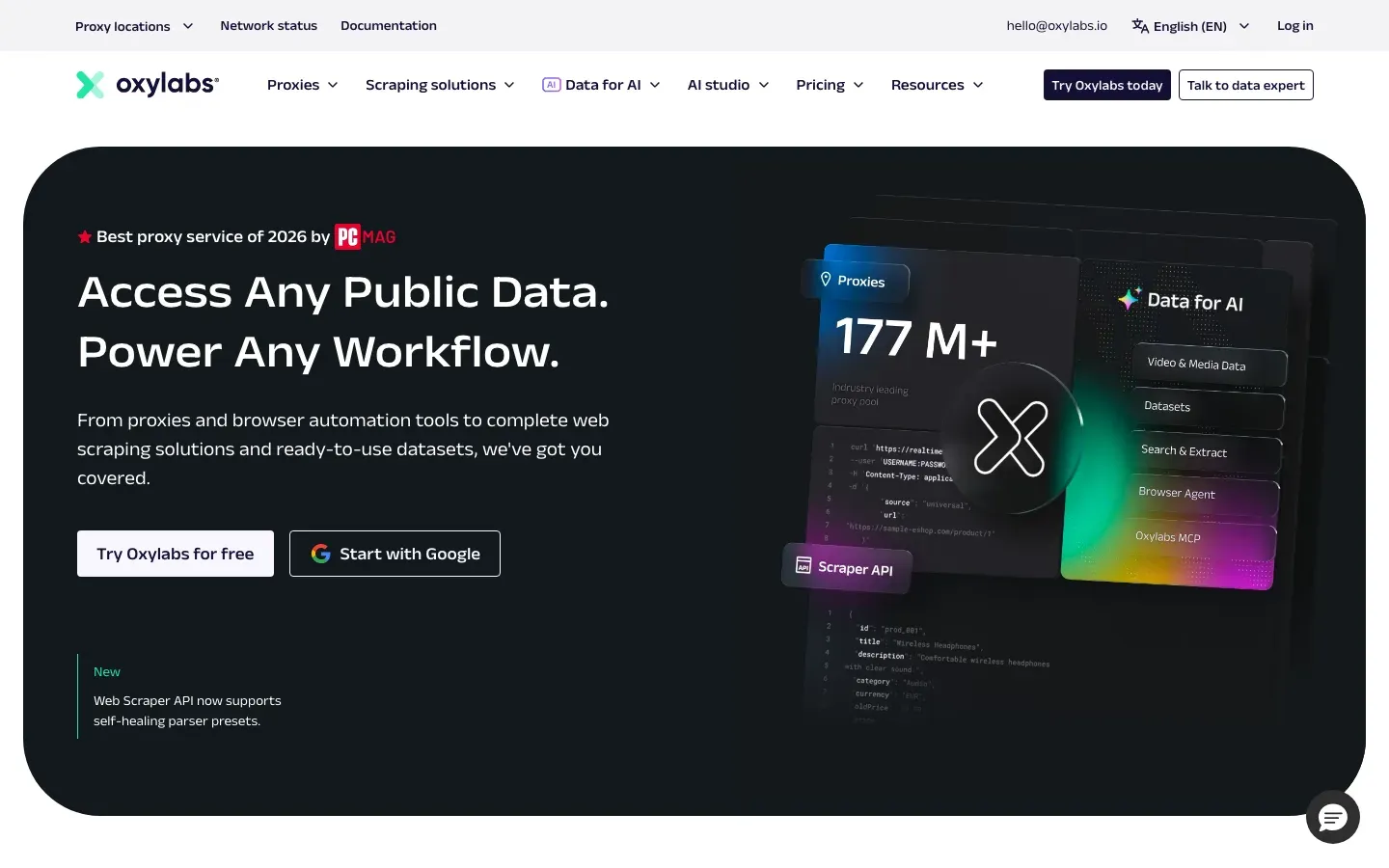
Best for: enterprise teams wanting a premium alternative to Bright Data, valuing the 100%-success-rate billing model or an EU vendor relationship.
Oxylabs is the direct competitor to Bright Data, with comparable infrastructure scale (102M+ IPs) and a different commercial posture. Its 100% success-rate guarantee — charging only for successful requests — is genuinely meaningful at scale. A failed scrape is a $0 line item, which simplifies forecasting and aligns vendor incentives with customer outcomes.
Key features
- 102M+ residential IPs with fast rotation.
- Google Search, Maps, Images, Jobs, Shopping, and News endpoints.
- Adaptive parser that adjusts to layout changes.
Pros
- Premium proxy quality and strong enterprise account management.
- Billing model is the safety net DIY scrapers don’t have.
Cons
- High monthly minimum at the entry tier.
- Overkill for simple rank tracking or small-volume use cases.
- For a deeper comparison see our Oxylabs alternatives breakdown.
Pricing. Pro plan $99/month entry; committed-volume pricing for production workloads.
Tier 3: Vertical specialists for Maps and Business Profile
These tools don’t try to be general SERP APIs. They go deep on one or two Google surfaces where per-record economics matter more than breadth.
7. Outscraper — best for Google Maps and Business Profile
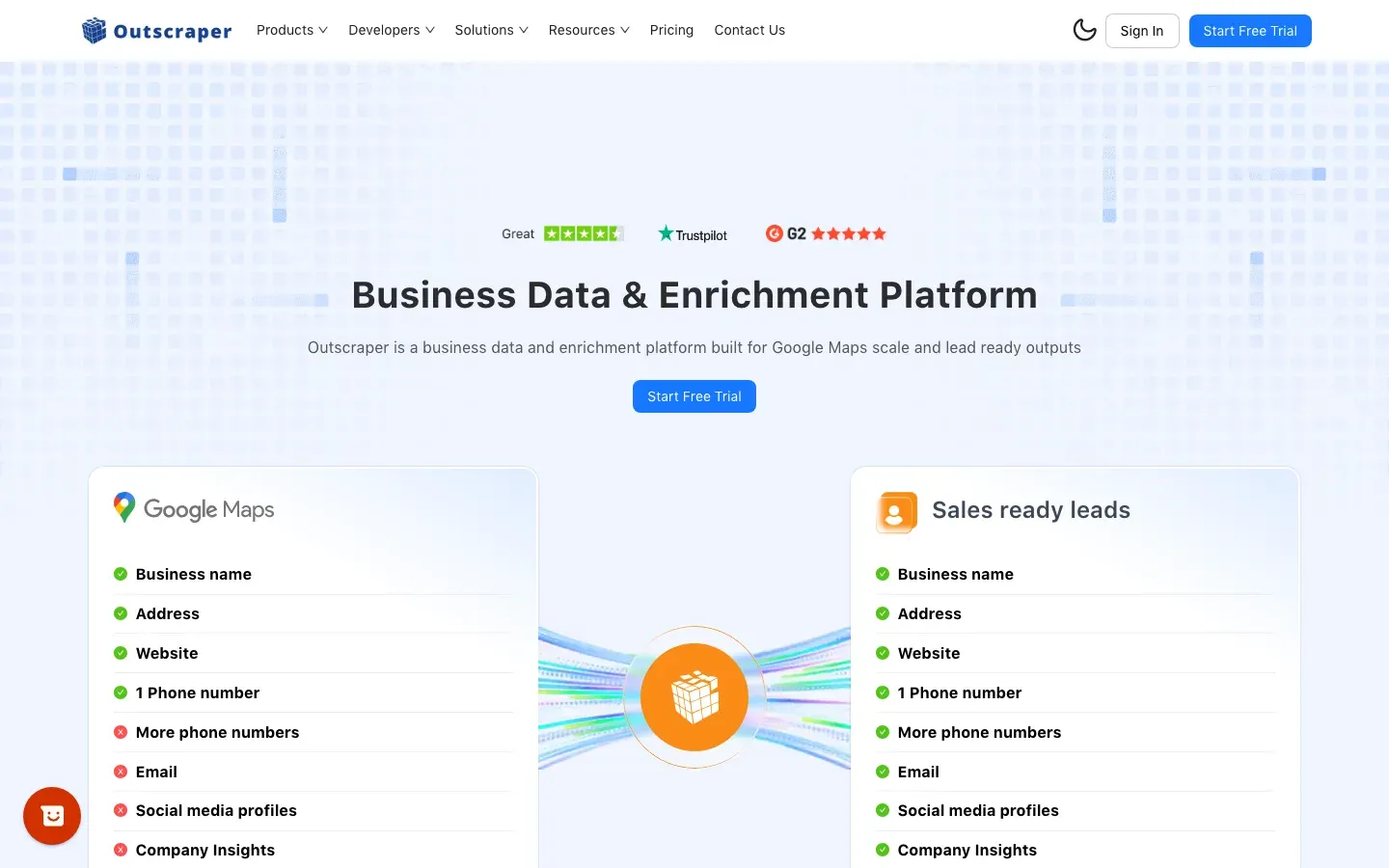
Best for: teams needing bulk Google Maps and Business Profile data — local SEO agencies, lead-generation programs — at the lowest per-record cost.
Outscraper is the Maps and Business Profile specialist with the most aggressive per-record pricing in the category. Per their public pricing, the first 500 records are free, the next 99,500 cost $3 per 1,000, and volume above 100,000 records drops to $1 per 1,000 — roughly 30× cheaper than Google’s official Places API at ~$32/1,000 for comparable fields. The trade-off is scope: Outscraper ships no general SERP product.
Key features
- Google Maps business data (name, address, phone, hours, ratings, photos).
- Reviews and photo extraction, plus optional email enrichment.
- Pay-as-you-go with no monthly minimum and 500 free records to evaluate.
Pros
- Lowest per-record cost for Maps and Business Profile data on the market.
- 500-record free tier is a real evaluation runway, not a gated demo.
Cons
- No general SERP product — Maps and Business Profile only.
- Less ergonomic API design than the SERP-API category leaders.
Pricing. Free for the first 500 records. $3/1,000 for the next 99,500. $1/1,000 above 100,000 records.
8. Apify — best actor marketplace for long-tail Google verticals
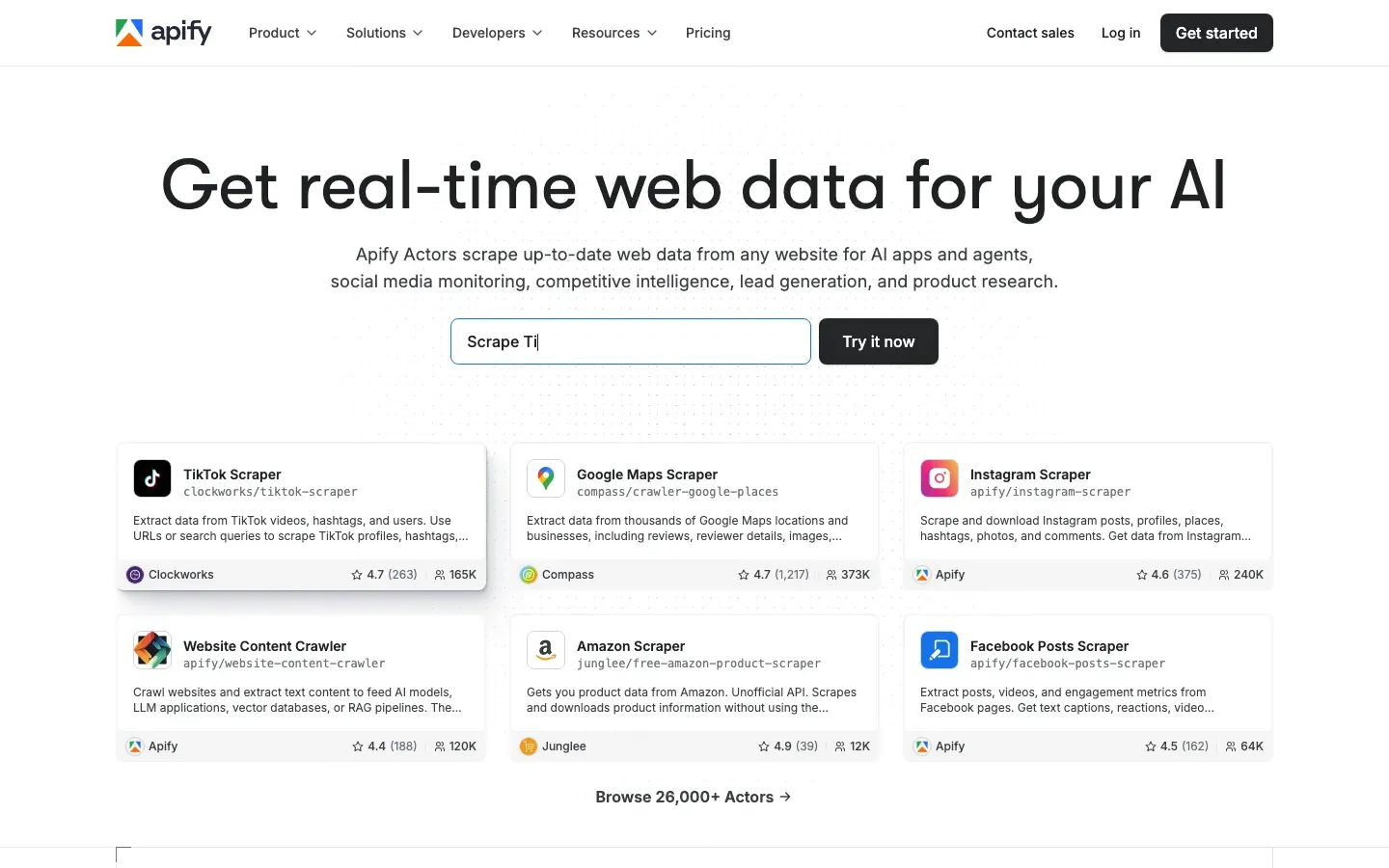
Best for: teams needing niche Google verticals (Shopping, News, Scholar, Trends, Lens) and preferring a marketplace of pre-built actors over a SERP-API contract.
Apify is a scraping platform with a marketplace of community-built and official “actors” — containerized scrapers with fixed input schemas. The model lets you compose or buy a scraper for almost any Google surface, including ones the SERP APIs don’t cover natively. Common actors include apify/google-search-scraper and lukaskrivka/google-maps-scraper. The trade-off is reliability: community actors depend on whoever maintains them, and can lag a Google layout change by days.
Pros
- Widest long-tail Google coverage available.
- Pay-per-actor-run can beat per-API-call pricing for sporadic use cases.
- For a deeper comparison see our Apify alternatives breakdown.
Cons
- Reliability of community actors varies widely.
- Compute-time pricing is harder to forecast than per-request billing.
Pricing. Free tier with $5 platform credit. Paid plans from $49/month plus per-actor compute.
Tier 4: General web scrapers used for Google
These are general-purpose scrapers that handle Google well thanks to anti-bot tech, but aren’t SERP-specific. Best when you also need to scrape destination pages after the Google click.
9. ZenRows — best for anti-bot evasion on Google + destination pages
Best for: teams scraping a mix of Google SERPs and the destination pages those SERPs link to, where the anti-bot challenge is the main engineering problem.
ZenRows is a web-scraping API focused on bypassing tough anti-bot stacks (Cloudflare, Akamai, PerimeterX). It handles Google through the same architecture, with the headless browser, evasion, and proxy rotation behind a single call.
Cons
- Not SERP-specific — JSON output is generic and needs more parsing than SerpApi or cloro.
- Limited or no native Google vertical endpoints (Maps, Jobs, Images).
- Better fit for after-the-click scraping than for the SERP itself.
Pricing. From $69/month for the entry plan.
10. ScrapingDog — best budget all-rounder
Best for: solo developers and small teams wanting one API for Google Search, Maps, and Images plus general web scraping at the lowest entry price.
ScrapingDog ships a Google SERP API (with AI Overview support), a Maps API, an Images API, and a general scraper under one auth and one dashboard. It sits firmly at the budget end, with entry pricing well below SerpApi or Bright Data and a straightforward API design.
Pros
- Lowest credible entry price for Google SERP scraping with AIO parsing.
- Clean API design suited to single-developer integration.
Cons
- Less mature parsing depth on tricky surfaces (PAA, related searches, ad blocks).
- Smaller documentation and community ecosystem.
Pricing. From $40/month for the entry plan.
DIY vs buying: the real math after n=100
The biggest single change to the DIY-vs-buy math in 2025 was the &num=100 deprecation. Here is the cost of tracking 10,000 keywords daily in 2026 dollars, with the multiplier baked in.
DIY (Python + Playwright + residential proxies)
Building this route yourself means maintaining the full stack our Python guide to scraping Google Search results walks through. Here is what that costs per month.
- Residential proxies: 10,000 keywords × 30 days = 300,000 requests/month, or 3,000,000 page-loads at top-100 depth. At ~80 KB per rendered SERP that’s ~24 GB/month at top-10 and ~240 GB at top-100. Per aimultiple’s 2026 pricing survey, small-volume residential runs $5–8/GB — so $150–$400/month at top-10 depth, or $1,200–$1,920 at top-100 depth.
- CAPTCHA solving: ~$1–3 per 1,000 captchas, with Google challenging 5–15% of new-IP requests — $30–$150/month.
- Server compute for RAM-hungry headless browsers — $80–$150/month.
- Engineering time: Google updates SERP layouts several times a month, and each patch takes a senior engineer 2–4 hours. At $100/hour that is $600–$2,400/month — the line item most teams underestimate.
- Total DIY: $1,260–$3,500/month at top-10, or $2,310–$5,020 at top-100 with AIO.
Managed SERP API
- Subscription for 10,000 keywords daily runs $300–$500/month at top-10 with AIO, and $800–$1,400 at top-100 with AIO.
- Engineering time is roughly zero for SERP parsing maintenance — constant integration work rather than ongoing firefighting.
The honest comparison
The DIY-vs-buy delta widened sharply after &num=100. Before September 2025, a small team could plausibly justify DIY for top-100 tracking at moderate volume. After it, the bandwidth multiplier alone pushes DIY infrastructure above managed API pricing at almost every scale below true enterprise volume. Unless you sell scraping technology or have a strategic reason to keep the whole stack in-house, buying the managed layer is the right call.
How to choose: a working decision tree
The 10 tools don’t compete head-to-head — they compete on which workload they fit. There is no single best Google scraper, only the best Google scraper for a specific job:
- Parsed JSON for Google Search + AI Overview + ChatGPT + Perplexity + Gemini through one API? cloro’s SERP API.
- Broad Google-vertical coverage under one auth? SerpApi.
- Lowest base SERP rate, and can absorb a horizontal platform? DataForSEO.
- A lightweight tool needing fast, cheap Google Search? Serper.
- Millions of pages per day or pre-packaged datasets? Bright Data or Oxylabs.
- Bulk Google Maps and Business Profile at the lowest per-record cost? Outscraper.
- A long-tail vertical (Shopping, Trends, Scholar, Lens)? Apify’s actor marketplace.
- A mix of SERPs and destination pages behind tough anti-bot? ZenRows.
- Solo developer on the lowest budget who still wants AIO? ScrapingDog.
For most teams the realistic setup is two tools: a Tier 1 SERP API for core search plus one Tier 3 specialist for the vertical that matters most. Consolidating to a single tool usually means accepting weaker coverage on a priority surface.
If you want to see parsed Google SERP responses for your own keyword set, start with cloro — 500 free monthly credits baseline your top 100 priority queries across organic results, AI Overview, People Also Ask, and related searches. The same credits work against ChatGPT Search, Perplexity, Gemini, AI Mode, and Copilot from one key, so you can map visibility across the full post-AIO SERP in one pass. That combination is why we rate cloro the best Google scraper for AI-era search intelligence.
For the focused cost breakdown across SERP APIs, see our cheapest SERP API 2026 comparison. For the multi-engine roundup, see Best SERP APIs in 2026.

About the author
Ricardo Batista
Founder, cloro
Ricardo is one of the founders and engineers behind its SERP and AI-search scraping infrastructure. Before cloro he scaled a financial comparison site to $7M ARR and ran the full-country operations of a unicorn to $65M ARR, then went back to building. He writes about search engine scraping, generative-engine optimization, and turning live search and AI-answer data into something teams can act on.
Frequently asked questions
What is the best tool to scrape Google in 2026?+
It depends on which Google surface you need. For multi-engine SERP intelligence with AI Overview support, cloro and SerpApi lead. For massive scale enterprise scraping, Bright Data and Oxylabs are the proxy infrastructure layer. For Maps and Business Profile data at the lowest per-record cost, Outscraper is the specialist. For a marketplace of pre-built per-vertical actors (Maps, Jobs, Images, Shopping), Apify covers the long tail. There is no single best tool — most production setups use two: a SERP API for core search plus a specialist for the vertical they care most about.
How did Google's n=100 deprecation in September 2025 affect Google scraping?+
Google quietly removed the &num=100 parameter on September 11, 2025, forcing scrapers to paginate 10 results at a time instead of 100. SERP API providers like Semrush and Ahrefs now make roughly 10× more requests to retrieve the same top-100 dataset, and infrastructure costs jumped accordingly. The change also caused dramatic GSC impression drops between September 10-12, 2025 as bot-driven impressions from rank trackers vanished from reporting.
How do I scrape Google Maps and Business Profile data?+
Outscraper is the lowest-cost specialist for Google Maps and Business Profile data, with pay-as-you-go pricing at $3 per 1,000 records (dropping to $1 per 1,000 after the first 100,000) compared to Google Places API at roughly $32 per 1,000. Apify also offers community and official actors for Maps. Bright Data and Oxylabs handle Maps at scale through their general SERP APIs but at higher per-record cost.
How do I scrape Google AI Overviews?+
Scraping AI Overviews requires a browser-based scraper that renders JavaScript and waits for the generative block to populate. Simple HTTP requests miss it entirely. Among the tools we tested, cloro, SerpApi, Bright Data, Oxylabs, and DataForSEO all return parsed AI Overview content with cited sources in the SERP response. Coverage depth varies — cloro and SerpApi return the full source list with structured fields, while some providers return text-only summaries.
Why does Google block my scraper, and what does it actually cost to get around it?+
Google runs one of the most aggressive bot-detection stacks on the public web — IP fingerprinting, behavioral signals, CAPTCHA challenges, and TLS fingerprinting. A scraper needs rotating residential proxies (typically $3-15 per GB depending on volume), a JavaScript renderer for dynamic SERP elements, and continuous selector maintenance. At a few thousand queries per day, those costs and engineering hours exceed managed API pricing within the first month.
Is geolocation important for Google scraping?+
Yes — Google personalizes results aggressively by location. Country-level targeting often isn't enough, especially for local SEO or local-pack tracking. The best tools support city-level geolocation via UULE parameters or explicit location strings (e.g., 'New York,New York,United States'). Local-pack composition and ad placement frequently diverge sharply by city, so country-only sampling misses most of the local-search reality.
Can I just use Google's official Custom Search JSON API?+
For most production use cases, no. The Custom Search JSON API returns a curated subset of Google's index, with no ads, no AI Overview, no People Also Ask, and no related searches. It's also rate-limited to 100 free queries per day with paid extension capped at 10,000 per day. The rendered google.com surface that real users see is not what the official API returns.
Related reading
Best ChatGPT Scraper 2026: 8 Tools Tested (Web UI)
We tested 8 ChatGPT scrapers against Cloudflare TLS fingerprinting, SSE streaming, and weekly-changing class names to find the best ChatGPT scraper for 2026.
Best Web Scraping Tools 2026: 10 Tested Options
Compare the best web scraping tools for 2026: Scrapy, Playwright, Firecrawl, Crawl4AI, no-code tools, managed APIs, and AI scrapers for teams.
Best SERP APIs 2026: 12 Tested, Ranked by Real Cost
Benchmark of 12 SERP APIs — AI Overview parsing depth, true cost at 100k calls/month, and which one beats SerpApi on AI coverage. 2026 tested results.