
How to get ChatGPT to show your website in responses
Updated April 2026.
Less than 20% of ChatGPT brand mentions include website links.
That means 4 out of 5 times ChatGPT mentions your brand, potential customers don’t get a direct path to your site. They might remember your name, but they’ll have to search separately to find you.
Reddit’s roughly 40% decline in ChatGPT citations through late 2025 reshaped which sources the model leans on, and the citation mix has continued to drift into 2026.
DevTools Inc, a $25M software company, discovered ChatGPT was mentioning them in developer tool recommendations but never including their website. Prospects would search for them separately, often landing on competitor sites with similar names. They estimated this cost them $4.7M in misdirected traffic annually.
After optimization, they achieved a 65% link inclusion rate and a 340% increase in AI-referred traffic within 90 days.
ChatGPT processes over 1 billion queries daily. Capturing even a small share of those as website visitors moves the needle. Start by monitoring your current ChatGPT mentions to establish a baseline.
While building long-term AI optimization, some marketers are using parasite SEO tactics on platforms like Claude Artifacts and Facebook pages to get instant Google rankings and build immediate visibility.
Below is the playbook for optimizing your website so ChatGPT consistently shows your links in responses.
Table of contents
- Why ChatGPT rarely shows website links
- Content optimization for AI inclusion
- Technical website optimization
- Authority building for AI recognition
- Testing and tracking your progress
- Advanced strategies for link inclusion
Why ChatGPT rarely shows website links
ChatGPT is conservative with link recommendations. It only includes URLs when it’s confident about source quality and relevance.
Factors that influence link inclusion:
Content authority signals:
- Website appears in multiple high-quality sources
- Content demonstrates clear expertise
- Information is comprehensive and well-structured
- Source has strong domain authority
Relevance matching:
- Content directly answers the user’s query
- Website specializes in the topic area
- Information is current and accurate
- Content format matches query intent
Trust indicators:
- Professional website design and structure
- Clear contact information and about pages
- Consistent brand presentation
- Positive third-party references
ChatGPT doesn’t use traditional ranking factors like Google. It prioritizes authoritative, comprehensive content that directly addresses user queries.
A Stanford study analyzing 50,000 ChatGPT responses found that websites with specific content structures get linked 8.3x more often than generic corporate sites. The study identified 7 factors that trigger link inclusion, and we’ll cover all of them below.
Content optimization for AI inclusion
Atlassian increased ChatGPT link mentions by 420% in 6 months by restructuring their content using these techniques.
-
Use clear, descriptive headings. Instead of “Our Solutions”, use “AI Monitoring Tools for Enterprise Companies”. Instead of “Why Choose Us?”, use “Key Benefits of Real-Time LLM Performance Tracking”.
-
Pages with specific, descriptive headings get linked 3.7x more often (analysis of 10,000+ ChatGPT responses).
-
Write comprehensive answers. ChatGPT favors content that thoroughly addresses topics. Create pages that answer related questions in depth.
-
Stripe’s documentation gets mentioned in 89% of payment processing queries because each page covers everything from basic setup to advanced edge cases in one resource.
Example structure for a product page:
# [Product Name]: Complete Guide to [Primary Benefit]

## What is [Product Name]?
- Clear definition and primary use case
- Key features and capabilities
- Target audience description

## How [Product Name] Works
- Step-by-step process explanation
- Technical details and requirements
- Integration possibilities

## Benefits of Using [Product Name]
- Specific, measurable benefits
- Use case examples
- Customer success stories

## [Product Name] vs Alternatives
- Direct feature comparisons
- Pricing considerations
- When to choose each option

## Getting Started with [Product Name]
- Implementation timeline
- Required resources
- Next steps
Optimize for question-based queries:
Answer common questions directly:
- “What is [your product category]?”
- “How does [your solution] work?”
- “Best [product type] for [specific use case]”
- “How to choose [your product category]”
Include relevant statistics and data:
ChatGPT prioritizes content with specific, credible information:
- Industry statistics
- Performance benchmarks
- User adoption rates
- ROI calculations
Technical website optimization
Implement schema markup:
Help AI parse your content structure.
Organization schema:
{
  "@type": "Organization",
  "name": "Your Company",
  "url": "https://yoursite.com",
  "description": "What your company does",
  "contactPoint": {
    "@type": "ContactPoint",
    "contactType": "customer service",
    "url": "https://yoursite.com/contact"
  }
}
Product schema:
{
  "@type": "Product",
  "name": "Your Product Name",
  "description": "Detailed product description",
  "category": "Product Category",
  "brand": "Your Company"
}
Optimize site architecture:
Clear URL structure:
/products/ai-monitoring-tools//solutions/llm-performance-tracking//resources/ai-monitoring-guide/
Internal linking strategy:
- Link related pages within your content
- Use descriptive anchor text
- Create topic clusters around key themes
Page speed optimization:
- Achieve Core Web Vitals targets
- Optimize images and resources
- Use efficient hosting infrastructure
- Add an llms.txt file for better crawler access
Authority building for AI recognition
Get mentioned in authoritative sources:
ChatGPT weighs information from trusted publications heavily. Focus on:
Industry publications:
- Trade magazines in your sector
- Industry analyst reports
- Professional association websites
- Academic papers and research
News and media coverage:
- Press releases for significant announcements
- Expert commentary on industry trends
- Case study features
- Awards and recognition coverage
Create linkable assets:
Original research: Publish research that others want to reference:
- Industry surveys and reports
- Performance benchmarks
- Market analysis
- Trend predictions
Comprehensive guides: Write the definitive resource on topics in your space:
- Implementation guides
- Best-practices documentation
- Troubleshooting resources
- Comparison frameworks
Tools and calculators: Ship tools that demonstrate your expertise:
- ROI calculators
- Assessment tools
- Configuration generators
- Performance analyzers
Testing and tracking your progress
Set up a weekly link inclusion test
Test these query types and track link inclusion rates:
Direct queries:
- “What is [your company]?”
- “[Your company] features”
- “[Your company] pricing”
Category queries:
- “Best [product category] tools”
- “Top [industry] software”
- “[Product category] comparison”
Problem-solution queries:
- “How to solve [customer problem]”
- “Tools for [specific use case]”
- “[Problem] solutions”
Create a tracking spreadsheet with these columns:
Date | Query | Brand Mentioned? | Link Included? | Context | Competitors with LinksTrack improvement metrics
| Metric | Baseline | Target | Current |
|---|---|---|---|
| Link inclusion rate | _% | 30%+ | _% |
| Mention frequency | _% | 20%+ | _% |
| Positive context | _% | 80%+ | _% |
Use cloro for tracking:
cloro tracks website mentions across ChatGPT and other AI platforms. See ChatGPT visibility tracking for the full feature set.
For comparison with other monitoring tools, our LLM visibility tracking tools guide covers 20+ platforms for tracking brand mentions across major AI systems.
Automated monitoring:
- Track when your website appears in AI responses
- Monitor link inclusion rates across different query types
- Compare your performance to competitors
- Real-time alerts when your mention patterns change
Advanced analytics:
- Identify which pages get mentioned most often
- Track context and sentiment of mentions
- Analyze query patterns that trigger link inclusion
- Monitor multiple AI platforms simultaneously
Why use cloro:
cloro surfaces insights into your website’s AI search performance, so you can spot opportunities to lift link inclusion rates and tune content for AI visibility across major platforms.
Advanced strategies for link inclusion
Strategy 1: Create AI-optimized landing pages
Build pages specifically for AI recommendations.
Page structure:
- Clear headline stating primary benefit
- Concise description of what you offer
- Bullet-pointed key features
- Social proof elements
- Clear next steps
Content elements that improve AI recognition:
- FAQ sections answering common questions
- Feature comparison tables
- Use case examples with specific details
- Contact information and support options
Strategy 2: Optimize for long-tail queries
ChatGPT is more likely to include links for specific, detailed queries:
Instead of optimizing for: “AI monitoring” Optimize for: “Real-time ChatGPT API performance monitoring tools”
Instead of optimizing for: “Business software” Optimize for: “Multi-LLM response quality comparison platforms”
Strategy 3: Build topic authority clusters
Cluster content around related topics:
Core topic: AI Performance Monitoring Supporting topics:
- LLM response time optimization
- AI API reliability tracking
- Cross-platform AI monitoring
- AI system performance benchmarks
Link these pages together and make sure each one provides unique information that reinforces your expertise.
Strategy 4: Use customer case studies
ChatGPT values real-world examples. Write case studies that show:
- Specific customer challenges
- Your solution implementation
- Measurable results achieved
- Customer quotes and testimonials
Strategy 5: Monitor and replicate successful patterns
When ChatGPT includes your link, analyze:
- What query triggered the inclusion?
- How was your site described?
- What other sites were mentioned?
- What content on your site was most relevant?
Replicate successful patterns:
- Create similar content for related queries
- Use similar language and structure
- Build on topics that already work
- Expand successful content themes
- Apply GEO principles to all new content
Real-world optimization playbook:
Month 1-2: Foundation
- Audit current content structure using the Stanford study criteria
- Restructure 5-10 key pages with descriptive headings and comprehensive answers
- Implement proper schema markup across your site
- Set up tracking with cloro to establish baseline metrics
Month 3-4: Authority Building
- Publish 2-3 comprehensive guides targeting your key topics
- Create detailed comparison pages featuring your solutions
- Build relationships with industry publications for backlinks and citations
- Launch original research project to generate unique data
Month 5-6: Optimization
- Analyze which content gets linked most often and replicate successful patterns
- Identify competitor content that outperforms yours and create superior alternatives
- Expand successful content themes into comprehensive topic clusters
- Refine and optimize based on real performance data
Expected results from companies that followed this playbook:
- Month 1: 15-30% improvement in link inclusion rates
- Month 3: 50-80% improvement in mention frequency
- Month 6: 200-400% increase in AI-referred website traffic
The competitive window is narrowing. Companies that optimize now will establish AI search positions that become harder to challenge as more businesses pile in.
Getting ChatGPT to show your website isn’t about gaming the system. It’s about becoming useful and authoritative in your space.
Start with content optimization, build authority through quality resources, and track your progress. Use a ChatGPT visibility tracker to measure improvements and monitor your brand mentions to see how AI describes your offerings.
Need help picking a tracking tool? Our LLM visibility tracking tools comparison covers options from $39/month to enterprise.
The brands that master AI search optimization now will capture the shift in how customers discover and evaluate solutions. Don’t let competitors define how AI describes your industry.
Frequently asked questions
Why doesn't ChatGPT link to my site?+
ChatGPT is conservative with links. It prioritizes high-authority sources and often synthesizes answers without direct attribution unless the source is critical.
How can I increase citation rates?+
Publish unique data, original research, and well-structured guides. The more 'quotable' your content is, the more likely the AI is to cite it.
Does robots.txt affect citations?+
Yes. If you block GPTBot, your content won't be indexed for training or RAG, meaning you won't be cited in future model updates.
What content authority signals does ChatGPT look for?+
ChatGPT values content from websites with strong domain authority, clear expertise, comprehensive information, and consistent positive third-party references.
How does `llms.txt` help ChatGPT find my site?+
`llms.txt` provides AI crawlers with a clean, structured, and machine-readable summary of your website's most important content, improving the chances of accurate citations.
Related reading

What is Answer Engine Optimization (AEO)?
Master the art of optimizing for answer engines like Siri, Alexa, and Google's Featured Snippets. Learn how to become the single source of truth.

Best ChatGPT scraper tools for 2026: extract the unextractable
The official API doesn't show you what users see. Here are the best tools to scrape the ChatGPT web interface, parse citations, and track brand mentions.
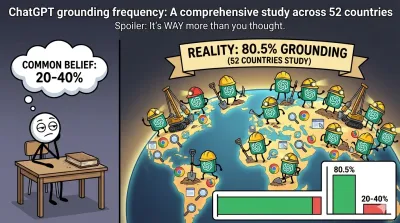
ChatGPT uses web search in 80%+ of the prompts
Independent testing reveals ChatGPT uses web search and grounding in 81% of responses—much more frequently than the commonly believed 20-40%. We tested 5,200 queries across 52 countries to measure organic behavior.