
Competitive Intelligence Examples: 10 Workflows to Copy

On this page
Competitive intelligence (CI) is public-data analysis that helps you spot competitor moves before they show up in a press release. It has also moved into the mainstream: Crayon’s State of Competitive Intelligence report finds that a majority of teams now run a dedicated CI platform and increasingly tie it to measurable revenue impact.
The best signals are practical: pricing changes, job postings, review complaints, content shifts, SERP feature ownership, AI visibility, and regional expansion. Each one can become a repeatable workflow, not a one-off research project.
This guide gives you 10 competitive intelligence examples to copy, with the data source, what to watch, and how to act. Pair it with our competitive analysis template and best competitive intelligence tools.
Is competitive intelligence legal?
Yes, when it uses public, legally obtained information. SafeGraph’s guide draws the line against industrial espionage, which means taking information the law lets a company keep hidden, such as trade secrets or insider details; a public company’s quarterly earnings report is fair game. Investopedia names the risks on the wrong side of that line: corporate espionage, privacy breaches and confidentiality violations. Every example below uses public search results and AI answers.
1. AI overview and search results monitoring
Look past brand mentions to which competitors get cited, how features are compared, and what narrative the AI builds. A SaaS company might find an AI Overview praising a competitor’s “ease of use” by citing three G2 reviews while ignoring its own higher-rated G2 profile. That’s a content gap and a vulnerability.
Google’s AI Overviews (which began rolling out to everyone in the U.S. in May 2024) and AI-native engines like Perplexity have moved the battle for visibility beyond organic rankings into AI-generated summaries. Tracking how your brand, products, and content appear in those answers versus competitors is one of the most immediate competitive intelligence examples for any modern business.
The data layer is a competitor analysis API that returns the AI Overview source list and organic SERP per query. Fix a competitor domain, watch where they appear across your keyword set, and roll it up to a share-of-voice metric.
Strategic applications and tactics
Monitor a core set of queries across Google’s AI Overview, Perplexity, and Microsoft Copilot — the same query can return different answers and cite different sources.
- E-commerce. Track queries like “best running shoes for flat feet” to see which brands and retailers appear in the AI buying guide, and which attributes (cushioning, price) it prioritizes.
- B2B software. Monitor “competitor A vs competitor B” or “best CRM for small business” queries, noting the sources the AI leans on — industry blogs, review sites, or competitors’ own marketing.
AI Overviews pull from a small cluster of top-ranking sources. Google’s own documentation confirms that AI Overviews and AI Mode draw on regular web content and surface links back to it. Identify which sources the AI prefers per topic, then focus content on sites with high citation potential.
Automating capture with cloro turns this into a real-time visibility dashboard. You can spot a competitor suddenly dominating AI answers for high-intent keywords and react. To set up your own monitoring, see how to scrape Google AI Overview.
2. Multi-platform AI assistant tracking
A travel company might find Gemini recommending its tour packages for “family trips to Italy” while Copilot favors a competitor by citing recent travel blogs. ChatGPT, meanwhile, ignores both and produces a generic itinerary. That exposes platform-specific content gaps, one of the more revealing competitive intelligence examples for the fractured nature of AI-powered discovery.
LLM assistants like ChatGPT, Gemini, Copilot, and Grok each develop their own “opinion” from training data, architecture, and real-time access. This method queries them with identical prompts to map divergent recommendations, source preferences, and positioning.
Strategic applications and tactics
Run parallel tracking for the same high-intent queries across each major AI assistant. The responses show which models are friendly, neutral, or hostile to your brand.
- B2B SaaS. Monitor “best alternative to Salesforce” or “HubSpot vs Zoho comparison” across ChatGPT, Perplexity, and Copilot, noting which platform recommends your solution and what sources justify it.
- Finance. Track “best robo-advisor for beginners” or “is
{{stock_ticker}}a good investment.” Grok’s real-time X/Twitter data can produce very different sentiment than Gemini’s more conservative, web-indexed answers.
Each assistant has a distinct source of truth, whether that is academic papers, fresh blogs, or forum posts, so once you know the preference you can tailor content and backlinks per AI. Each assistant can be queried through its API, so cloro runs them in parallel into one comparative dashboard and you can watch a single blog update shift your standing on Gemini but not on ChatGPT.
3. SERP feature distribution and competitor visibility analysis
Winning on Google is no longer about the ten blue links. Visibility is distributed across featured snippets, People Also Ask (PAA) boxes, local packs, and shopping carousels, and the distribution is lopsided in a way worth knowing before you build a tracker.
Our SERP feature census scores every Google result cloro collects: People Also Ask appears on 93.8% of US results and an AI Overview on 85.4%, against 98.2% for the organic list. Ads showed on 0.8% and local packs on 6.3%, though those two are corpus-dependent since the sample leans toward conversational and commercial-research intent. For competitive monitoring the ordering is the actionable part: two surfaces appear on the large majority of question-shaped queries, so a competitor’s presence in PAA and AI Overviews tells you more, more often, than their organic position does. This example dissects the search results page to map where competitors capture attention outside organic rankings, and where they lose it.
This goes past rank tracking to the type of visibility each competitor earns. One might not rank #1 organically yet consistently own the featured snippet; another dominates People Also Ask, controlling the narrative on key customer questions. The distribution exposes each rival’s content strategy — structured data, formatting, and question targeting.
Strategic applications and tactics
Create a SERP feature matrix that tracks your brand and competitors against each feature type for your target keywords, mapping who’s winning which SERP real estate.
- Publishers. Monitor which competitors capture featured snippets and for which topics. Note the format (list, table, paragraph) to inform your own content and improve snippet takeover odds.
- E-commerce. Track competitor presence in shopping cards and product features. Watch pricing, review counts, and in-stock status to spot opportunities in pricing or inventory.
- Local services. For “plumbers near me,” the local pack is everything. Google says local results rank mainly on relevance, distance, and prominence, and that more positive reviews can improve local ranking. Monitor competitor rankings within the pack, average review scores, and review counts to find gaps in local SEO.
Each feature is won differently. A featured snippet — a box Google elevates above the regular results when its systems judge a page best answers the query — needs well-structured content that directly answers a question. The local pack instead depends on Google Business Profile optimization and reviews. A feature-by-feature analysis uncovers what it takes to unseat a competitor.
For trend tracking, a dedicated Google rank tracking API pulls structured data for every feature on the page, so you can see whether a competitor’s new structured-data implementation led to them winning rich results.
4. Brand mention and citation analysis in AI responses
A fintech company might track “best app for budgeting” and find its brand mentioned, but always as a secondary option behind a key competitor. That’s a signal to reinforce its value proposition in content and PR. A software vendor could find its product cited in “tool comparison” answers with negative sentiment pulled from outdated forum posts, a reputation problem.
Tracking brand mentions in AI-generated text measures brand salience directly. This example weighs the frequency, context, and positioning of those mentions to show how AI systems perceive your authority in real time.
Strategic applications and tactics
Monitor exact brand names and common variations across AI systems, weighing whether each mention is a primary recommendation, a passing reference, or part of a negative comparison — context matters as much as presence.
- CPG brands. Track mentions in queries like “best protein powder for vegans,” checking whether the AI names your product a top choice and which attributes it highlights (“clean ingredients,” “great taste”).
- Consulting firms. Monitor thought-leadership mentions for queries like “how to improve supply chain efficiency” to see which firms and experts AI associates with each domain.
Mention frequency relative to market share is where the threats show up early: a competitor with small market share but heavy mention frequency in AI answers is probably running a digital-authority play that is working. Use cloro to scrape AI responses for brand and competitor names, then read the surrounding text for sentiment, which gives you a continuous feed on your own positioning.
5. Query fan-out and content gap identification
AI search rarely answers a single query. Google says its AI Mode uses a query fan-out technique that issues multiple related searches across subtopics at once, deconstructing intent into a network of related questions. Analyzing that expansion reveals content clusters where competitors dominate and gaps traditional keyword research misses.
The view extends past a single SERP to the conversational path an AI guides a user down. “Best project management software” might fan out into “software for creative teams” and “integrations with Slack” — and if a competitor owns those follow-ups, they control the discovery journey even when you ranked for the initial query.
Strategic applications and tactics
Capture the related questions, People Also Ask entries, and suggested query variations AI platforms generate — a roadmap for topic clusters aligned with how AI interprets intent.
- SaaS platforms. From a broad term like “CRM platform,” identify integration sub-queries like “CRM with email automation” or “HubSpot vs Salesforce pricing” to spot gaps in comparison content.
- E-commerce. Map “women’s hiking boots” into variants like “lightweight hiking boots” or “waterproof boots for wide feet” to surface high-intent segments.
- B2B services. Fan out “supply chain logistics” into verticals like “pharmaceutical logistics” or “cold chain logistics for food,” then build specialized landing pages and case studies.
Query fan-out signals semantic relevance. Aligning content with these AI-generated topic clusters builds authority for a whole subject area, not a single keyword — one of the most future-proof competitive intelligence examples in this list.
Manual collection doesn’t scale, so cloro automates extraction of related query patterns from AI results and lets you compare your coverage against both the AI-suggested topics and your competitors.
6. Competitor content performance and replication strategy
A financial-services firm might find an AI Overview consistently citing a competitor’s “What is a Roth IRA?” guide. On inspection, it uses short paragraphs, a Q&A format, and a clear summary table, all easy for an AI to parse. That’s an evidence-based roadmap for a superior version. This example analyzes which competitor content (blog posts, guides, reports) gets cited by AI search engines: the URLs and formats they favor, plus the topics, structures, and data points the AI treats as authoritative. The work is deconstructing why a piece is chosen.
Strategic applications and tactics
Build a performance matrix that correlates competitor URLs appearing in AI answers with their content attributes and citation frequency.
- Tech publishers. Track which competitor research reports and data studies are cited for industry-trend queries, and analyze their data presentation (charts, key stats) and structure to inform your own original research.
- Educational platforms. Monitor which competitor tutorials or course pages get recommended for how-to queries. Looking at how competitors use tools like podcast transcription software that boosts SEO can reveal content-repurposing tactics.
- Software companies. Analyze which competitor comparison articles appear in “best [tool category]” or “alternative to [competitor]” searches, breaking down their feature tables, pricing comparisons, and testimonials.
AI models reward content that’s structured, factually dense, and easy to excerpt. Identify the most-cited competitor content, then reverse-engineer its format, depth, and data points to outperform it — so your content investment targets assets with a real chance of earning AI answers.
7. Dynamic pricing and product information monitoring
Tracking competitor pricing, features, and availability in real time is one of the most foundational competitive intelligence examples, now amplified by AI. This method monitors how pricing and product data appear on websites, Google Shopping cards — where products can show for free across Search, the Shopping tab, and more — AI-powered shopping responses, and recommendation queries. It gives direct insight into a competitor’s go-to-market tactics, from promotional calendars to inventory.
It’s more than price checks — it’s the full data set presented to buyers. A consumer-electronics brand might find an AI Overview highlighting a competitor’s lower price while omitting its smaller battery and older processor, an opening to contrast total value rather than the sticker price. A marketplace can track inventory across sellers to predict stockouts and adjust positioning.
Strategic applications and tactics
Good monitoring needs automated collection from key buyer touchpoints, because the price on a product page, in a Google Shopping ad, and in a generative AI answer can differ — inconsistencies you can exploit.
- E-commerce retailers. Set automated alerts when a competitor drops a key product line by more than 10%, so you can counter the same day. For marketplace capture, see our Amazon scraping API guide.
- SaaS platforms. Monitor how pricing tiers appear in AI responses to queries like “best project management tool for marketing teams,” noting which features AI ties to each price point for you versus competitors.
Competitors often test pricing in specific channels before a site-wide rollout. Monitoring shopping feeds and AI summaries catches those tests early. A sudden drop in one region’s Google Shopping results can signal an impending global discount or targeted clearance.
cloro captures structured product and pricing data from search and AI interfaces, so teams can build dashboards surfacing promotional frequency, discount depth, and supply-chain stress.
8. SEO tool and platform recommendation monitoring
A new SEO startup might monitor recommendation queries and find AI models consistently omit tools with strong backlink auditing outside the established leaders. That’s a recommendation gap: an opening to build content and digital PR around the feature.
In the SEO software market, monitoring digital shelf space is constant work. This example tracks how your brand and services appear in AI recommendations and search for queries like “best SEO tools” or “SEMrush vs Ahrefs,” where perception forms and customers are won or lost.
Strategic applications and tactics
Track a portfolio of commercial and informational queries across Google AI Overviews, Perplexity, and ChatGPT, mapping the competitive narrative and where your brand fits in or is absent.
- SEO tool vendors. Monitor “best rank tracking tools” or “SEO software comparison” to see which features AI highlights. If a summary praises a competitor’s “user-friendly dashboard,” that’s an attribute to address in your marketing.
- SEO agencies. Track “best enterprise SEO agency” to see which competitors are mentioned and which sources are cited — industry awards, client case studies, popular blogs — telling you where to focus thought leadership.
First-mention advantage matters: AI often treats the first tool it names as the default, so identifying which competitor holds that spot for high-intent keywords gives you a target.
cloro automates this into a dashboard tracking mention frequency, positioning (first, second, third), and feature highlights — a near real-time view of market standing.
9. Multi-region and localization strategy intelligence
A global e-commerce platform might find a German competitor consistently outranks it because those product pages aren’t just translated but fully localized, with culturally relevant imagery and local payment options highlighted. Adapting the experience to local expectations is what multi-region analysis catches.
Your digital presence isn’t monolithic. It’s perceived differently across borders, languages, and cultures. Monitoring how search results, AI responses, and SERP features shift across regions reveals competitor localization strategies by comparing data from multiple locales.
Strategic applications and tactics
Move from a one-size-fits-all view of the marketplace to a region-by-region understanding by systematically collecting search and AI data from priority markets with location-specific parameters.
- Global e-commerce. Track “women’s winter coats” across the US, UK, and Australia to compare which competitors appear, the pricing (and currency) displayed, and seasonal messaging tied to local climates.
- SaaS and B2B tech. Monitor solution keywords in expansion markets like Japan or Brazil, checking whether competitors use machine-translated content versus native-language blogs — a signal of regional investment and maturity.
Competitors often test messaging, products, or pricing in smaller regions before a global rollout, so monitoring their localized footprints gives early warning of strategic shifts.
cloro supports multi-region capture, automating SERP and AI collection from countries, languages, and city-level locations. The dataset shows how your brand and competitors are positioned globally, and where a localized approach could win share.
10. Content authority and link profile intelligence from AI citations
Monitoring your own brand in AI answers matters, but the layer underneath it is the sources AI models cite, and that is where most of the upside in this list sits. Work out which competitor domains AI systems treat as authoritative and you can see how traditional SEO signals like domain authority and backlinks translate into AI visibility.
This goes past brand mentions to the content infrastructure powering AI responses. For “cloud data security,” a tech company might find a smaller competitor’s blog consistently cited by Perplexity. That topical authority makes its domain a primary source, informing both content strategy and link-building priorities.
Strategic applications and tactics
Build a citation authority matrix mapping which domains get cited most for your core topics — it shows who the AI trusts and gives a clear roadmap for SEO and content marketing.
- Publishers. Track which media outlets or niche blogs dominate AI citations for breaking news or industry analysis. The names that recur are your emerging competitors and your likely content partners.
- B2B companies. For “best project management software,” identify the third-party review sites and publications the AI cites; those become priority targets for guest posting and digital PR.
- Enterprise brands. Monitor citation patterns for thought-leadership gaps. If AI answers on a trend consistently cite academic papers and one competitor’s whitepaper, build a fuller resource.
AI models rely on a core set of trusted domains per topic. Identify those citation hubs, then focus off-page SEO on backlinks and mentions from the same sources competitors use.
Automating AI source collection with cloro tracks citation patterns and flags new domains entering the AI’s consideration set — an early warning of emerging competitors.
10-Point AI Competitive Intelligence Comparison
| Monitoring Type | Implementation Complexity 🔄 | Resource Requirements ⚡ | Expected Outcomes 📊 | Ideal Use Cases 💡 | Key Advantages ⭐ |
|---|---|---|---|---|---|
| AI Overview and Search Results Monitoring | Medium — structured extraction + continuous scraping | Medium — API access, ETL, storage | 📊 Map AI citations, visibility shifts vs organic | 💡 E‑commerce, SaaS, publishers, enterprise software | ⭐ Surfaces AI visibility gaps and source attribution |
| Multi-Platform AI Assistant Competitive Tracking | High — parallel integrations & normalization | High — multiple APIs, higher cost & maintenance | 📊 Platform-specific bias and recommendation differences | 💡 Enterprises active across ChatGPT, Gemini, Copilot, Perplexity | ⭐ Exposes platform-specific threats and fixes |
| SERP Feature Distribution & Competitor Visibility Analysis | Medium — capture many feature types; manual eligibility analysis | Medium — multi-device/region capture, parsing | 📊 Feature-level visibility, CTR impact, schema insights | 💡 E‑commerce, local services, publishers, product companies | ⭐ Finds high-value SERP feature and schema wins |
| Brand Mention & Citation Analysis in AI Responses | Medium — mention detection + sentiment context | Medium — NLP models, monitoring pipelines | 📊 Brand mention frequency, sentiment, positioning in AI outputs | 💡 Fintech, software vendors, CPG, consulting firms | ⭐ Flags reputation risks; gauges AI brand awareness |
| Query Fan-Out & Content Gap Identification | Medium-High — query decomposition and topic modeling | Medium — analytics, clustering, intent inference | 📊 Uncovers query variations, content gaps, intent patterns | 💡 SaaS, publishers, e‑commerce, B2B content planning | ⭐ Uncovers untapped keywords for pillar strategy |
| Competitor Content Performance & Replication Strategy | Medium — extract cited URLs and content-type analysis | Medium — tracking citation frequency and content metrics | 📊 Identifies high-performing formats and frequently cited assets | 💡 Publishers, software companies, educational platforms | ⭐ Benchmarks rival content to guide better assets |
| Dynamic Pricing & Product Information Monitoring | High — near real‑time price/inventory extraction | High — frequent captures, verification, multi-region | 📊 Real-time pricing intelligence, promo and inventory alerts | 💡 Retailers, marketplaces, consumer electronics, SaaS pricing | ⭐ Powers dynamic pricing and promo detection |
| SEO Tool & Platform Competitive Landscape Monitoring | Low-Medium — focused recommendation tracking | Low-Medium — targeted queries and periodic capture | 📊 Tool recommendation positioning and feature visibility | 💡 SEO agencies, tool vendors, startups monitoring discovery channels | ⭐ Reveals recommendation bias; guards tool reputation |
| Multi-Region & Localization Strategy Intelligence | High — distributed capture and localization analysis | High — regional infrastructure and language expertise | 📊 Region-specific SERP/AI differences and localization gaps | 💡 Global e‑commerce, SaaS, agencies, enterprise expansion | ⭐ Surfaces localized opportunities for regional strategy |
| Content Authority & Link Profile Intelligence from AI Citations | Medium — citation tracking and authority correlation | Medium — citation datasets and authority metrics | 📊 AI-trusted domains, citation patterns, link-building targets | 💡 Tech companies, publishers, B2B firms, enterprise brands | ⭐ Maps AI-trusted domains for link/partner strategy |
The takeaway: start with the low-to-medium complexity rows, SEO tool monitoring, brand mention analysis, and content replication tracking, since they need only targeted queries and periodic capture. Save multi-platform AI assistant tracking, dynamic pricing, and localization intelligence for once that first tier is running, since those three need the heavier infrastructure (parallel integrations, near real-time capture, or regional infrastructure) the table lists for them.
From intelligence to action: building your AI SEO moat
Knowing who ranks for a keyword isn’t enough any more. You also need to know who AI cites, whose content structure gets replicated in generative summaries, and which brand gets named as the authority in conversational search. Those answers take structured data and steady analysis rather than spot checks.
Key strategic takeaways
A few themes recur across these competitive intelligence examples.
The first is to own the whole results page and not just the ranking. Visibility is spread across AI Overviews, People Also Ask boxes, featured snippets, and the blue links, and the feature distribution analysis is how you map your footprint across all of them. The second is that citations now carry some of the weight backlinks used to: a mention in an AI Overview or a Perplexity answer signals authority, so tracking citations deserves the same effort as link building.
The third is structural. AI models favor structured, concise information, and marking pages up with schema.org vocabularies that Google, Microsoft, and other search engines understand makes that structure explicit to them. Clear headings, bulleted lists, and direct answers do the rest. The fourth is consistency: a brand that reads the same way across Google, Perplexity, and ChatGPT is easier for every engine to place, and an inconsistent one creates friction at each surface.
Turning examples into workflows
AI and SERP results change constantly, so set up a capture routine first, then wire the output into workflows that already exist. Content creation can start with query fan-out analysis to find gaps competitors miss. Product marketing can use dynamic pricing intelligence to adjust positioning as the prices move. The change that sticks is procedural: someone owns each feed, and something happens when it moves.
Ready to move from theory to execution? cloro is the structured data capture engine for replicating these competitive intelligence examples at scale. Get JSON outputs from Google AI Overviews, Perplexity, ChatGPT, and more. Start with cloro.

About the author
Ricardo Batista
Founder, cloro
Ricardo is one of the founders and engineers behind its SERP and AI-search scraping infrastructure. Before cloro he scaled a financial comparison site to $7M ARR and ran the full-country operations of a unicorn to $65M ARR, then went back to building. He writes about search engine scraping, generative-engine optimization, and turning live search and AI-answer data into something teams can act on.
Frequently asked questions
What are examples of competitive intelligence?
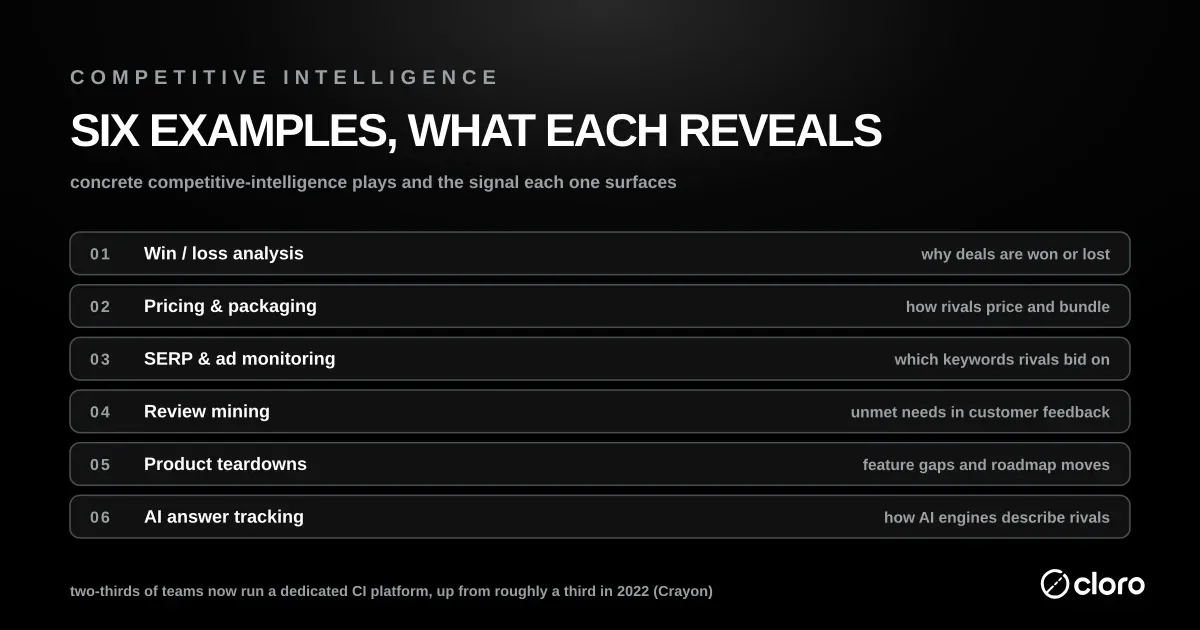
Common competitive intelligence examples include monitoring competitor pricing and inventory, analyzing job postings for hiring signals, mining customer reviews for product gaps, mapping which competitors own featured snippets and People Also Ask boxes, and measuring how often each brand is cited in AI Overviews and AI assistants. This guide details ten such examples spanning e-commerce, SaaS, publishers, and enterprise use cases, each with its data source and a recommended action.
What are the main types of competitive intelligence?
Competitive intelligence usually splits into strategic intelligence (long-term moves like market expansion, acquisitions, and product roadmaps), tactical intelligence (day-to-day signals such as pricing changes, promotions, and SERP feature ownership), and counter-intelligence (understanding how rivals perceive and target you). Modern programs add a fourth layer — AI-visibility intelligence — tracking which brands and sources generative engines cite. Our competitive analysis template organizes these into a single workflow.
Is competitive intelligence legal and ethical?
Yes — competitive intelligence is legal and ethical when it relies on publicly available information such as websites, pricing pages, job boards, reviews, search results, and AI answers, which is the basis for every example in this guide. It crosses the line only when it involves misrepresentation, hacking, or obtaining trade secrets through deception. Collecting and structuring public SERP and AI data with a tool like cloro stays firmly on the ethical side.
What is the difference between competitive intelligence and market research?
Market research studies the broad market, customers, and demand, usually through surveys and reports, while competitive intelligence focuses specifically on rival companies and their moves — pricing, positioning, content, and visibility. Competitive intelligence is also more continuous: instead of a periodic study, it runs as an ongoing feed of signals you act on quickly. The two are complementary, and the best competitive intelligence tools automate the CI side.
What tools do you need for competitive intelligence?
A practical stack includes a structured data source for search and AI results, a place to store and compare that data over time, and dashboards to surface the changes. cloro provides the capture layer — returning JSON from Google AI Overviews, Perplexity, ChatGPT, and the SERP — which you can pair with rank tracking and BI tools. See our roundup of the best competitive intelligence tools for options.
Related reading
Best Rank Tracking Software 2026: 12 Tools Tested
Compare the 12 best rank tracking software tools for 2026 by daily cadence, accuracy, and enterprise scale, scored against live SERP data.
Your AI SEO Competitive Analysis Template for 2026
Build a modern competitive analysis template that tracks SEO, AI Overviews, and brand signals to outperform your competition in 2026.
12 Best Competitive Intelligence Tools (2026 Review)
We tested 12 competitive intelligence tools across SEO, social, sales enablement, and AI search. See pricing, who each is for, and the honest weak spots.